
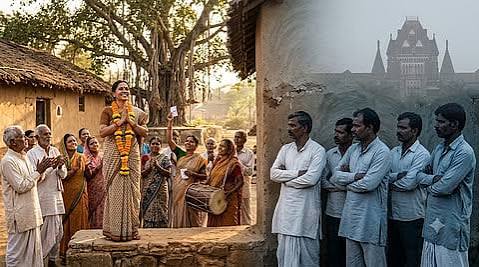
The division bench stated in its 179-page judgment that a comprehensive consideration of the oral evidence, medical and forensic evidence, and other proven facts establishes beyond reasonable doubt that the accused assembled unlawfully and, with a common objective, committed the murder of Mahesh Gawande out of political enmity.
Yavatmal – The Nagpur bench of the Bombay High Court has delivered a major verdict in the highly publicized 2018 Sarpanch-husband murder case in Parwa village, Yavatmal district. The division bench of Justice Urmila Joshi-Phalke and Justice Nivedita Mehta dismissed the appeals of the ten convicts, upholding the life imprisonment sentences awarded by the Special (Prevention of Atrocities) Court in Yavatmal. The verdict was delivered on August 4. The murder of a woman’s husband in broad daylight by multiple assailants in a village political battle, and the subsequent eight-year legal battle, has reached a crucial juncture with this High Court decision.
What is the whole matter?
Nalini Gawande, a resident of Parwa village in Yavatmal district, was elected as a Gram Panchayat member in April 2015. In January 2016, after a no-confidence motion was passed against the then Sarpanch, Rama Chimurkar. The post of Sarpanch was reserved for the general category, and Nalini, who belonged to the Dalit Buddhist community, became Sarpanch, a move opposed by a faction in the village. Munna Thakur, a prominent among the accused, openly objected to this election, and since then, a continuous conflict has erupted between the two factions.
In December 2017, the accused abused Nalini’s husband, Mahesh Gawande, on the basis of caste, while in January 2018, a dispute erupted again over the distribution of hand pumps in the village. On January 27, 2018, accused Munna Thakur directly threatened over the phone that “her husband would be killed.” The very next day, on January 28, the accused attacked Nalini’s home, vandalized household items, and also assaulted Prafull Shabarkar. Fed up with this constant harassment, Nalini Gawande and her family moved to Yavatmal city.
Murder in broad daylight
On March 27, 2018, at around 1 p.m., Nalini returned to Parwa village with her husband Mahesh, son Mayur, and nephew Samyak to carry out repairs. At around 1 p.m., Mahesh Gawande left the house to have a snack with Sheikh Imran and Sheikh Israel, the repairmen. Mahesh was talking to Prashant Shabarkar, Nitin Lokhande, Raju Kawale, and Prakash Bhagat, who were playing cards near the Anganwadi, when the accused, armed with deadly weapons, formed an unlawful assembly and attacked Mahesh Gawande.
Hearing the noise, son Mayur and nephew Samyak rushed to inform Nalini of the incident. Nalini then rushed to the scene and witnessed the accused attacking her husband with weapons. She screamed for help, which drew a crowd, and the accused fled the scene. Police arrived at the scene, and Mahesh was rushed to the Yavatmal District Hospital, where he had already died by the time they arrived. Nalini filed a police complaint that evening.
According to the post-mortem report, a total of seventeen wounds were found on Mahesh Gawande’s body, including stab wounds near the left eye, on the cheek, on the jaw, on the forehead, on the chest, and on the abdomen, and a slit wound was also found. Medical officials concluded that these wounds were caused by sharp and sharp weapons, such as a knife, chopper, sword, and sickle, and determined the cause of death to be multiple stabbings and slashing of the throat.
What the Investigation Revealed
During the investigation, police recovered swords, sickles, and other weapons from the accused. The chain of custody of these weapons was established by the police through various panchnamas. Samples of soil collected from the crime scene and the nails of the body matched, which was confirmed by forensic examination and strengthened the eyewitness testimony. A total of eighteen witnesses were examined during the investigation, including Nalini Gawande, her son Mayur, and key eyewitnesses Sharda Narayane and Prashant Shabkar.
Following the completion of the investigation, the police filed a charge sheet, and the trial was held in the Special (Prevention of Atrocities) Court of Additional Sessions Judge-2 in Yavatmal under Special Case No. 18/2018.
On January 20, 2020, the Sessions Court convicted the accused under sections 302 (murder), 149 (unlawful assembly, offence committed with common intention), 120-B (conspiracy), 143, 147, 148, and 201 of the Indian Penal Code and sentenced them to life imprisonment.
The accused appealed to the High Court.
Ten convicts—Sunil Deotale, Hanuman Pendor, Shubham Tekam, Raj Thakur, Munna Thakur, Vinod Chapriya, Sumit alias Pandya alias Sumedh Meshram, Praveen Bhagat, Bhimrao Awathare, and Swapnil Kumbhekar—filed five separate criminal appeals against the Sessions Court’s decision. Defense lawyers argued that there were inconsistencies in the eyewitnesses’ statements, that their testimony was unreliable because they were relatives of the complainant, and that the guilt of the accused had not been proven beyond a reasonable doubt.
However, the High Court rejected these arguments. The court noted that eyewitness Nalini Gawande, a woman from a rural background, could not be expected to provide an accurate and photographic account of an incident that unfolded over a few minutes when multiple attackers were attacking with deadly weapons. Citing the Supreme Court’s decision in State of Punjab vs. Hakam Singh, the division bench clarified that minor inconsistencies are not appropriate when evaluating the testimony of rural witnesses.
The bench also elaborated on the thirteen principles of evidence evaluation laid down in the Supreme Court’s decision in Balu Sudam Khalde v. State of Maharashtra (2023). The court stated that the testimonies of Nalini Gawande, Mayur Gawande, Sharda Narayane, and Prashant Shabkar were corroborative, consistent, and reliable, and that minor discrepancies, despite their existence, did not affect the fundamental facts of the case.
The judgment noted that the post of Sarpanch was held by the general category, and Nalini belonged to the Scheduled Castes. The accused party opposed her election as Sarpanch. This background was seen as the origin of the political rivalry that arose in the case.
The court’s observations on unlawful assembly and common purpose
The judgment detailed the provisions of Sections 141 (unlawful assembly), 146 (rioting), 148 (rioting with deadly weapons), and 149 (offence committed with common purpose) of the Indian Penal Code. Citing the recent Supreme Court decision in Jainul v. State of Bihar (2025), the bench stated that the common purpose of an assembly is established by its composition, the weapons possessed by its members, and their behavior before and during the incident. Once a common purpose is established, it is not necessary to prove that each member directly participated in the crime.
Based on these principles, the court concluded that all the accused, including Munna Thakur and Vinod Chapriya, were members of an unlawful assembly and, out of a political rivalry, committed the murder of Mahesh Gawande. While acknowledging that there was a long-standing political rivalry between the victim and the accused, the court clarified that a prior animosity alone does not invalidate a conviction based on evidence.
The bench concluded its 179-page judgment by stating that a comprehensive consideration of the oral evidence, medical evidence, scientific (forensic) evidence, and other proven facts establishes beyond reasonable doubt that the accused were members of an unlawful assembly and, out of a common purpose, committed the murder of Mahesh Gawande out of a political rivalry. Therefore, all five criminal appeals were dismissed, upholding the Sessions Court’s conviction and life sentence, and the appeals were disposed of.
The Parwa village case thus traces the dispute that began in 2016 after a Dalit woman was elected to the general category sarpanch seat, to the murder of her husband, Mahesh Gawande, in 2018, and now to the High Court’s upholding of the convicts’ life sentences. The court’s judgment examines in detail all the aspects of caste, panchayat politics, past disputes, alleged threats, the murder, eyewitness testimony, and forensic evidence. While the court did not definitively call the murder a “caste murder,” the mention of caste-related disputes and Nalini’s belonging to a Scheduled Caste in the record of the judgment is an important part of the background of the case.
ACJP’s Active Role
In a conversation with The Mooknayak, Nagsen Sonare, National President of the Ambedkar Centre for Justice and Peace (ACJP), said, “The organization was involved in this case from the very beginning – from registering the FIR to filing the charge sheet, ensuring justice for the victim’s family during the trial, providing them with police protection, financial assistance, and helping the deceased Mahesh Gawande’s daughter find a job. In November 2022, the case was also raised before the UN High Commissioner for Human Rights in Geneva, urging the UN to direct India to take immediate action to prevent caste atrocities. Our ACJP team, led by the Maharashtra Secretary, monitored the case from the very beginning, and lawyer Pradeep Rathod fought the case on behalf of the victim and did a great job in securing justice. Congratulations to Vinod Tatke and the ACJP Maharashtra team for securing justice for the late Mahesh Gawande.”
Geetha Sunil Pillai
Courtesy: Hindi News