
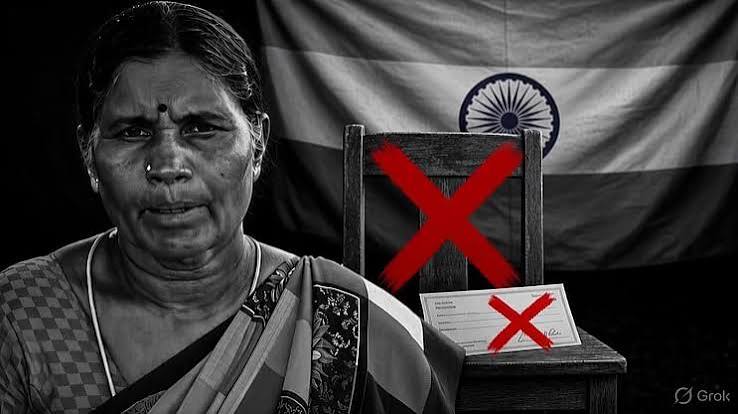
On August 31st, Malarvizhi arrived at the Villupuram Collectorate with her petition and attempted to set herself on fire.
Villupuram – A Dalit woman is in the news these days, alleging that despite being elected as panchayat president, she was denied rights such as the chair, office keys, hoisting the flag, and signing checks. Malarvizhi, the president of the Kodungal Panchayat in Villupuram district, Tamil Nadu, belongs to the Scheduled Caste and was elected in 2021. She alleges that she was not allowed to sit on the chair, was prevented from entering the office and hoisting the national flag, and was obstructed from exercising administrative powers.
Alleging caste discrimination, Malarvizhi says she was prevented from participating in panchayat-related work for nearly four and a half years. Hurt by this treatment, she attempted to set herself on fire at the Villupuram Collectorate on August 31st. The police stopped her from setting herself on fire, after which she was allowed to submit her application to the collector.
What is the whole matter?
Malravizhi was elected Panchayat President in 2021. She alleges that Kathavarayan, a local DMK official known to her husband, persuaded her to contest the election. She was initially hesitant, but later went ahead. She had no idea what lay ahead. Despite being the Panchayat President, she was unable to perform her duties due to lack of check signing authority. She was sidelined, and other people took over the Panchayat’s public works.
According to a TNM ground report, Malaravizhi complained to the Tehsildar that she was not allowed to work, hoist the national flag, or handle the office keys, and requested permission to sign checks. After nearly four and a half years of persistent discrimination, she was finally allowed to sit in the President’s chair, received the office keys, and hoisted the tricolor. However, her demands for the right to sign checks and pass resolutions remained unfulfilled.
According to local media reports, Malarvizhi accused Vice President Muniyammal and her brother Kathavarayan of obstructing her independent decisions through their influence on other elected members.
Whenever she attempted to exercise her authority, she was threatened with removal from office through a no-confidence motion. Payments for public works completed under her leadership were withheld.
Instead of taking action on her complaints, officials allegedly advised her to “settle” with the accused. She also alleged that she was pressured to accept alleged commissions of over 10 lakh rupees for MNREGA work.
On August 31, Malarvizhi arrived at the Villupuram Collectorate with her petition and attempted to set herself on fire. Police intervened before she could do so, and she was subsequently allowed to file another petition demanding an investigation. She demanded restoration of her rights, release of payments for completed works, and an investigation into those accused of discrimination, intimidation, and interference. District Collector Sheikh Abdul Rahman stated that the district administration has empowered him to sign checks. He also stated that upon providing proper evidence of caste discrimination, the Deputy Superintendent of Police will file a case and take action.
Cases of Caste Discrimination in Tamil Nadu Even Earlier
2022: In a survey conducted by the Tamil Nadu Untouchability Eradication Front (TNUEF) in 24 districts, many Dalit Panchayat presidents were not even allowed to hoist the national flag. According to an IANS report, Dalit presidents were denied seats in 22 of the 386 panchayats surveyed.
2020: In Attupakkam village, Tiruvallur, V. Amritham, a Scheduled Caste president, was prevented from hoisting the tricolor on Independence Day. Five days later, she hoisted the flag in the presence of the Collector and Superintendent of Police. The vice-president’s husband and the Panchayat Secretary were arrested.
Terku Tittai village: President S. After a photo of Rajeshwari sitting on the ground went viral, a case was filed against the Vice President and Secretary under the SC/ST Act.
In Maharashtra, a Dalit woman Sarpanch’s husband was murdered due to political rivalry.
Cases of discrimination against Dalit women Sarpanchs are not limited to Tamil Nadu; in 2018, a high-profile case of the murder of the Sarpanch’s husband occurred in Parwa village, Yavatmal district, Maharashtra. In April 2015, Nalini Mahesh Gawande, belonging to the Buddhist (Dalit) community, was elected as a member of the Parwa Gram Panchayat. Following the passage of a no-confidence motion against the then Sarpanch in January 2016, Nalini Gawande became the Sarpanch from the general category.
Some influential and upper-class members of the village were unhappy with a Dalit woman becoming the Sarpanch from the general category. This political and caste rivalry deepened her conflict with another faction in the village. As a result of this rivalry, in 2018, Mahesh Gawande, the husband of Sarpanch Nalini Gawande, was brutally murdered in broad daylight in the village. This incident sent shockwaves throughout the Yavatmal district.
Geetha Sunil Pillai
Courtesy: Hindi News