
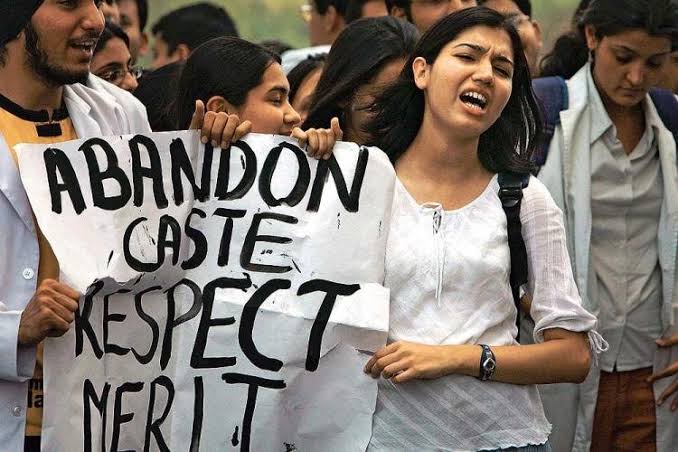
If we truly want equality, we must first take the initiative to end “Vedic reservations,” meaning caste-based socio-economic dominance. Do you want 78 years of constitutional reservations to end, while Vedic reservations, meaning the arrogance and arrogance of the caste system that has existed for thousands of years, remain intact? Why don’t you want to abolish Vedic reservations?
Today, there is a strong demand from a section of “upper castes” for reservations based on economic grounds. Furthermore, misleading and insensitive comments are made on social media about constitutional concessions, the Prevention of Atrocities Act, and educational benefits available to Scheduled Castes and Scheduled Tribes. Misinformation and propaganda are being aggressively spread about all of this. There are also demands to limit Dalit reservations to just one generation—to impose restrictions like a “ceiling” or a “creamy layer.” There is a demand to provide reservations only to the poor. There is talk of abolishing the Scheduled Castes and Scheduled Tribes (Prevention of Atrocities) Act.
The Scheduled Castes and Scheduled Tribes (Prevention of Atrocities) Act is a safeguard for those who still face caste-based violence and discrimination in their daily lives. Regarding the misuse of laws, all laws are misused to some extent, but courts dismiss such cases. Scheduled Castes and Scheduled Tribes are often targeted with hostility and even called “beggars.” Although some members of the Dalit community respond effectively, they are subjected to insulting taunts and intimidation. In response, incidents range from calls for rallies in front of Parliament demanding the abolition of reservations to threatening statements and derogatory slogans.
On the other hand, these upper caste people fail to see or discuss the benefits of the “creamy layer” and reservations enjoyed by the children of millionaires and billionaires within their own community, or by those who have served the government for four or five generations. They only see the “creamy layer” and reservations associated with Dalits. They constantly spread false, fabricated, and one-sided narratives about Dalits. Such people fail to see the creamy layer of the sons and daughters of upper caste leaders and officials who are reaping benefits, and the Vedic reservation holders who have received degrees through donations. They fail to see the fraudulent degrees of upper caste people and the unfair benefits they receive by obtaining fake income and caste certificates. But they can see the creamy layer of Dalit leaders and officials from afar. Why is the creamy layer and ceiling of upper caste officials who have served for three or four generations not discussed and debated? Why is there no talk of imposing a ceiling on them? Why don’t they talk about giving the poor upper castes a share from their own share? Why are they resorting to tricks to get the poor upper castes a share from Dalits? Are they so malicious towards Dalits that they make such one-sided, false and fabricated accusations? Intellectuals who unilaterally question Dalits are dishonest and fraudulent.
No member of the “upper castes” ever questions how their sons, daughters, and sons-in-law use their influence to get appointed to important positions—or why poor upper caste people aren’t appointed to such positions. Yet, when it comes to Dalits, all upper castes loudly and unanimously claim that the rights and positions of poor Dalits are being usurped or usurped by wealthy or influential Dalits. They constantly spread such rumors and propaganda, which reveals their evil intentions. Every affluent Dalit family is a resentment towards them. The people making such demands are upper caste people with fascist mindset, who are trying to usurp the rights of Dalits in some form or the other by raising various irrelevant issues.
Some upper caste people vehemently demand the implementation of a “creamy layer” provision in Dalit reservations. They argue that wealthy Dalits take advantage of the poor. What exactly does this demand prove? Haven’t high-ranking, wealthy, and influential people like Jagjivan Ram, Ramnath Kovind, Draupadi Murmu, Jitan Ram Manjhi, and former Chief Justice Gavai faced caste discrimination—and are they still facing it? So, what justifies the demand for dividing Dalit reservations based on economic status? Is this truly a demand for their welfare, or a cunning ploy to usurp their rightful share and weaken them?
It is noteworthy that reservation for Scheduled Castes and Scheduled Tribes has been an undisputed national policy to ensure social justice and participation in governance. This reservation is not a poverty alleviation program. This reservation is not a question of bread and butter. This reservation is not for providing employment and eliminating poverty. This reservation is not an economic issue. This reservation is a means to bring about a social revolution. This reservation is a matter of Dalits’ participation in governance and administration.
This reservation does not provide jobs to everyone. It simply means that a fixed share and percentage of available government positions—approximately 1 to 2 percent of the total population of that reserved group—is set aside for that particular group. Its purpose is to ensure the participation of that section of society in governance and administration; it is not a solution to poverty, nor is it a plan to distribute jobs or eliminate poverty. Has anyone found out how many Dalits are unemployed? Today, Dalits are more unemployed than upper castes.
The demand for reservation based on economic basis raises the question: will providing reservation based on economic basis stop the birth of Dronacharya’s children? Will providing reservation based on economic basis eliminate the poison of caste? Will providing reservation based on economic basis produce highly meritorious individuals? Obviously, no such change is going to happen. The status quo will remain.
Why do upper castes talk about reservation based on economic basis only in government jobs? They neither talk about nor demand reservations based on economic status in the country’s other resources, such as land, property, and ancestral property. When this issue is discussed, they remain silent. Even in the name of abolishing caste, they become silent. When asked if they can make a poor Brahmin a Dom and a rich Dom a Brahmin, they become silent or resort to abusive language. Or they start chanting “Sanatan” (eternal) and “Sanatan” (eternal).
Isn’t the demand for reservations based on economic status a demand of those frauds who are always looking to usurp the share of their socially backward classes? If poverty is the sole criterion for reservation, then all the upper castes in the country, even millionaire upper castes, will become poor. Just as lateral entry recruits make IAS officers without examination, no backward caste or Dalit is visible in this. This selection is not based on reservation, but on so-called recommendation qualifications. The same game continues in the appointment of High Court and Supreme Court judges by the collegium.
Today, reservations based on economic status are setting new standards for corruption. Millionaire upper castes are even becoming IAS officers by obtaining certificates of poverty. Despite complaints, there are no FIRs filed against them, nor are they dismissed from their jobs. The millionaire upper castes are enjoying the corruption, hooliganism, and fraud perpetrated by wealthy upper castes, while shamelessly raising the slogan of reservation based on economic status. 90% of the beneficiaries of EWS reservation are fake. From the Indian Express to other newspapers and channels, news reports periodically appear about beneficiaries based on such fake certificates. Will the country’s enlightened people and poor upper castes take to the streets to protest against such upper caste terrorists?
The repeated ten-year extension of the constitutional reservation period often draws sharp criticism and calls for its abolition. Why is the constitutional reservation period extended every ten years, when it was only intended for ten years? What was the original rationale for reservation? Reservation is not meant to usurp anyone’s share, but rather to provide weaker sections of society with the representation they cannot achieve on their own. This system was created to prevent the stronger classes from usurping the weaker sections’ share. The ten-year timeframe was established keeping in mind the 1932 Poona Pact. In this pact, all major Hindu leaders, including Gandhi, along with Dr. Ambedkar, pledged that within ten years, untouchability, social discrimination, and educational inequality would be eliminated, and all citizens would be granted equal status. Based on this promise, the Constitution included a ten-year reservation for Scheduled Castes and Scheduled Tribes, with a provision for further review and extension. According to the Poona Pact, untouchability and socio-economic injustice were to be eradicated within ten years, and all people were to be brought to an equal social level. Gandhi, Malaviya, and other Hindu leaders accepted full responsibility for this. But even after 78 years of independence, has Hindus’ discrimination, oppression, and hatred towards Dalit castes ended? If not, why should political reservations be abolished?
For this reason, the constitutional legislative reservation deadline has been extended every ten years. But this deadline has no bearing on reservations in educational institutions or government services. This reservation has never been extended. This means that as long as social inequality and caste discrimination persist, this reservation will continue. This system of protection for the weaker sections is essential until centuries-old social inequality and the arrogance of the upper castes are eradicated.
Therefore, to truly achieve equality, we must first begin by eliminating “Vedic reservations”—that is, caste-based socio-economic dominance. Do you want the 78-year-old constitutional reservation to end, but the Vedic reservation, the arrogance and arrogance of the caste system that has existed for thousands of years, to remain intact? Why don’t you want to abolish Vedic reservation? Are those who demand the abolition of constitutional reservation while maintaining Vedic reservation, the caste system, fascists?
These days, Vedic reservation holders, who live in the arrogance, pride, and superiority of their birthright, are continuously waging a misleading and false campaign against constitutional reservation. Upper castes constitute 15% of the total population. Yet, they have been given 10% reservation in the name of EWS. And they are also appointed in the remaining 50%. Despite this, these people are not satisfied. They keep shouting about reservation and violation of merit. Those whose ancestors enjoyed 100% reservation for centuries are now vehemently opposing constitutional reservation.
The caste system is a major form of colonialism. Weaker castes live in fear of stronger castes. Casteism is the biggest form of terrorism in India. Attacks, oppression, atrocities, and murders based on caste—what do you call them—terrorism? Castes are anti-national and the cause of India’s destruction, fragmenting society into chasms of hierarchy and discrimination. The caste system is a social system of upper castes that helps maintain their selfishness, arrogance, and privileges. Constitutional reservations were introduced to mitigate the poison of this Vedic reservation. Recall how Dronacharya cut off Ekalavya’s thumb. Reservations were introduced because Ekalavya wasn’t weak, but Dronacharya was deceitful, cunning, and dishonest. Therefore, start a campaign for Vedic reservation, meaning, “Remove the caste system, bring equality, and save the country.” Constitutional reservations will end on their own.
The upper castes loudly talk about merit, but people don’t discuss the actions of meritorious individuals. When it comes to merit, the minimum marks required to pass exams are the same for everyone. Some concessions are given in admissions, but the final exam, which is the benchmark of merit, is the same for everyone. No unqualified Dalit is appointed, yet Dalits continue to face false and misleading accusations of “incompetence.”
The selection of Olympic athletes, the Indian media, and the Indian judiciary supposedly recruit the most promising and highly capable individuals; there are no reservations for Scheduled Castes and Scheduled Tribes, yet what is the global standing of these institutions? Analysis of this truth shatters the pride of their competence, as today these institutions are nowhere in the world’s top 100.
Why did major bridges in the country collapse shortly after construction? What caste was the contractor who built the bridge? What caste were the engineers working there? What caste was the doctor who cried and left scissors in the patient’s stomach? Which caste do most people who become doctors and engineers through donations belong to? Can those who oppose reservations tell us how many Dalits are among those who sell confidential security documents and commit crimes like treason?
There has been a long-standing backlash regarding reservations. “Hey, these Dalits… they are reserved, they are quota holders, they are government sons-in-law… what do they need to be educated?” Upper caste Hindus are commonly found saying this about Dalits and tribals.
On the other hand, similar things are said among Dalits and tribals about upper caste Hindus. “Hey, brother, these are Brahmins… they are born from the mouth of Brahma… they eat the earnings of others without any hard work, they are parasites, they have received religious reservations, the Dwijas should never be trusted,” etc. This distrust and hatred is growing in society. Now, with the advent of social media, this hatred has been fueled by a double engine. Sadly and worryingly, even the so-called social and cultural organizations of upper caste Hindus and Bahujans have been strengthening their organizations based on this hatred. Consequently, creative dialogue among them has stalled. If this dialogue continues to stall for much longer, the danger will only increase.
Today is the era of the information revolution. Spreading fake news through artificial intelligence can incite major riots and discontent. In a multi-religious, multilingual, and culturally diverse country like India, this danger is greater than in Western society. Therefore, if a minimum level of courtesy and dialogue is lacking within social movements, it can be fatal for all forms of socio-political movement. Today’s India stands at a juncture where accusations are replacing dialogue, and hysteria is replacing reason. Recent events and articles and videos circulating on social media have pushed society into an “us versus them” abyss. This situation is not a good sign for any democratic country.
Today, Babasaheb Ambedkar is being either deified or demonized, even though he guaranteed equal rights to every Indian through the Constitution. His fight wasn’t against any caste, but against caste-based injustice. Social media is awash with divergent opinions about Babasaheb Ambedkar; one side portrays him as a villain, the other hails him as a hero, and this debate continues. Turning this into hateful slogans further divides society. If this trend continues, the harm won’t be to any one caste—it will be to India as a whole. Will the country’s conscious citizens reflect on these issues and take their initiatives forward?
Rajendra Prasad
Emr. Rajendra Prasad is a social thinker. He is actively involved in writing. His important books are “Sant Gadge and his Life Struggle” and “Jagjivan Ram and his Leadership.” He lives in Patna.
Courtesy: Hindi News