
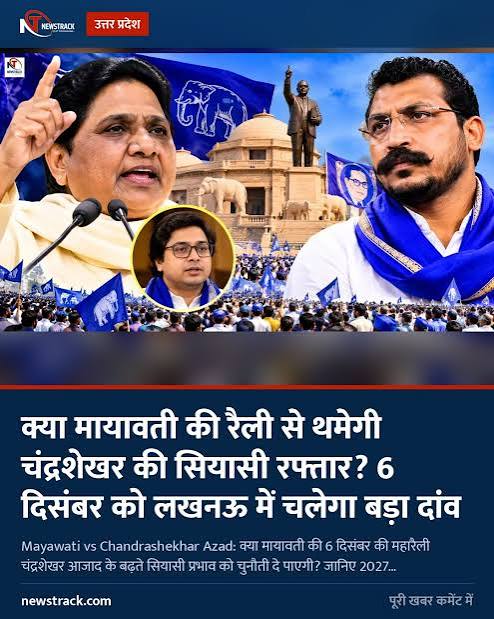
UP Dalit Politics: Ahead of the 2027 assembly elections in Uttar Pradesh, the political competition for the Dalit vote bank has intensified. Chandrashekhar Azad’s increasing activism has increased the BSP’s challenge. Consequently, Akash Anand faces the significant responsibility of keeping Mayawati’s old Bahujan vote bank united.
Ahead of the 2027 assembly elections in Uttar Pradesh, the political competition for the Dalit vote bank has intensified. The Bahujan Samaj Party (BSP) was once the strongest force in Dalit politics in the state. In 2007, under Mayawati’s leadership, the party won 206 seats and formed a government with an absolute majority. However, the BSP’s performance has steadily weakened in the last three assembly elections. In 2022, the party was reduced to just one seat. Meanwhile, Azad Samaj Party (Kanshi Ram) chief Chandrashekhar Azad established a strong presence in Dalit politics by winning the Nagina seat in the 2024 Lok Sabha elections. In such a situation, the BJP, SP, and Congress are also trying to woo Dalit voters. The biggest question is whether Akash Anand will be able to carry forward Mayawati’s political legacy and the BSP’s traditional Bahujan vote bank, or will Chandrashekhar Azad further strengthen his position in this political vacuum?
BSP’s electoral performance has steadily weakened since 2007
The biggest challenge facing the BSP is to preserve its traditional vote bank. The party, once in power in the state, has seen a steady decline in the electoral graph over the past few years. In the 2007 assembly elections, the BSP secured 30.43 percent of the vote, winning 206 seats. In 2012, the party’s vote share dropped to 25.91, winning 80 seats. In 2017, despite securing 22.23 percent of the vote, the party won only 19 seats. In the 2022 assembly elections, the BSP’s vote share dropped to 12.88, winning just one seat.
Akhilesh Yadav entrusts women workers with significant responsibilities, promising ₹40,000 and mobile phone deliveries door-to-door.
These figures clearly indicate that the BSP’s electoral base has steadily weakened. However, the decline in vote share does not mean that the party’s entire traditional cadre has migrated to other parties. Dalit voter preferences can vary by caste, region, and local political circumstances. It would be inaccurate to assume uniform political preferences between Jatav and non-Jatav Dalit voters.
Chandrashekhar Azad poses a challenge to the BSP
The rise of Chandrashekhar Azad in Dalit politics has posed a new challenge to the Bahujan Samaj Party (BSP). Azad Samaj Party (Kanshi Ram) leader Chandrashekhar demonstrated his political strength by winning the Nagina constituency in the 2024 Lok Sabha elections. He defeated the BJP candidate and secured his place in Parliament. His victory is significant because the BSP’s performance in Uttar Pradesh was disastrous, failing to win a single Lok Sabha seat.
Chandrashekhar’s political agenda is dominated by issues such as youth participation, social justice, the Constitution, and Dalit rights. His aggressive stance against the government has helped him establish a distinct political identity, especially among young Dalit voters.
However, it would be premature to interpret his victory in Nagina as proof of his influence over the entire Dalit vote bank in the state. Nevertheless, these election results indicate that a new political alternative is emerging within Dalit politics beyond the BSP. The real test for Chandrashekhar in the 2027 elections will be whether he can expand his organization and support base beyond western Uttar Pradesh.
All parties eye the Dalit vote bank
Political parties have intensified their preparations for the UP assembly elections. This time, engaging Dalit voters has become a key part of all parties’ strategies. The BSP’s biggest challenge is retaining its traditional cadre vote. The BJP, SP, and Congress are constantly trying to make inroads into this vote bank. The BJP recently announced the renovation of Ambedkar sites across the state. Apart from this, emphasis is also being laid on connecting the Dalit class through government schemes.
Akash Anand faces the challenge of carrying on Mayawati’s legacy.
Amidst the BSP’s declining electoral performance, Akash Anand faces the significant responsibility of reinvigorating the party. Mayawati has given him a key role in the party’s organization and campaigning. Akash Anand is trying to activate the party through public meetings and political events in the state.
However, his biggest challenge is to further Mayawati’s political acceptance and her hold on the organization. Mayawati has long distinguished herself in Dalit politics. Her political experience, connection with the Bahujan movement, and influence among the cadre have been the BSP’s greatest strengths.
Simply inheriting Mayawati’s political legacy will not be enough for Akash Anand. He will have to win the trust of the party workers under his leadership and keep the youth and the party’s old cadre together. Furthermore, he faces the challenge of taking the BSP to the entire society.
The BJP is balancing the equations with the help of Ambedkar and government schemes.
The BJP is also trying to strengthen its hold among Dalit voters. The party’s strategy focuses on the development of sites associated with Dr. Bhimrao Ambedkar, social representation, and the promotion of government welfare schemes. The announcement of the renovation of Ambedkar sites across the state is also being seen as part of this political effort.
Congress also leans on Ambedkar and the Constitution
Congress has also intensified its efforts to engage Dalit voters. The party has appointed Dalit leader Rajendra Pal Gautam as the state co-in-charge. It has also incorporated Constitution Day and the ideas of Dr. Bhimrao Ambedkar into its election strategy. As in the Lok Sabha elections, Congress is preparing to prioritize the issues of the Constitution and Dalit rights in the Assembly elections. In this regard, a Constitution Protection March was held in the state, and a meeting was held by the party’s national president, Mallikarjun Kharge. Ambedkar was also a key issue in Kharge’s speech.
Emphasis on Dalits in Akhilesh Yadav’s PDA formula
The Samajwadi Party is also working on its strategy to woo Dalit voters. In Akhilesh Yadav’s PDA formula, the D stands for Dalit. The party aims to strengthen its hold among Dalit leaders by prioritizing them in the party organization. The SP is attempting to unite backward, Dalit, and minority voters to challenge the BJP in the elections.
The question now is whether Akash Anand will be able to keep Mayawati’s old Bahujan vote bank united, or whether the activities of other parties, including Chandrashekhar Azad, will weaken the BSP’s political base.
Akash Anand’s public meeting in Bilhore today
Amidst this political atmosphere, BSP leader Akash Anand will address a public meeting in Kanpur’s Bilhore assembly constituency today. The program will begin at 10 am at Ramsahay Inter College in Bari Shivrajpur. A large number of people from Bilhore and surrounding areas are expected to attend the public meeting. Akash Anand’s meeting is being seen as a link to the BSP’s political activities in the Kanpur and Misrikh parliamentary constituencies. The BSP has won the reserved Bilhore assembly seat twice. The party fielded candidates here in 1996 and 2007, and they won.
Courtesy: Hindi News