
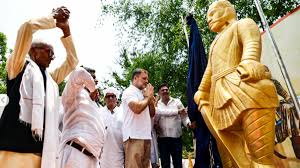
Rahul Gandhi unveils Veera Pasi’s statue in Rae Bareli: Learn about the glorious history of the unsung Dalit hero of 1857 and the full dynamics of Dalit vote bank politics ahead of the UP Assembly elections.
Uttar Pradesh: Rahul Gandhi, Leader of the Opposition in the Lok Sabha, on Wednesday unveiled the statue of Veera Pasi, the “unsung hero” who fought the British during the 1857 rebellion, in Rae Bareli. This is not the first attempt by political parties in Uttar Pradesh to woo the Pasi community through their legends. However, Gandhi’s move in his constituency is considered significant ahead of next year’s UP Assembly elections.
On the same day, he also addressed a “Bahujan Swabhiman Sabha” in memory of Veera Pasi. At the event, Gandhi said that while we remember Veera Pasi and Dr. Ambedkar, their ideology is not being properly defended, as the Constitution is being constantly attacked before our eyes.
Who was Veera Pasi?
In the 19th century, Veera Pasi was the most trusted companion and commander of Rana Beni Madhav Bakhsh Singh, the ruler of the Shankarpur estate in modern-day Rae Bareli. This Dalit warrior, belonging to the Pasi caste, was born on November 11, 1835, into a poor family in Lodhwari village, Rae Bareli district.
After losing his parents in his childhood, he went to live with his sister. In the local dialect, a brother living with his sister’s family was called “Veerna,” which later changed to “Veera.”
Impressed by his extraordinary physical strength, Singh recruited him into his army. With his loyalty and bravery, he soon became one of his most trusted associates.
According to local folklore, when Singh was captured by the British during the 1857 rebellion, Pasi displayed indomitable courage and rescued him safely from prison. The British government, in a panic, announced a hefty reward of 50,000 rupees for Pasi’s capture or information about his whereabouts.
Although Veera Pasi’s name is not prominently recorded in history books, his legacy lives on in Rae Bareli and its surrounding areas. The Pasi community lives in large numbers in these areas, and their oral traditions have preserved this hero. Folklore also says that Pasi attained martyrdom while protecting Singh from the British army.
Dalit History and Politics in Uttar Pradesh
In recent years, political parties in Uttar Pradesh have begun to prominently commemorate Dalit icons of the past and their contributions to the freedom struggle. A clear example of this was provided by Samajwadi Party (SP) MP from Faizabad (Ayodhya) Awadhesh Prasad, while taking oath in the Lok Sabha after the 2024 general elections. During his oath, he specifically mentioned two prominent figures from the Pasi (Dalit) community: “Veerangana” Uda Devi and “Maharaja” Bijli Pasi.
Uda Devi was part of the royal guard of Begum Hazrat Mahal of Awadh and actively participated in the 1857 rebellion. She is credited with mobilizing the common people to take up arms against the British. In recognition of this historical contribution, the Samajwadi Party celebrated Uda Devi’s death anniversary on a grand scale at its party headquarters in November 2022.
The Bijli Pasis, who ruled parts of Uttar Pradesh during the medieval period, are considered one of the most prominent Dalit symbols. The Yogi Adityanath-led BJP government in Uttar Pradesh has announced plans to develop Bijli Pasi’s fort in Lucknow as a tourist destination.
In December 2025, Prime Minister Narendra Modi also paid a heartfelt tribute to Maharaja Bijli Pasi. Chief Minister Adityanath echoed the Prime Minister’s sentiments, describing him as a brave warrior from Lucknow who openly challenged foreign rule to protect India’s eternal traditions.
Dalit leaders and academics in Uttar Pradesh clearly believe that historians have largely “ignored” the community’s great men. Ajay Kumar, Assistant Professor in the Department of Sociology at Babasaheb Bhimrao Ambedkar University, says that mainstream history writing has often neglected the contributions of Dalits, tribals, and other marginalized communities.
According to Professor Kumar, these communities have long strived to reclaim their historical and cultural heritage in response to this neglect. This process is not limited to rediscovering the past, but is also a powerful means of reviving identity, self-respect, and political consciousness.
He further explained that since these communities traditionally had very few written records, their history was passed down from generation to generation through folklore, folk songs, memories, and oral traditions. These oral traditions became the most important carriers of their social experiences, struggles, and collective consciousness.
SP leader Manoj Paswan, who belongs to the Pasi community, also openly supported Professor Kumar’s views. He said that it was Kanshi Ram who brought Dalit heroes to the forefront and appealed to the community to learn to be proud of their history rather than be ashamed of it.
Paswan believes that Dalit leaders played a vital role in the country’s freedom struggle. Despite this, unlike upper caste heroes like Mangal Pandey, they did not receive the place they deserved in history books, and now there is a dire need to correct this historical mistake.
The Pasi Community and Uttar Pradesh’s Dalit Vote Bank
The Pasi community constitutes approximately 7 percent of the state’s total Scheduled Caste population. This figure makes them the second largest and most influential group among Dalits in Uttar Pradesh, after the Jatavs. Although they also have a significant presence in other Indian states, their largest population resides in Uttar Pradesh.
When the Samajwadi Party (SP) performed remarkably well in the 2024 Lok Sabha elections, winning 37 seats, the party benefited significantly from this community. Five Pasi candidates fielded by the SP won, while only three Pasi candidates from the BJP managed to win their seats.
The Mayawati-led Bahujan Samaj Party (BSP), once a strong force in Uttar Pradesh politics, is now steadily losing its support base. The BSP’s total vote share in the 2017 assembly elections was 22.23 percent, which fell to 12.88 percent in the elections held exactly five years later.
Interestingly, this remaining vote share is roughly proportional to the Jatav-Ravidasi Dalit population, which has been the BSP’s core and unwavering support base since its inception. Everyone from the SP and Congress to the Azad Samaj Party (Kanshi Ram) led by Chandrashekhar Azad is now striving to fill this vacant political space left by the BSP.
Both the SP and Congress are working to reach out to Dalit voters by constantly invoking the names of B.R. Ambedkar and Kanshi Ram. This year, on the occasion of Ambedkar’s birth anniversary on April 14th, both parties made their intentions clear by organizing several large events across the state.
After claiming overwhelming support from the Dalit community in the 2024 Lok Sabha elections, the SP and Congress are now seeking to further strengthen their ground hold. Election results also clearly indicate that the Dalit voter sentiment is shifting.
This is the main reason why both parties are working to ensure they continue to receive the support of the Dalit community, which constitutes approximately 20 percent of Uttar Pradesh’s total population. The primary goal of both parties is to fully consolidate this large and decisive vote bank in next year’s assembly elections.
Rajan Chaudhary
Courtesy: Hindi News