
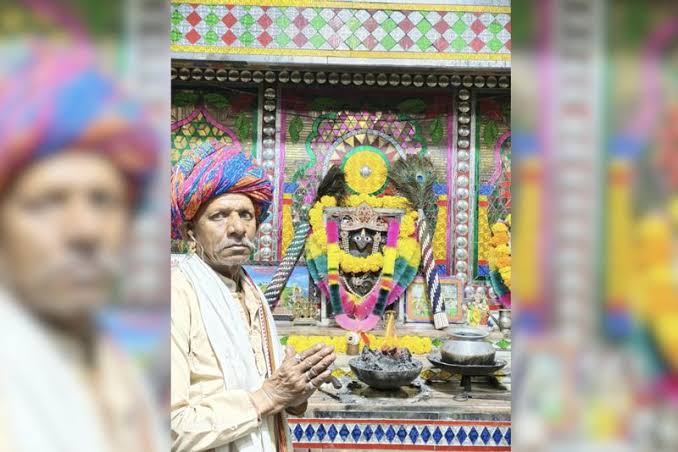
The Balai family is not demanding admission into someone else’s temple. It claims with historical authority that its ancestors established, maintained and served as hereditary priests of the shrine for centuries, and that these rights are now being challenged by people associated with the RSS.
Khakul Dev Temple of Barana village in Rajasthan’s Bhilwara district. In frame, a member of the Balai family, who is the acting priest to the temple. Photo: By arrangement
When Vishnu Kumar Balai, the hereditary priest of the Khakul Dev Temple of Barana village in Rajasthan’s Bhilwara district, wrote to Rashtriya Swayamsevak Sangh (RSS) chief Mohan Bhagwat in May this year asking, “Are we not Hindus?”, his appeal was widely understood as only an instance of caste discrimination and exploitation. But that reading misses what makes the Barana dispute historically and socially significant.
This is not a story about Dalits seeking entry into Brahminical temples or demanding the right to perform rituals in Brahminical spaces. It is about a Dalit family which founded, owned and served as hereditary custodians of a temple for nearly four centuries, and whose assertions whose claims are supported by a body of historical material preserved by the family.
Per the evidence furnished by the family, their position as priests and owners was recognised through a tamrapatra (copper-plate grant), issued by Maharana Karan Singh II of Mewar, grandson of Maharana Pratap, in 1624 CE. That historical continuity makes the present controversy all the more remarkable: a custodianship they say was acknowledged under a 17th-century Mewar ruler now finds itself challenged in 21st-century democratic India.
The Khakul Dev dispute, therefore, raises a question that extends far beyond one village: why has a centuries-old Dalit temple ownership become the subject of contemporary political contestation?
The tradition
The Balai priestly family traces its association with Khakul Dev to Ghasiramji Balai, who, according to family tradition, discovered the deity in the early seventeenth century near present-day Hadkiya village. The shrine was subsequently established at Barana and gradually developed into an important regional place of worship.
The family preserves a body of historical material – including genealogies, temple records, inscriptions and the 1624 tamrapatra – which it documents uninterrupted hereditary succession. The tamrapatra, as attested by the family, recognises their custodianship and ownership over both the temple and land attached to its maintenance, including their right for hereditary priesthood.
Taken together, these records suggest that the family’s claim is rooted in a long tradition of hereditary custodianship rather than being a recent assertion.
Rajasthan’s forgotten non-Brahmin religious landscape
Many of Rajasthan’s most-revered folk shrines evolved outside the framework of orthodox Brahmanical institutions.
Rajputs and Meghwals have historically performed hereditary ritual roles at the shrine of Baba Ramdevji, a 14th century Tomar chief whose cult transcends caste boundaries. In fact, the main temple of Baba Ramdev houses the samadhis of both Ramdevji and Dalibaiji, his Meghwal dharmbehan. Baba Ramdev Tomar, although a Rajput, is viewed as an important figure in the tradition founded by Meghrishi, a Dalit saint. Likewise, the traditions surrounding Pabuji Rathore, another Rajput folk hero, have long depended upon Nayak Bhils and Bhopa communities as hereditary ritual specialists and custodians of oral epics. Most temples dedicated to Gujjar deity Devnarayan are found in Mewar and built by Mewar’s rulers. The current Gogaji shrine at Gogamedi was built by the Bikaner’s rulers, but its tradition of Muslim priests has persisted till the modern era.
Seen in this context, Khakul Dev is less an exception than a surviving example of a much older religious tradition. Recent scholarship has also questioned the assumption that Rajasthan’s religious institutions were historically organised according to a single Brahmanical model,showing that many Lok Devta traditions were sustained through the ritual practices of Bhopas, Bhils, Dalits and other non-Brahmin communities . In Merchants of Virtue, historian Divya Cherian shows how the increasing Brahminisation of Rajput courts during the 18th century reshaped social hierarchies and forms of social legitimacy. The persistence of non-Brahmin hereditary priesthoods at shrines such as Khakul Dev, Ramdevji, Gogamedi and Pabuji points to an older and more socially diverse religious landscape.
Ownership, not entry
Speaking to The Wire over email, social activist and Ambedkarite thinker Bhanwar Meghwanshi, said, “The Khakul Dev temple dispute also brings to light a striking historical irony. The feudal state, notwithstanding its own drawbacks and criticisms, not just recognised Dalits as hereditary priests but also granted them rights over the temples and the land attached to them. Yet, in contemporary democratic India, such hereditary rights are increasingly being challenged. In many places, dominant caste groups, including those classified as OBCs, have sought to wrest control of temples, offerings and attached lands from Dalit custodians, while simultaneously subjecting them to caste-based humiliation and violence.”
Much of the discourse on caste and temples has understandably centred on temple entry – the struggle of Dalits to access spaces from which they were historically excluded. Khakul Dev presents an altogether different question.
The Balai family is not demanding admission into someone else’s temple. It claims with historical authority that its ancestors established, maintained and served as hereditary priests of the shrine for centuries, and that these rights are now being challenged by people associated with the RSS.
The issue, therefore, is not access but owner. It concerns hereditary priesthood, temple management, ritual legitimacy and institutional control. That distinction makes the dispute historically significant.
Pamphlet published by the Dalit villagers for mobilisation against forceful takeover of the temple.
Amid the ongoing dispute, the local Balai community have published and circulated pamphlets. For instance, this publication by the community was intended both, to mobilise support against what they view as an attempt by dominant castes to take over the temple and to document the historical and legal basis of the family’s claim. Photo: By arrangement
The conflict
According to Vishnu Kumar Balai, the conflict began in 2023, when influential villagers questioned the family’s exclusive custodianship of the temple. He has alleged that Sampat Jat, along with others, attempted to alter the temple’s traditional management and remove the hereditary priesthood. He has also highlighted that Sampat and other accused are members of RSS.
The disagreement intensified over the following two years. Vishnu maintains that the annual Khakul Dev fair, traditionally organised within the temple precincts, had to be shifted elsewhere because of the dispute.
The conflict turned violent on August 14, 2025, when Vishnu alleged that he and his family were assaulted inside the temple, subjected to caste-based abuse and prevented from performing religious duties. An FIR was registered under provisions of the Bharatiya Nyaya Sanhita (BNS) and the Scheduled Castes and Scheduled Tribes (Prevention of Atrocities) (SC/ST) Act. He further alleged that a separate donation box was installed and that efforts were initiated to constitute a new committee to manage the temple.
As the dispute continued, the Rajasthan administration appointed the local Tehsildar as Receiver to oversee the temple pending legal proceedings. Vishnu argues that this effectively displaced his family’s hereditary custodianship.
In May 2026, he wrote an open letter to Mohan Bhagwat alleging that local RSS workers had supported attempts to remove him from the temple and asking whether the organisation’s commitment to social harmony extended to protecting a Dalit hereditary priest.
Barely two months later, on July 16, 2026, Vishnu was assaulted again while preparing to conduct rituals at the shrine. Police registered fresh cases under the BNS and the SC/ST Act, while counter-complaints were also lodged.
The Barana dispute has already resonated beyond the village. Community publications such as Balai Samaj Darpan News24 have framed the issue not simply as a conflict over temple management but as an attempt to displace a hereditary Dalit priesthood. It draws attention to a question largely absent from contemporary discussions on caste and religion: why is the traditional Dalit custodianship of temples being made a subject of socio-political conflict now?
When religious structure acquires economic value
One aspect of the controversy has received surprisingly little attention – the economics of temple management.
For centuries, many shrines maintained by Dalit and other non-Brahmin priestly families remained local institutions with modest offerings and limited public attention. Their hereditary custodianship rarely became a matter of contestation. In January 2026, a rightwing activist Riddhima Sharma tried to mobilise communal sentiments opposing the tradition of Muslim priests at the Gogamedi shrine.
Khakul Dev temple occupies a similar position. According to those seeking changes in the temple’s administration, the shrine now attracts substantial offerings and donations, necessitating a more formal management structure. Vishnu Kumar Balai, however, views these demands as an attempt to dispossess a hereditary priesthood whose authority predates the temple’s contemporary prosperity.
Hence, as religious institutions acquire greater economic and symbolic value, long-settled traditions of local non-Brahmin custodianship may become vulnerable to competing claims of management and authority.
Symbolic inclusion versus institutional power
For many decades, RSS and Hindutva organisations have performed ceremonial support for Dalit priesthood to cultivate an inclusive image. However, the Khakul Dev controversy highlights a more difficult question.
There is a fundamental difference between permitting Dalits to perform rituals in temples owned and administered by others and recognising the Dalit community’s historical claim to owning and exercising hereditary authority over a temple institution itself.
The Khakul Dev dispute also adds a different aspect to the anti-caste discourse. Most scholarship has examined Dalits as communities excluded from temples.
Here, however, the historical evidence points in the opposite direction: a Dalit community claiming to have founded and administered a temple whose authority is now being questioned. This reverses the conventional framework through which caste and temple politics are usually understood.
Adityakrishna Deora
Adityakrishna Deora is a mechanical engineer and social science enthusiast.
Courtesy ; The Wire
Note: This news is originally published on https:/thewire.com/bha and is used purely for non-profit/non-commercial purposes, especially human rights