
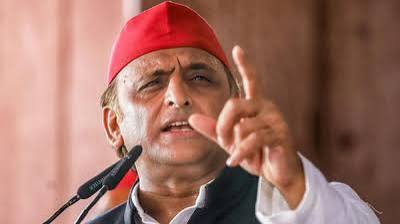
With UP elections due in early 2027, the SP chief is redefining his party’s coalition, courting Brahmins with one hand and Dalits with the other — while BJP watches its most loyal vote bank show early signs of restlessness
On August 5, Samajwadi Party national president Akhilesh Yadav stood before a Brahmin Sammelan at his party’s Lucknow headquarters and made a statement that carried considerably more weight than it appeared to on the surface.
He declared that the ‘P’ in ‘PDA’ stands for ‘Pandits’.
This was not a slip of the tongue. When Akhilesh coined the term PDA during the 2022 UP Assembly elections, the ‘P’ explicitly stood for ‘Pichhda’, meaning backwards or Other Backward Classes. That formulation was the foundation of the social coalition he was building: Pichhda, Dalit, Alpsankhyak — backward castes, Dalits and minorities. It was a direct challenge to the BJP’s dominant Hindu consolidation strategy and helped the SP make significant gains, even if it was not ultimately enough to form the government.
Now, with the 2027 UP elections scheduled for February or March of next year, the ‘P’ has been expanded, or perhaps repositioned, to include Pandits. The question being asked across Lucknow’s political circles is whether this represents a genuine strategic evolution or an opportunistic repositioning. The answer, on examination, appears to be both, and that combination is precisely what makes it interesting.
Why Brahmins Matter So Much in Uttar Pradesh
To understand Akhilesh’s Brahmin outreach, you need to understand the electoral arithmetic of Uttar Pradesh at a granular level.
Political analysts estimate that the Brahmin community can decisively influence outcomes in more than 115 of the 403 Assembly constituencies across the state. This is not simply a function of numbers — Brahmins constitute approximately 10 to 11 percent of UP’s population — but of their geographic distribution across constituencies and their traditional role as opinion leaders in rural and semi-urban settings.
The data across successive elections makes the pattern unmistakable.
In 2007, when Mayawati led the BSP to a landmark 206-seat majority, the party had achieved something genuinely unprecedented: it secured 16 percent of the Brahmin vote through a deliberate Brahmin-Dalit alliance strategy. The BJP still received 44 percent, but the split was significant enough to help the BSP sweep to a majority.
The 2012 SP victory saw the party win 224 seats, partly on the strength of 19 percent of the Brahmin vote, double its 2007 performance of 10 percent. The BJP got 38 percent of Brahmin votes that year, with the community fractured across multiple parties.
Then came 2017, and the numbers tell a stark story. Riding the Modi wave, the BJP secured approximately 83 percent of Brahmin votes and more than 300 seats. The SP collapsed to 7 percent of Brahmin votes.
In 2022, the consolidation deepened further. The BJP captured 89 percent of Brahmin votes. The SP got 6 percent.
Those two numbers, 89 and 6, are the context for everything Akhilesh is doing with the Brahmin Sammelan and the reframed PDA acronym. Even a modest swing in Brahmin votes, from 6 percent to 15 or 20 percent, could alter outcomes in dozens of constituencies.
What Is Driving Brahmin Discontent With the BJP?
The opposition’s narrative about Brahmin disenchantment with the BJP government under Chief Minister Yogi Adityanath centres on two overlapping allegations.
The first is that Thakurs or Rajputs, the caste community to which Yogi himself belongs, have been disproportionately favoured for appointments across state administration, police postings and government positions. This allegation of Thakur dominance in the state’s power structure has been circulating within Brahmin circles for several years and carries enough traction that the BJP has felt compelled to respond.
The second is the Maha Kumbh episode. Akhilesh has repeatedly alleged that Shankaracharya Avimukteshwaranand Saraswati, a revered religious figure with significant standing among Brahmins, was prevented from taking a holy dip during the Maha Kumbh. Whether or not this allegation is fully accurate, it has served as a powerful symbolic touchpoint for Brahmin grievance politics, suggesting that even high-status religious figures from the community are not immune to being marginalised under the current administration.
At the Brahmin Sammelan, Akhilesh wove these threads together: the BJP targets SP workers, it targets Brahmins, and now it is even after the ‘P’ in PDA. The framing positions Brahmins not as a group being invited into the SP’s coalition out of political convenience but as a community that shares a common adversary with the SP’s traditional base.
How much of this narrative has actually penetrated Brahmin opinion is difficult to assess. Many Brahmins in UP remain deeply sceptical of the SP, which they have historically associated with minority appeasement policies and a governance culture they see as hostile to their interests. The gap between Brahmin discontent with the BJP and Brahmin willingness to vote SP is wide, and bridging it requires more than a well-attended sammelan.
The BJP’s Response: Playing Defence on Its Own Ground
The BJP has not sat passively while Akhilesh pursues his Brahmin outreach. The party’s response has been both structural and strategic.
Its appointment of Nagendra Nath Tripathi, an RSS ideologue, as national organiser for senior workers’ outreach is the most revealing signal. Tripathi previously served as BJP’s zonal general secretary for Bihar and Jharkhand and is considered an expert in grassroots-level organisation. Deploying him specifically for senior workers’ outreach, a category in which Brahmin party workers are prominently represented, is a clear message that the BJP intends to actively retain rather than passively assume the loyalty of its most historically reliable upper-caste constituency.
Newly appointed UP in-charge Vinod Tawde has also specifically targeted the PDA strategy in his early public interventions, signalling that the BJP has decided to contest Akhilesh’s social coalition framing rather than ignore it.
The BJP’s structural advantage in this contest is considerable. It has 89 percent Brahmin votes to protect rather than 6 percent to build from. Even if Brahmin discontent is real, translating it into votes for the SP requires Brahmin voters to take a leap that most of them have not taken since the SP secured 19 percent of their votes in 2012.
The Blue Gamcha: A Second Simultaneous Message
While the Brahmin outreach addresses one flank of Akhilesh’s 2027 strategy, the blue gamcha and the accompanying visual makeover address another entirely.
Akhilesh has been seen wearing a blue stole in public appearances, a conspicuous departure from the SP’s traditional red and green colour identity. The party’s student wing is being asked to adopt blue T-shirts and jeans, abandoning the conventional kurta-pajama and party cap combination that has defined the visual language of regional political organisations for decades.
The symbolism of blue in Indian politics is not subtle. It is the colour most strongly associated with Dalit politics, the Bahujan movement and the legacy of BR Ambedkar. The BSP has built its entire visual and cultural identity around blue. For the SP to adopt the colour, even partially, is to reach into the BSP’s symbolic territory, and the BSP knows it.
Mayawati’s response has been pointed. She has reactivated her party’s own Brahmin outreach through Satish Chandra Mishra, the BSP’s prominent Brahmin leader, positioning him to lead the party’s legal, media and electoral preparation teams. She has explicitly invoked the 2007 Brahmin-Dalit alliance formula that delivered her a full majority. In August, she posted on X warning BSP supporters to remain vigilant against opposition parties’ tactics to poach her political territory, a message directed squarely at the SP.
The irony of the 2027 situation is striking: the SP is pursuing Brahmins and adopting Dalit symbolism, while the BSP is simultaneously pursuing Brahmins through its own channels. Both are in effect competing for the same demographic even as they represent different ideological traditions.
The Gen-Z Dimension
The jeans-and-T-shirts component of the SP’s visual makeover is a separate but connected message, directed not at caste communities but at generational identity.
Akhilesh himself appeared in jeans and a T-shirt earlier this year, attracting attention on social media precisely because the image was so different from conventional political optics. The student wing’s proposed dress code of blue T-shirts and jeans is clearly designed to make SP membership look less like joining a traditional party machinery and more like aligning with a contemporary movement.
This matters for a reason beyond aesthetics. The 2027 electorate will include a significant cohort of first-time voters who were too young to vote in 2022. For many of them, their formative political experience is of a UP under Yogi Adityanath’s governance, and their primary concerns are employment, education, competitive examination delays, digital opportunity and social mobility. These are precisely the issues where anti-incumbency narratives around the state government are most available.
The SP’s positioning attempt is to make the party feel simultaneously rooted in social justice concerns — through PDA, blue symbolism and Dalit outreach — and forward-looking in its generational identity. Whether that combination can actually resonate depends less on the colours people wear at rallies and more on whether the party can convincingly speak to the issues that are actually shaping young people’s political calculations.
Can the Strategy Actually Work?
Political analyst Shashikant Pandey, Head of the Department of Political Science at Dr Bhimrao Ambedkar University in Lucknow, offers a calibrated verdict. He describes the blue shift as a carefully calibrated attempt to expand the social meaning of SP’s PDA politics, simultaneously speaking to Dalit voters through Ambedkarite symbolism and to younger voters through generational change. But he is clear that symbolism will have electoral value only if it is supported by genuine organisational inclusion, representation and a clear policy agenda.
That qualification captures the core challenge the SP faces in every dimension of its 2027 strategy. Wearing a blue stole matters only if it is backed by meaningful representation of Dalit leaders within the party’s candidate lists and power structures. Talking about Brahmin grievances at a sammelan matters only if Brahmin voters can see a credible path from their discontent to a different government. Appealing to Gen-Z through casual clothes matters only if the party’s actual programme addresses the issues of employment and education that are defining that generation’s relationship with UP politics.
The SP’s 2027 experiment is, in its broadest frame, an attempt to build a coalition that cuts across the caste and community boundaries that have historically constrained it. Expanding PDA to include Pandits, adopting blue alongside red, dressing in jeans alongside the traditional gamcha: each of these moves is individually incremental. Together, they sketch the outline of a party trying to be something larger than it has previously allowed itself to be.
Whether that ambition translates into the 200-plus seats required to form a government in Lucknow will depend not on the symbols Akhilesh chooses to wear but on whether the coalition those symbols represent can hold together on polling day, when voters across 403 constituencies make their own calculations about power, representation and who is most likely to actually change their lives.
Authored by: Saptadeepa Bhattacharjee
Courtesy : ET Now
Note: This news is originally published on https:/etnow.com/bha and is used purely for non-profit/non-commercial purposes, especially human rights