
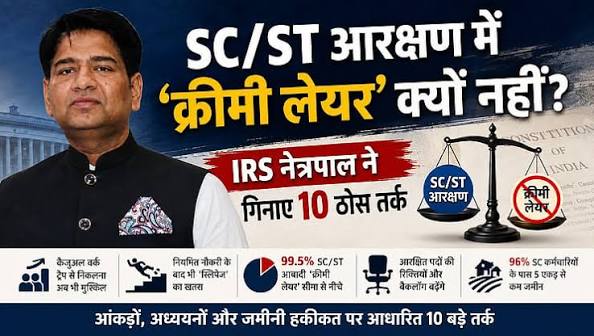
The claim that wealthy Dalits are enjoying the benefits of reservation is not supported by statistics. The Bihar Caste Census revealed that 99.5 percent of the Scheduled Caste/Tribe population is below the economic creamy layer threshold. Even in national income tax data, the number of people earning more than ₹1 crore is negligible in the total population; this number is statistically almost zero in the Scheduled Caste/Tribe community.
New Delhi – Amidst the debate over implementing a ‘creamy layer’ in reservations for Scheduled Castes (SC) and Scheduled Tribes (STs) and excluding the next generation from reservation benefits after one generation of a family has received it, senior IRS officer Netra Pal has put forward 10 key arguments against it. He argues that the socio-economic status of the SC/ST community cannot be judged solely on the basis of current income, employment, or success of a single individual.
The data he cites draws attention to factors such as intergenerational employment, the possibility of moving from regular jobs to the informal sector, lack of assets, a high share of casual employment, social differences in higher education, and vacancies in reserved positions. Netrapal argues that before implementing a “creamy layer” or generational restriction, it is important to understand its impact based on solid empirical data.
Escape from the “Casual Work Trap” Remains Effortless
Netrapal’s first argument is based on intergenerational employment data provided in the “State of Working India 2023.” The report clearly demonstrates caste-wise differences in the distribution of the workforce and income, where social identity impacts labor market outcomes.
In 2018, among SC/ST men who worked as daily wage laborers, 75.6% of their sons also worked as daily wage laborers. According to these data, in 2018, among “other” caste groups, if the father was a casual worker, the probability of his son also remaining a casual worker had decreased to approximately 53 percent. In contrast, among the SC/ST community, this probability was approximately 75 percent.
In comparison, this figure was 86.5% in 2004, suggesting that the sons of SC/ST daily wage laborers have now moved into other forms of employment, especially informal, regularly paid work, but this growth is very slow.
According to Netrapal, this difference indicates that it remains more difficult for SC/ST families to break the cycle of casual and temporary employment than for other social groups. Without continued government support, such as reservations, the cycle of manual labor and irregular employment is difficult to break.
He argues that if one generation gains access to employment and education through government support or reservations, then the next generation is excluded from reservations, the true nature of this intergenerational mobility may be overlooked.
The risk of ‘slippage’ even after achieving regular employment
The second argument is that a member of an SC/ST family securing a regular salaried job does not in itself guarantee lasting socio-economic security.
According to data provided by Netrapal, even children of SC/ST parents who achieve regular employment are at risk of moving into the informal sector, casual work, or self-employment.
This means that regular employment for one generation does not guarantee the continuation of that status for the next generation. Limiting reservation to one generation ignores the fragility of this social climb for Dalits.
On this basis, Netrapal argues that excluding the next generation from reservation based solely on the first generation’s access to regular employment may ignore the instability of social progress.
How large is the ‘creamy layer’?
The argument in favor of implementing a creamy layer in reservation is that economically well-off SC/ST families are consistently benefiting from reservation.
Netrapal, in response, questions the actual size of the creamy layer.
He cites data from the Bihar Caste Survey, which shows that 99.5 percent of the SC/ST population falls below the creamy layer threshold. Furthermore, the national income tax data also shows a very low number of people with incomes exceeding ₹1 crore compared to the total population. According to Netrapal, the number of people falling within this income bracket within the SC/ST community is even more limited.
On this basis, he argues that the presence of a very small economic group should not be used as a basis for limiting reservation eligibility for the entire SC/ST community.
The Creamy Layer Threatens to Increase Vacancies in Reserved Positions
Netrapal’s fourth argument relates to the vacancies in reserved positions and seats.
According to him, the problem of many positions and seats remaining vacant within reserved categories already exists. In such a situation, if creamy layer or second-generation candidates are excluded from reservation, the pool of eligible candidates will narrow further.
This could reduce the number of candidates available for reserved positions and increase backlog vacancies.
According to Netrapal, before limiting the scope of reservation beneficiaries, it is important to assess how many reserved positions are being filled and how many are vacant under the current system.
Increasing income does not necessarily mean generational wealth
According to Netrapal, it is not appropriate to consider the current income of SC/ST employees as an indicator of their family’s generational wealth.
He cites a study on government employees. According to this, 96 percent of SC employees owned less than five acres of land.
Similarly, among rural SC graduates, 82 percent owned less than 1.23 acres of land.
Based on these data, Netrapal argues that many SC employees who have entered government service come from families that do not own large amounts of land or family property.
Therefore, a person’s current income and their family’s generational wealth cannot be viewed on the same scale.
Reserved categories already face a crisis of vacant seats. Excluding the so-called creamy layer or second-generation educated youth will further shrink the pool of eligible graduates. This is likely to further increase backlog vacancies, defeating the very purpose of representation.
Casual employment is very high among SC workers
Netrapal’s sixth argument relates to the employment patterns of the SC community.
According to 2021-22 data, approximately 40 percent of SC workers were in casual employment. In comparison, the share of casual employment among ‘other’ social groups was approximately 13 percent.
Based on these data, Netrapal argues that regular salaried employment is still not widespread for the SC community.
Therefore, exclusion from reservation based on economic grounds will focus on the relatively small segment that has accessed regular employment, while the vast majority of the community remains in casual employment.
Social gaps persist even after admission to institutions like IITs
Netrapal also includes studies on the backgrounds of SC/ST students admitted to higher education in his arguments.
Surveys of higher education institutions like IITs show that SC/ST students come from different social backgrounds than other groups.
These students are less likely to attend English-medium schools. Their parents are also less likely to have received a college-level education.
Additionally, differences are also evident in cultural capital, such as social confidence and certain social skills needed to navigate the institutional environment.
Netrapal argues that a student’s admission to a prestigious institution does not automatically eliminate these social and educational gaps.
The example of a few successful individuals cannot be used to judge the entire community.
Netrapal also questions the “merit” argument that cites examples of successful students or toppers from the SC/ST community.
He argues that these are statistical outliers. The exceptional success of a few individuals cannot be considered representative of the socio-economic status of the entire community.
According to him, broader data also reveals issues such as dropout and suicide in higher education among SC/ST students.
Therefore, the exceptional success of a few SC/ST students in an examination or institution cannot be considered proof that the community has completely overcome social and educational barriers.
The root of the problem lies in a weak educational pipeline.
According to Netrapal, understanding the problem of representation requires looking at the initial stages of education, rather than just the upper levels of higher education and government jobs.
He argues that the lack of quality primary education, especially English-medium education, for SC/ST children limits the pool of graduate candidates available for higher education.
If the pool of qualified candidates is insufficient, further restricting eligibility at the top level of reservation will not solve the representation problem.
Therefore, Netrapal emphasizes strengthening the foundation of education rather than narrowing the scope of reservation, so that a sufficient number of candidates from SC/ST communities can be prepared for higher education and employment.
Comprehensive ethnic and social data is essential before policy change.
Netrapal’s tenth argument is that major changes to SC/ST reservations, such as the creamy layer, sub-categorization, or generational restrictions, should be based on solid data, not on assumptions.
According to him, the government should first comprehensively investigate the true state of employment, education, income, property, land ownership, and intergenerational social mobility within the SC/ST community.
It should also be studied what impact excluding some individuals from reservations based on economic or generational factors would have on the vacancies and backlog of reserved seats and government positions.
According to Netrapal, without a comprehensive caste census and related socio-economic data, it would be difficult to accurately assess the potential impact of such policies.
What questions need to be answered before the ‘creamy layer’ is considered?
Considering Netrapal’s ten arguments, his main question is on what basis can an improvement in the economic status of an individual or family within the SC/ST community be considered sustainable social progress.
The data presented by him paints a picture of three distinct dimensions: on the one hand, there is a high share of casual employment and weak intergenerational mobility within the SC/ST community, and on the other, there is a significant lack of intergenerational wealth even among those who have access to government or regular employment. Third, differences in social and educational backgrounds have been reported among students entering higher education.
On this basis, Netrapal concludes that mere access to government jobs or higher education by one generation of a family cannot be considered definitive proof of social equality.
He emphasizes that before any changes to SC/ST reservations, such as the creamy layer or intergenerational restrictions, comprehensive and community-specific data should be used to determine the actual impact of such exclusions, particularly on reserved seats, government positions, backlogs, and social representation.
Summary
Reservation is not merely financial assistance, but a tool for representation against historical discrimination and social exclusion. Measures like the creamy layer and intergenerational restrictions will weaken this tool. Until there is genuine improvement in the conditions of a large section of the community, the focus should be on strengthening and making reservations more effective rather than limiting them.
Geetha Sunil Pillai
Courtesy: Hindi News