
Seven Dalit families living on their land for generations in Malayidamthuruth, Kerala, are facing the threat of eviction due to a land dispute. Learn the full story of this 50-year-old dispute.
Kerala: Seven Dalit families living in Malayidamthuruth, near Kizhakkambalam in Ernakulam, say it is unimaginable for them to leave the place where they were born and raised. Their ancestors are buried on this land, and their family has lived here for over 100 years.
74-year-old Chandran, who was injured during a recent violent eviction attempt, described his pain, saying he felt as if his breath had stopped and for a few moments, he felt like he was dying.
On May 20th, approximately 200 police officers arrived in Malayidamthuruth to evict these families, injuring several people. This incident occurred just 48 hours after the Congress-led United Democratic Front (UDF) government formed its cabinet. Following this, the opposition Communist Party of India (Marxist) [CPI(M)] has accused the new government of imposing “bulldozer raj” in Kerala.
This incident has brought back to the spotlight a decades-old land dispute between a private individual and seven Dalit families who have lived on the land for generations.
A 50-Year-Old Land Dispute
The dispute concerns 2.65 acres of land occupied by these seven families of the Pulaya caste, which falls under the Scheduled Caste (SC) category. This plot is adjacent to 19 acres of government (Purmbok) land. There is also a dispute over its boundaries, which can only be resolved through a proper survey.
The history of these Dalit families in Malayidamthuruth is linked to a bonded laborer named Kalukurumban, who lived on this land nearly a hundred years ago. The current residents are his fifth- and sixth-generation descendants. Legal battles fought in the 1970s confirmed the families’ right to live on this land.
According to S. Sathish, Ernakulam District Secretary of the CPI(M), the legal battle over this land occurred in two phases. In 1975, a man named Shankaran Nair filed a case claiming ownership of the property. At the same time, Dalit families approached the Perumbavoor Munsif Court demanding land rights (patta).
M.K. Anilkumar, former president of the Kizhakkambalam Panchayat and a member of the CPI(M) local committee, said that Shankaran belonged to a landowning family in the area. He passed away nearly 20 years ago, and the case is currently being handled by his daughters, Subhadra and Ambika, and their family members.
In 1975, the court considered both cases jointly and rejected Shankaran’s claim. Regarding the Dalit residents’ demand for a lease, the court clarified that leasing revenue land is a matter of government policy, and only the government has the authority to decide on it. The case then went to the Paravur Sub-Court and then the Kerala High Court, where the lower court’s order was upheld both times.
Record Manipulation and Legal Battle
The land was resurveyed in the early 1980s. CPI(M) leaders and local residents allege that Shankaran manipulated the records by influencing officials to show the disputed land under a survey number owned by him. Based on these new records, he approached the court a second time in 1984 and obtained a favorable verdict.
The case went through the Kerala High Court and finally reached the Supreme Court in 2022, where a verdict was given in Shankaran’s favor. However, the court’s orders could not be implemented due to strong opposition from Dalit residents.
Following this, the Perumbavoor Munsif Court issued a strict ultimatum to the police administration to complete the eviction process by May 23 and submit a final execution report by May 26. Following this order, a team of police and the Advocate Commission arrived in the village on May 20 to evict the Dalits.
Families say this police action was unprecedentedly severe. Three days after the incident, residents of the area reported that the police had come to evict them 14 times before, but never used such force.
According to a LiveLaw report, when the case again reached the Kerala High Court on May 25, the court granted the government two weeks to complete the eviction proceedings. The court remarked that if those people are living on the property, they must have a pre-existing right that has been legally enforced, and until that happens, they cannot create a nuisance.
Demand for land measurement and survey
The CPI(M) alleges that the police action exposes the UDF government’s cruelty towards Dalits. They argue that after the 2022 decision, the LDF government initiated a survey to determine whether the land was government land. They believe that instead of evictions, the UDF government should continue the land measurement process.
Advocate Santhakumari, former MLA and state vice-president of the Pattikajathi Kshema Samiti (PKS), stated that the previous Left Democratic Front (LDF) government appointed a joint verification team to survey 19 acres of land. She said that this decision was made three to four years ago and notices were issued to the concerned people, but the process could not be completed.
Following the High Court’s October 10, 2023, order on a writ petition filed by social activist NA Ashraf alleging manipulation of documents related to 19 acres of government land, the Ernakulam Collector also ordered a survey of the 19 acres of Puramboka land on March 23, 2024.
Lives in the Shadow of Uncertainty
Amidst all this, the future of seven Dalit families hangs in the balance. They have built their homes here with their life savings. Facing the threat of eviction, resident Ebin Thankachan questioned how people who have lived here for five generations can leave this place.
These families primarily depend on farming, animal husbandry, and daily wage labor. Ebin explained that they have been paying taxes on their homes, but have not paid land tax due to lack of ownership rights. The graves of their ancestors are also located right behind their homes.
They also have two sacred groves (kavu) and temple-related traditions here, which they have followed for generations. Sajitha, 48, said she watched her father fight for this land since childhood, and now her children are experiencing the same stress. These seven families have about 10 school-age children.
Sanisha, a native of Malayidamthuruth who moved to Airpuram after marriage, said that if the land belongs to Shankaran Nair, they can take it by showing the documents. But if it is government land, the government should take possession of it and decide who should be given it. She strongly opposed the transfer of the Puramboka land to a private individual.
Growing anger over police action
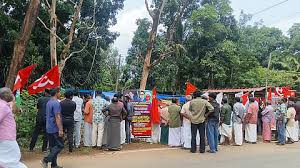
The CPI(M) and its affiliated organizations protested in Malayidamthuruth following the incident. PKS Vice President Santhakumari described the police intervention as a violation of human rights and social justice, citing it as a result of a feudal mindset and deep-rooted caste system.
Regarding the police action, a 44-year-old woman, speaking on condition of anonymity, said that the policemen tore her clothes and dragged her on the street. Sajitha also recalled that the attack was sudden, and that both male and female police officers were present.
Senior CPI(M) leader and former minister P. Rajeev called this an example of police brutality. He said that the previous government’s stance was not to evict people through police force, so no one was forced to do so even after the 2022 decision. He said that such sudden action was not expected from the new government, especially in the Chief Minister’s own district.
However, this is not the first time these families have faced police action. According to residents, when police and revenue officials came to conduct a survey in 2025, physical force was used, and cases were even filed against some people.
Government’s stance and assurance of rehabilitation
Reacting to this growing controversy, Chief Minister V.D. Satheesan told the media on Monday, May 25, that the previous LDF government had done nothing for these families despite 14 attempts. He assured that if evictions are carried out as per the court order, the government will not leave them homeless. The government will ensure their adequate rehabilitation by providing them with alternative housing and land.
Backward Classes Welfare Minister K.A. Tulsi clarified that as soon as the matter came to the government’s attention, immediate steps were taken to stop the police action.
Meanwhile, social activist P.J. Manuel expressed concern over the systemic marginalization of Dalit and landless communities in Kerala. He pointed out that legal frameworks often favor privileged landowners over the historical residents. Manuel firmly believes that the only solution to this problem is to hand over the land to these marginalized communities, rather than repeatedly relocating them.
Rajan Chaudhary
Courtesy: Hindi News