
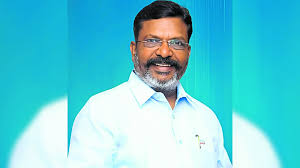
The 63-year-old suddenly became the hinge between two futures: helping Vijay complete his rise to power, or accepting an extraordinary proposal from the DMK and the AIADMK to become the state’s first Dalit Chief Minister.
Chennai: On May 8 and 9, Tamil Nadu politics began revolving around a Dalit man who did not hold enough MLAs to form or topple a government, or even dominate the Assembly numerically. Yet every major party waited for VCK president Tholkappiyan Thirumaavalavan.
The 63-year-old suddenly became the hinge between two futures: helping TVK president C Joseph Vijay complete his rise to power, or accepting an extraordinary proposal from the DMK and the AIADMK to become the state’s first Dalit chief minister.
Thirumaavalavan was neither reluctant nor confident about the latter proposal. He knew the move might have carried the tacit blessings of the BJP — his ideological adversary for nearly two decades. Yet, the DMK and the AIADMK continued to court him in a last-ditch effort.
While the DMK agreed to the idea of a Dalit CM, AIADMK general secretary Edappadi K Palaniswami initially opposed it. The original plan behind the DMK-AIADMK alignment was to let Palaniswami head a coalition government with smaller allies on both sides, backed by external support from the DMK
On May 8 evening, when his decision was expected, Thirumaavalavan went incommunicado. He was later spotted at then-outgoing CM M K Stalin’s residence, and kept most visitors away, deepening speculation around his next move.
The next day, TVK’s Aadhav Arjuna landed at Thirumaavalavan’s office and received the letters of support from the VCK’s two MLAs, effectively bringing down the curtains on one of the most dramatic coalition moments in TN’s politics.
VCK sources insisted that the delay was not because Thirumaavalavan was interested in the CM’s post, but because he wanted to consult senior office-bearers and district-level functionaries.
Political journey
Born in Anganur in the Ariyalur district, Thirumaavalavan worked in the Tamil Nadu Forensic Sciences Department in Coimbatore, Chennai, and Madurai before coming into contact with Malaichamy, founder of the Dalit Panthers Iyakkam.
After Malaichamy died in 1989, Thirumaavalavan assumed leadership of the movement and began working in villages across southern Tamil Nadu, where caste oppression often remained invisible. The organisation entered electoral politics in 1999 at the insistence of Congress veteran G K Moopanar, who attempted to build a Third Front against both the DMK and the AIADMK.
The experiment failed electorally, but it marked Thirumaavalavan’s transition from an activist to a full-time politician. Over the next two decades, he emerged as one of Tamil Nadu’s most recognisable Dalit voices, particularly for his confrontational politics against caste violence and, later, his uncompromising opposition to the BJP and its Hindutva ideology.
His politics increasingly fused Ambedkarite, Marxist, and Periyarist frameworks, while consciously bringing Muslims into a broader subaltern political coalition against majoritarian nationalism.
Ironically, Thirumaavalavan first entered the Assembly from the Mangalore constituency in the Cuddalore district while aligned with a DMK-BJP alliance. He later described that phase as a political “misadventure” and resigned his seat in 2004. Since then, he has never aligned with the BJP.
He also adopted a firm stand against the PMK — a Vanniyar-based party — after caste violence targeting Dalits intensified in northern Tamil Nadu. In 2011, he declared that he would never again be part of any alliance that included the PMK.
Ideology vs survival?
Both the DMK and the AIADMK continued courting him over the years because the VCK wielded influence across parts of northern and central Tamil Nadu, especially among Dalit youths. A three-time Lok Sabha member from Chidambaram, Thirumaavalavan became electorally useful to larger alliances while also remaining ideologically inconvenient to them.
Feeling that the VCK had little independent future if it remained permanently tied to the Dravidian majors, he experimented with a Third Front in 2016 under actor Vijayakanth alongside the Left parties. The alliance collapsed electorally, and Thirumaavalavan himself lost narrowly.
Since then, he has returned as a trusted DMK ally. But during the DMK’s 2021-2026 tenure, he faced increasing criticism from Dalit activists and younger cadres for his perceived silence on caste atrocities and for not holding the Stalin government sufficiently accountable.
As the VCK’s seat share diminished over successive elections, many supporters urged him to walk out of the DMK alliance altogether. Yet the BJP’s presence within the AIADMK-led front closed that route.
At the same time, Thirumaavalavan struggled to prevent a visible drift of Dalit youth toward Vijay and the TVK. In what many saw as an attempt to reassert independent strength, he briefly announced his candidature from Kattumannarkoil before withdrawing it after reported unhappiness within the DMK.
Ultimately, the VCK won only two seats this time. Yet in a fractured Assembly, those two seats suddenly
became decisive.
Part of Thirumaavalavan’s long-term political project has been to expand the VCK beyond a purely Dalit party by drawing in Muslims and even sections of non-Dalit backward communities — particularly Vanniyars.
It has produced partial electoral success but also internal anxieties over ideological compromise and political dilution.
With just two MLAs, the VCK is now well-positioned to achieve one of its founding principles — seeking a share in power and being part of a government. And Thirumaavalavan seems to be moving towards accepting this historic opportunity and seeing his men enjoying power.
Courtesy : DH
Note: This news is originally published on https:/deccanherald.com/bha and is used purely for non-profit/non-commercial purposes, especially human rights