
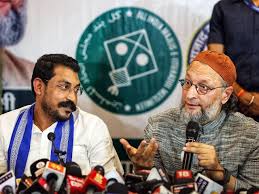
Asaduddin Owaisi and Chandrashekhar Azad have joined hands ahead of the 2027 Uttar Pradesh Assembly elections, projecting a Dalit-Muslim political alternative. But can this alliance translate social representation into electoral strength, or will it further complicate the opposition’s efforts to unseat the BJP?
The announcement of the Samajik Parivartan Morcha—an alliance between Owaisi’s All India Majlis-e-Ittehadul Muslimeen (AIMIM) and Azad’s Azad Samaj Party (Kanshiram)—has added a volatile new dimension to UP politics. Unveiled in Lucknow on November 12, 2026, the front has named Azad as its chief ministerial candidate and declared its intention to contest all 403 Assembly seats.
Positioning itself as a platform for the deprived and marginalised, the alliance has also invited the Samajwadi Party (SP) and the Congress to join forces to prevent the BJP from securing a third consecutive term. On paper, it is a compelling partnership: Owaisi brings a national profile and a consolidated base among sections of Muslim voters, while Azad has emerged as a prominent Dalit voice, particularly appealing to younger demographics.
Yet, political alliances cannot be judged merely by the demographics their leaders represent. Their viability depends on organisational depth, local leadership, and the ability to convert social support into legislative seats. The central question is not whether Dalits and Muslims can unite politically, but whether this formation can build a meaningful alternative without fatally fragmenting the opposition vote.
The Arithmetic of 403
Uttar Pradesh remains one of India’s most consequential electoral battlegrounds, where the margins of victory are often razor-thin. The 2022 Assembly results underscore this reality. The BJP won 255 seats with roughly 41.3% of the vote, taking the NDA tally to 273. The SP secured 111 seats with around 32.1%, bringing the broader opposition tally to 125. The BSP, once a dominant force, was reduced to a single seat.
The arrival of a new formation targeting communities that traditionally vote for the opposition naturally raises concerns about vote distribution. While AIMIM and the Azad Samaj Party argue they are offering an independent choice, the reality of first-past-the-post electoral math is unforgiving. Where their candidates contest against the SP or Congress, the anti-BJP vote risks being fatally divided.
The ‘Vote-Cutter’ Dilemma
This brings us to the most contentious critique of the alliance: is it inadvertently acting as a ‘vote-cutter’?
AIMIM has not built a significant statewide presence in UP; its influence remains concentrated in specific pockets. Owaisi’s high visibility does not automatically equate to a broad grassroots base. In constituencies with substantial Muslim electorates, tactical voting often dictates that voters back the candidate with the best chance of defeating the BJP. If an AIMIM candidate splits the vote against an SP nominee in such a seat, the beneficiary is almost always the BJP. A similar dynamic could play out between the Azad Samaj Party, the BSP, and the SP for the Dalit vote.
While it is fair to criticise the alliance for potentially splitting the anti-BJP vote, labelling it a deliberately engineered “BJP B-team” requires evidence that currently does not exist. Furthermore, there is a democratic counterargument: voters from marginalised communities cannot be expected to remain permanently tethered to the electoral strategies of larger opposition parties. Smaller parties have a democratic right to carve out independent political space.
Beyond Identity: The Need for a Common Programme
The alliance’s most compelling proposition is the potential consolidation of Dalit and Muslim constituencies. Both communities have faced distinct but overlapping forms of marginalisation. However, the Bahujan Samaj Party’s history demonstrates how difficult it is to maintain a broad social coalition without sustained grassroots organisation and ideological clarity.
For the Morcha to be a genuine social justice platform, it must offer more than identity-based mobilisation. It needs a common programme that addresses the diverse, everyday concerns of its constituents: unemployment, agricultural distress, education, healthcare, and social discrimination. Contesting all 403 seats is a monumental task requiring booth-level networks, financial resources, and robust candidate-selection mechanisms—not just high-decibel public rallies.
The Organisational and Ideological Challenge
Naming Chandrashekhar Azad as the CM face is a major political statement. His 2024 Lok Sabha victory from Nagina gave him a parliamentary mandate and proved his ability to win an independent base. However, translating a single constituency victory into a statewide consolidation is a different challenge entirely.
For Owaisi, the partnership is an opportunity to expand AIMIM’s footprint in India’s most populous state. But the alliance raises immediate questions about political compatibility. Will AIMIM remain focused primarily on Muslim representation, or will it embrace a broader, secular social justice agenda? How will seat-sharing be negotiated? What happens when the radical constitutionalism of Azad clashes with the conservative religious politics often associated with Owaisi’s base? The alliance must establish transparent mechanisms to resolve such disputes.
The BJP’s Silent Beneficiary
The BJP’s strength in UP rests on its formidable organisational capacity, welfare outreach, and ability to build a broad social coalition. A divided opposition makes constituency-level contests vastly easier for the ruling party. Furthermore, this alliance hands the BJP ready-made messaging to paint the opposition as fractured and overly reliant on identity politics.
While the BJP will undoubtedly benefit from this fragmentation, electoral consequences must be assessed through evidence, not assumption. The Morcha’s potential to help the BJP is a structural reality of vote-splitting, not necessarily proof of a secret understanding.
The Missing Manifesto
Beyond personalities and electoral calculations, voters deserve to know what the Samajik Parivartan Morcha actually proposes to do.
What is the alliance’s concrete plan for job creation? How will it reform government schools and public healthcare? What specific measures will it propose to curb atrocities against Dalits and ensure communal harmony? Without a detailed, costed policy agenda, the alliance risks remaining a mere electoral arrangement built around the celebrity of its leaders.
Empowerment Over Arithmetic
The formation of the *Samajik Parivartan Morcha* opens a new chapter in UP politics. There is nothing undemocratic about smaller parties seeking independent space; established opposition parties cannot claim exclusive ownership of the votes of Muslims, Dalits, or any other community.
But political assertion carries responsibility. Leaders who claim to represent the marginalised must ask themselves whether their strategies strengthen their constituents’ bargaining power or inadvertently weaken the collective ability to challenge the ruling establishment.
The Morcha will ultimately be judged not by its launch rallies, but by its ability to build a credible organisation and articulate a shared vision. Uttar Pradesh needs serious debate on unemployment, caste discrimination, and economic inequality. Its people deserve alternatives that address these concerns rather than treating their identities merely as variables in an electoral equation.
The alliance has announced its arrival. Whether it becomes a transformative political force or just another source of opposition fragmentation will depend on the choices its leaders make before 2027. Social justice cannot remain confined to slogans, and political ambition cannot be reduced to vote-bank arithmetic. The real challenge is to transform representation into empowerment.
By Mohd Ziyaullah Khan
Courtesy : Counterview
Note: This news is originally published on https:/counterview.com/bha and is used purely for non-profit/non-commercial purposes, especially human rights