
On August 5, 2026, the Special SC/ST Court in Merta acquitted all 40 accused in the case, granting them the benefit of the doubt. The court concluded that the incident was proven and its perpetrators were unproven. This single sentence from the court encapsulates the entire tragedy of the Dangawas Dalit massacre. Bhanwar Meghvanshi explains.
First, let’s understand what happened that day in Dangawas, a village in Nagaur district, Rajasthan. How the violence that began with a land dispute escalated into a Dalit massacre, and how the search for justice became a long struggle. Finally, a court verdict, delivered 11 years later, now appears to be a case of injustice.
To simply describe the Dangawas Dalit massacre as a land dispute between two parties would be an injustice to the entire incident. If we piece together the events, a horrific story emerges, in which an old land dispute, caste dominance, administrative inaction, open threats, the controversial role of the illegal village panchayat, armed mobs, tractor crushes, firing, alleged sexual and physical violence against women, and subsequent attacks on victims in the hospital all appear interconnected. The most important question is: was what happened on May 14, 2015, a sudden communal clash or a serious consequence of already building tensions and threats?
Dangawas is a village in the Merta City area of Nagaur district. According to the 2011 census, the village had 1,578 families and a total population of approximately 7,470. Dalits constituted approximately 16.59 percent of the population. There had been a long-standing dispute in the village over the occupation of Dalit land by non-Dalits and tenancy rights. The land dispute that later became the backdrop for the Dangavas massacre is 23 bighas and 5 biswas of land. This land has been in the name of the Dalit Meghwal family since its inception in government records. Later, a dispute arose over its alleged purchase, sale, transfer, and possession. According to the occupying Jat family, they had purchased the land, but it was only in the Dalits’ names on paper. Meanwhile, the Dalit family claims the land was mortgaged and was reclaimed after making a reasonable payment. However, the Jat family continued to illegally occupy it, leading the aggrieved Dalit family to approach the courts and the administration. Ultimately, proceedings before the Sub-Divisional Officer resulted in a decision in favor of the Dalit family, ordering the transfer of physical possession.
This is where the story becomes more serious. While the land belonged to the Dalits on paper, the land was in the hands of another party. The law stated one thing, while the powers that be asserted another. This cannot be explained by a single incident; it is a series of events. For example, on April 20, 2015, there was mention of an attempt to cut down trees and build a pond on the disputed land. Subsequently, on April 21, an incident of attempted rape and assault of a Dalit widow was reported. When the police failed to register a case, the victim had to go to court. Subsequently, threats against Dalits escalated.
On May 11, Dalits sought protection from the local administration. Dalit families living on the disputed land were receiving threats of eviction, and several local administration officials were aware of the dispute. That same day, members of the Jat community submitted a memorandum to the local administration, demanding the removal of Dalit families from the land and threatening to remove them themselves if action was not taken. The Dalit families again sought protection from the local administration, but the local administration remained silent.
This suggests that signs of danger were present before the violence of May 14. On the morning of May 14, 2015, members of the Jat community convened an illegal panchayat in the village regarding the disputed land, where a large number of people gathered. From there, this frenzied mob, armed with weapons, arrived on tractors, motorcycles, and other vehicles at the disputed land, where Dalit families were present with their relatives.
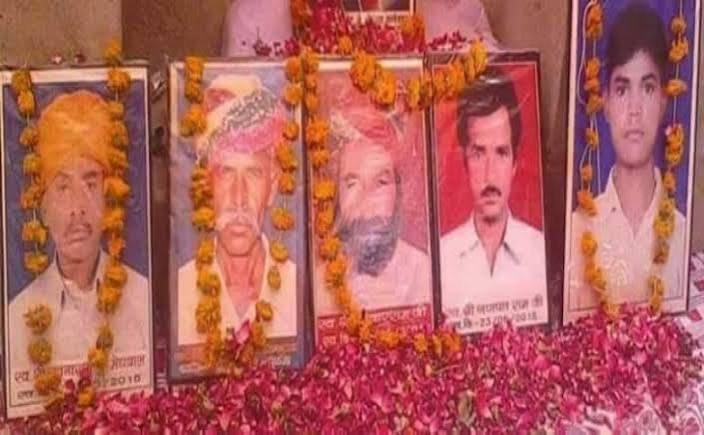
A mob of hundreds of people targeted and began killing Dalit men and women present there. The violent mob not only surrounded the Dalits and hurled caste-related slurs at them, but also attacked them with sticks, rods, axes, and other weapons. Their huts and houses were set on fire. Their vehicles were burned. But the most horrific part of the violence was tractor justice. Tractors were driven over Dalits. Many were hit by the tractors. Two Dalits, Ratnaram and Pokharram, died on the spot, and nearly a dozen others were seriously injured. Pancharam also succumbed to his injuries later. Ganeshram and Ganpatram died while undergoing treatment in the hospital. Thus, five Dalits were killed in the mob lynching of May 14, 2015.
To simply call the Dangawas incident a “murder” would be to minimize its full scale. Among those injured, many had broken limbs and head injuries. Several parts of their bodies also bore serious wounds and other injuries. When I visited the Dangawas victims after the incident, they also alleged that, in addition to caste-based slurs, women were assaulted, their clothes torn, and attempts were made to sexually assault them. This means that the attack wasn’t just on their bodies; their dignity and self-respect were also deeply hurt.
Another horrific chapter of the Dangawas Dalit massacre involves hospitals in Merta City and Ajmer. After the incident, the injured were taken to hospitals, but due to the police’s late arrival at the scene and the tense situation at the hospital, the mob targeted the injured at Merta Hospital. Most importantly, those who should have been protected in the hospital were forced to endure fear even there.
The case of Rampal Goswami’s gunshot death also came to light amid the violence on May 14th. Rampal’s family alleged that he was forcibly taken away by the mob. He later died of gunshot wounds. The Dalit community was blamed for the murder. According to the case report, the deceased Goswami had gone to Dangavas as an emissary of an illegal village council of villagers to convene Dalits and was shot by them. However, the CBI investigation failed to substantiate this allegation. Questions remain: how was Rampal Goswami killed? Who fired the shot? Where did the gun used to kill him go? Where was his body found? Why have his killers remained unidentified? The Dalit community alleges that an attempt was made to frame Dalit victims and their families as accused using Rampal Goswami’s murder as a basis. The CBI investigation later cleared the Dalits of Rampal Goswami’s murder charges.
The Rajasthan Police initially initiated the Dangavas case, but the investigation was later handed over to the CID. However, after strong protests, protests, and public pressure, the state government handed over the investigation of the Dangavas incident to the CBI. The CBI investigation confirmed the recovery of sticks, iron rods, sharp weapons, and a gun hammer and loading mechanism from the scene. The CBI filed a charge sheet against those accused of murdering five Dalits. A total of 40 accused were charged. Of these, 13 were reported absconding, and 27 were arrested. Following the Rajasthan High Court’s intervention, all the accused were arrested and sent to jail.
District and Sessions Court, Merta, Rajasthan (Photo courtesy: Pramod Indaliya)
This fact is extremely important because it at least makes it clear that the CBI did not dismiss the incident as a minor dispute between two families. So who was claiming it was a “fight between two families”? Following the heinous Dangavas massacre, a narrative was rapidly spread through social media that this was not caste violence, but a land dispute between two parties. This raises the question: If it was a dispute between just two families, then which side represented hundreds of people, and why? Why did so many people carry weapons? Why were Dalits’ homes and huts burned? Why were tractors driven over their bodies? The existence of a land dispute does not prove that the violence was not caste-based; rather, it is necessary to examine which social forces were used against whom during the conflict.
Serious questions also arise about the role of the Nagaur police and the Merta administration in the Dangavas Dalit massacre. The site of the attack on Dalits was just a few kilometers from the police station. The Dalit side claims that the police had already been informed in writing about the illegal panchayat being held in the village and the potential attack. Despite this, what could have been the reason for the police’s delay in arriving at the scene? Prior to this, on May 11th, Dalits had requested security, and this was because of the persistent tension in the village. Therefore, an important and uncomfortable question arises: was the Dalit massacre in Dangavas a sudden act or did the administration deliberately not prevent the violence? If Dalits were already being threatened, tensions were rife over land, there was a dispute in the Panchayat, the police administration had been informed and security had been sought, then where was the state police system on May 14?
Dalits killed in the Dangawas Dalit massacre
Following the incident, Dalit organizations, human rights groups, and progressive political organizations launched a massive movement. A sit-in was held outside the hospital in Ajmer. Demonstrations were held in various parts of the country, including Rajasthan. Memorandums and protests were held in Jaipur, Jodhpur, Nagaur, Barmer, and other places. The main demands of the movement were a CBI investigation, better treatment for the injured, compensation for the families of the deceased, arrest of the accused, and protection for Dalit families. Finally, on May 29, 2015, a notification from the central government paved the way for a CBI investigation. But did everything settle after the CBI investigation?
Beyond immediate relief, the Vasundhara Raje Scindia government, then in power in the state, failed to address many of the victims’ demands. An 18-point agreement was reached between the protesters and the Rajasthan government. This included demands for a CBI investigation, compensation, rehabilitation, removal of land encroachments, security, arrest of the accused, accountability of police officers, and separate trials for violence against women. The struggle was not simply about who killed. The question also arose: who were those who repeatedly warned and threatened Dalits? Who were those who refused to protect them despite their pleas? Who were those who took no action on Dalit complaints and allowed the massacre of Dalits to occur? And who were those who later delayed providing justice to the oppressed Dalits? What would their accountability be?
What is the true story of Dangavas? Undoubtedly, at its core was a land dispute, but it wasn’t just a land dispute. It was a conflict influenced by caste power relations. Forced occupation of Dalit land and social dominance were at its core. The violence did not occur suddenly. This is clear from the events described above. On May 14th, the violence escalated into mass violence. The use of mobs, weapons, tractors, arson, beatings, and sexual violence against Dalit women distinguished it from a normal conflict. The fight for justice that followed the incident was equally difficult. The initial police action, the direction of the allegations in the FIR, the events at the hospital, the administrative response, the subsequent CBI investigation, and now the decision of the Scheduled Castes and Tribes Special Court have further complicated the matter.
The second chapter of this Dalit massacre began with the question of who should be accused and who should be spared. Several Dalits were accused in the Rampal Goswami murder case, but the CBI investigation acquitted 19 Dalits of those charges. On the other hand, a large number of other accused were charged in the murder of five Dalits. The case dragged on for nearly 11 years in the Scheduled Castes and Tribes Special Court. Now, this court has acquitted all the accused. Therefore, the greatest tragedy of Dangavas was not just the loss of life. The tragedy was also that those whose loved ones were killed had to fight a long battle to get justice, and ultimately, they were denied. Perhaps the biggest lesson from Dangavas is that when land grabs are determined not by law but by social power, when the administration doesn’t take threats seriously, when victims aren’t protected in a timely manner, and when even the justice process following violence is shrouded in doubt, then the massacre ceases to be merely a one-day event. It becomes a test of the system.
The Dangavas Dalit massacre is crucial to remember so that it cannot be erased from history by calling it a “fight between two families.” Forgetting it isn’t just about forgetting the five victims. It’s about forgetting the entire question of when Dalits in this country will feel secure in their equal rights over their land, their bodies, and their lives.
But on August 5, 2026, the SC/ST Special Court in Merta acquitted all 40 accused in the case, giving them the benefit of the doubt. The court concluded that the incident was proven, but its perpetrators were unproven. This single sentence of the court encapsulates the entire tragedy of the Dangavas Dalit massacre. This means that murders occurred, the court accepts. People died, this is proven. People were injured, mass violence occurred, this is also proven. But no one was found to kill them! So the question then is: who killed those six people, including five Dalits and one from a backward class, that day?
Did Ratnaram, Pokharam, Pancharam, Ganpatram, Ganeshram (all Dalits), and Rampal Goswami (OBC) die spontaneously? Were the injuries on their bodies the work of an invisible hand? Was there no perpetrator of the violence in the fields? And if there were perpetrators, why couldn’t the police, CBI, and judicial process, which lasted for more than ten years, reach them? This is the question that is in the eyes of the families of Dangavas who lost their loved ones, and it should also be asked of the justice system of Indian democracy.
The technicalities of the law have their place here. A person cannot be convicted based on mere suspicion. I don’t disagree with this principle, but my question goes beyond this: if the court has proven five deaths, established mass violence, and established serious injuries, then why did the investigating agencies not gather evidence that could lead to the real culprits of the violence?
This question is more about the investigation and prosecution system than the court, because the court itself wrote in its decision that the prosecution’s failure was revealed by its own evidence. Several witnesses refused to identify the accused. Some said they did not know them beforehand. In some cases, the names were revealed later, and in the case of one accused, the prosecution witness himself admitted his false inclusion. So, the question arises: who was responsible for witness protection, identification, and evidence collection in such a large-scale mass murder? This was not a case where the local police merely performed the formalities and the matter was buried. Two FIRs were registered. Both cases were later handed over to the CBI. The CBI investigated and filed charge sheets. A total of 40 accused were tried in this case, but the situation before the court eleven years later is horrifying.
The court found that many seizures could not be legally proven; serology was not conclusive; DNA testing was not conducted; there was no dye declaration, and there was no sufficient scientific link connecting the bloodstained weapons to the deaths. This is not just a failure of the prosecution; it questions the entire structure of the investigation. If, after eleven years, the court says that a scientific link has not been established in a major mass violence case, then it is the right of a democratic society to ask: who conducted the investigation? How was the investigation conducted? Was the investigation adequate? Were witnesses protected? Was the evidence preserved? And if not, who is accountable?
This verdict on the Dangavas Dalit massacre reveals another horrifying truth: in India, the most vulnerable to justice are often those with the fewest resources. It is difficult for a poor Dalit family to even access the court. Fighting a case for years is difficult. It is difficult to secure witnesses. It is difficult to gather documents. It is difficult to monitor the investigation. And when the verdict finally comes and the accused are acquitted, what is left for the family? A few papers, a few post-mortem reports, some old photographs, a few testimonies, a few dates, and photographs of the deceased? Is this justice?
Bhanwar Meghvanshi
(Edited by: Naval/Anil)
About the Author
Bhanwar Meghwanshi is a writer, journalist, and socio-cultural activist. He began his public life as a volunteer with the RSS. His autobiography, “I Was a Kar Sevak,” was a major publication. An English translation of this book, titled “I Could Not Be a Hindu,” was recently published. Meghwanshi is currently the editor of “Shunyakaal.com.”_____________________________________
Forward Press, in addition to being a web portal, is also a publisher of books on Bahujan issues. These books, published under the name of FP Books, delve into the broader issues as well as the subtle aspects of the literature, culture and socio-politics of the Bahujan (Dalit, OBC, Tribal, Nomadic, Pasmanda community) sections.
Courtesy: Hindi News