
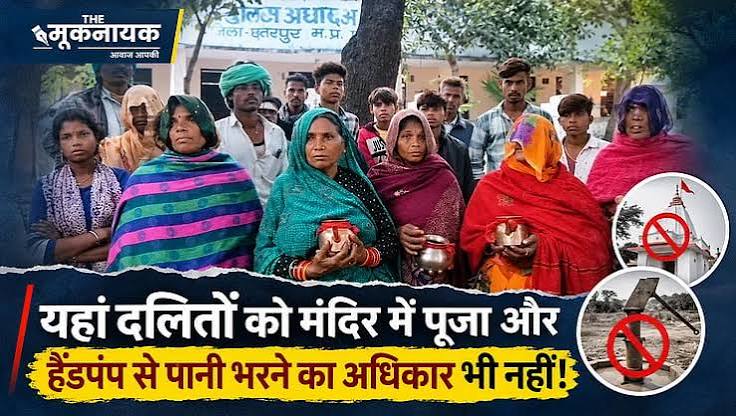
A Dalit family in Richhara village alleges caste discrimination, assault, and death threats; an FIR has been filed against four people under the SC/ST Act following the November 18 incident; the family now awaits protection.
Bhopal. With pots in their hands, helplessness in their eyes, and a question in their hearts, Dalit women from Richhara village in Chhatarpur district reached the Superintendent of Police’s (SP) office. This wasn’t a reflection of a religious event, but rather the voice of a family struggling for basic rights like worshipping and drawing water in their own village. The women allege that they are being prevented from worshipping at the Lord Shiva temple in their village. They are also objected to drawing water from public water sources. The family says they are constantly being discriminated against and insulted based on their caste.
The women reached the SP’s office with the pots used for Kartik Snan to tell the administration that their fight is not for any special privileges or concessions, but for the rights guaranteed to every citizen equally by the Constitution.
Wishing to offer water at the Shiva temple, but a caste barrier in the way
The family alleges that they are not allowed to enter the recently built Lord Shiva temple in Richhara village. The women of the family wish to go to the temple and offer water to Lord Shiva, but are allegedly prevented on the basis of caste.
According to the family, discrimination is not limited to the temple. Disputes arise even over drawing water from public hand pumps and wells. The women allege that they are not treated equally even in normal social activities.
The family also alleges that indecent songs are sung in front of their daughters-in-law and daughters, and objections are raised about simple things like riding a horse or wearing shoes at social events. These allegations raise serious questions about the family’s social status and respect in the village.
50-year-old Lota Ahirwar alleges assault
Lota Ahirwar, a 50-year-old woman from the family, alleged that on November 18th, some villagers assaulted her and insulted her using casteist slurs. The family alleges that a dispute was created over water use and an attempt was made to socially harass her.
Following the incident, the family filed a complaint at the Bhagwan police station. Based on the complaint, police have registered a case against four people under the Scheduled Castes and Scheduled Tribes (Prevention of Atrocities) Act, also known as the SC/ST Act.
However, even after the FIR was filed, the family does not feel safe. They allege that they continue to receive threats even after filing the complaint. The family has also reported receiving threats of being crushed to death by a tractor.
Family still in fear after FIR, demands protection from the administration
The women of the family say that despite filing a police complaint, their daily problems have not ended. They fear that their complaint against the accused could lead to further targeting of their family.
Amidst this concern, the women reached the SP’s office with pots. They say they do not want to fight with anyone in the village. Their only demand is that they be allowed to worship in the temple, draw water from the public hand pump, and live their lives without fear. The women have demanded the administration take effective action against the accused and provide security to the family.
Senior Azad Samaj Party leader Sunil Astey told The Mooknayak that the incident in Richhara village is extremely worrying. Even after so many years of independence, if Dalit families still have to struggle for basic rights like worshipping in a temple and drawing water from a public hand pump, it raises serious questions about our social system and casteist mentality. The Constitution guarantees every citizen the right to equality, respect, and freedom, yet at the grassroots level, people are still discriminated against on the basis of caste. This is not just a matter of one family, but an example of a societal mindset that even today denies Dalits equal rights.
He stated that the Dalit community will no longer remain silent for their constitutional rights and self-respect. Worshiping in a temple, drawing water from a public water source, and living a life with dignity are not a mere favor but a citizen’s right. It is the administration’s responsibility to provide immediate protection to the victim’s family, take fair and effective action against the perpetrators, and ensure a fear-free environment in the village. Humiliating someone or restricting their rights in the name of caste is unacceptable. Under constitutional rule, equality and justice should prevail, not the arbitrary rule of casteism.
The issue isn’t just about a temple and water, it’s about the right to equality.
This case in Richhara village isn’t limited to a dispute between two parties. If the family’s allegations are proven true, it raises serious questions about equal access to public facilities, religious freedom, and caste discrimination.
Article 14 of the Indian Constitution guarantees all citizens the right to equality before the law, while Article 15 prohibits discrimination based on caste. Ensuring equal access to public spaces and facilities is also an important part of the constitutional system.
The question is: in a village where everyone should be able to access water from a single public hand pump, why is a family being allegedly barred from access due to their caste? Why are complaints of alleged caste-based restrictions being raised at a temple where all devotees should have the opportunity to worship?
Ankit Pachauri
Courtesy: Hindi News