
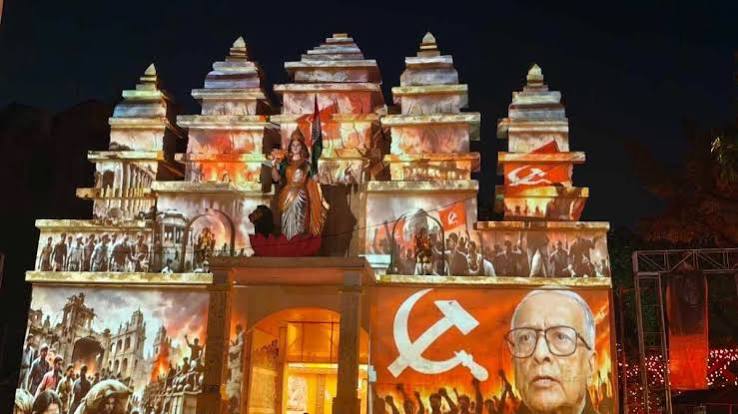
The Kamardanga Sarbojanin Durgotsav Samiti members told ThePrint they are trying to pull the Marichjhapi massacre out of oblivion.
The forgotten massacre of Dalit refugees on a faraway island in the Sundarbans during 1978-79 has become a Durga Puja pandal theme at Kamardanga Sarbojanin Durgotsav Samiti in Kolkata’s Entally area.
It is part of the broader theme of ‘Bam Bodh’ (eradication of the Left) that the organising committee has worked on for this puja.
“This year, we are organising Durga puja with the dream of establishing Sanatan Hindu Rashtra,” Suraj Kumar Singh, president of the 107-year-old Kamardanga Sadharan Durgotsav Samity, told ThePrint.
He added that it is “important for the new generation to know the historical struggles of Bengali Hindus”, before and after India’s independence. “The biggest massacre of Bengali Dalits in independent India was done by the same political party that claims to stand up for their rights.”
A forgotten massacre
In 1978, around a lakh Dalit refugees from erstwhile East Pakistan (now Bangladesh) had assembled at a tiny island named Marichjhapi in the Sunderbans. They hoped to turn it into a village of their own. These refugees had come to Marichjhapi from the Dandakaranya region, spread across the states of Madhya Pradesh, Orissa, Maharashtra and Andhra Pradesh, where the government of India had sent them to be part of the Dandakaranya rehabilitation plan for Hindu refugees from East Pakistan in early 1956.
Unable to adjust to their new surroundings, a band of women and men made their way to Marichjhapi island in the Sundarbans, the topography of which they were accustomed to. In the span of a few months, the refugees converted a shrub-filled, uninhabited island into a thriving village of their own with no help from the state or the central government. They built huts, a school, a bidi factory, a boat-manufacturing yard, even as the Left Front government wanted them to leave the island. The government designated it as a reserve forest and accused the refugees of violating the forest acts by destroying the existing and potential forest wealth and also creating ecological imbalance.
“On January 26, 1979, India’s Republic Day, then Left Front chief minister Jyoti Basu announced an economic blockade of Marichjhapi. Thirty police launches surrounded the island; the refugees were tear-gassed, their huts, fisheries and tube-wells destroyed. Those who tried to cross the river in makeshift boats were shot at,” a report in The Wire said.
The refugees, the report added, armed with carpentry tools and makeshift bows and arrows, were no match for the government’s armed forces. A conservative estimate put the death toll at several hundred men, women and children, who either starved to death or were shot, their bodies thrown into the Raimangal River.
“Marichjhapi became out of bounds to visiting journalists, opposition politicians and even a Parliamentary Committee, who came to investigate police atrocities, faced harassment at the hands of the Forest Department officials,” the report said.
Author and senior advocate of the Calcutta High Court Joydeep Sen told ThePrint the actual number of Dalit refugees killed by the police in Marichjhapi was much higher.
“It was not in the hundreds but in thousands that the police, under express orders of the Left Front government, killed in Marichjhapi. That history was suppressed even during the Trinamool Congress regime under Mamata Banerjee,” Sen said.
The Wire report said that when the Trinamool Congress was aspiring to power in Bengal, large hoardings about Marichjhapi had come up in Kolkata in 2009 promising justice to the survivors.
“However, the lesson from the massacre seems to have been consigned to oblivion and the cycle of political violence continues in the state through different semblances,” the report said.
The Kamardanga Sarbojanin Durgotsav Samiti members told ThePrint they are now trying to pull the Marichjhapi massacre out of that oblivion.
‘Left Front’s many misdeeds’
Suraj Kumar Singh said that he has not allowed Left parties to set up book stalls near his pandal this year.
“Members of the Left parties, who publicly state that they do not believe in gods and are anti-religion, use the occasion of Durga puja to set up book stalls near pandals where they sell Marxist literature. I won’t allow it near my pandal,” Singh said.
Instead, Singh and committee members of the Kamardanga Sarbojanin Durgotsav Samiti are using large 3D canvases in the pandal premises to tell the story of “many misdeeds of the Left regime from 1977 to 2011” through a four-and-a-half-minute documentary.
“Leftists in West Bengal pulled out 17 Hindu monks of the Anandamargi sect from taxis, thrashed them, and burned them alive near Bijon Setu in the Ballygunge area, hacked to death members of the Sain family and made the matriarch of the family eat rice soaked in the blood of her slain relatives, and gangraped three female health officials who had gone to inspect lapses in a government-funded rural immunisation programme,” Singh alleged.
He added the Left can not be allowed to take the moral high ground when their own political history is soaked in the blood of innocents.
In the audio-visual presentation at the pandal, Abanindranath Tagore’s painting of Bharat Mata finds a prominent display.
“This is the time to reclaim our narrative of a Sanatan Hindu Rashtra,” Singh said. “If you look closely at Tagore’s painting, Durga is Bharat Mata and Bharat Mata is Durga,” he said.
Deep Halder
(Edited by Ratan Priya)
Courtesy : The Print
Note: This news is originally published on https:/theprint.com/bha and is used purely for non-profit/non-commercial purposes, especially human rights