
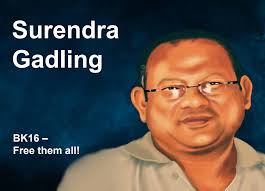
On June 6, lawyer Surendra Gadling completed eight years in prison. Arrested on this day in 2018, he was sent to the Yerawada prison in Pune, and then, in February 2020, he and other prisoners, accused in what has come to be known as the Bhima Koregaon case, were transferred to Taloja jail following the handing over of the case to the NIA. Out of the 16 accused in this case, he is the sole one still to be released.
Whilst he was given bail in the Bhima Koregaon case by the Bombay High Court, he is awaiting the outcome of the plea in the Supreme Court for what has come to be known as the Surajgarh arson case.
इरोनिकाल्ली, he has been held under the draconian Unlawful Activities Prevention Act (UAPA for almost a decade, considering that he is a foremost lawyer in it and other anti terror laws. He is someone whose expertise in this very field has helped secure the release of thousands of Dalits and Adivasis unfairly imprisoned as alleged Maoists.
During his three decade long career before his arrest, he came to be viewed as a formidable figure in court with his ability to argue cases in TADA, POTA, UAPA, the Scheduled Caste and Scheduled Tribes (Prevention of Atrocities) Act. His legal acumen helped in the acquittal of those held under these laws. He also took up cases of fake encounters, dowry deaths and was involved in securing justice for those who protested against the barbaric Khairlanji caste murders in 2006.
Among the high profile cases he had taken up, before his own arrest, were those of Dr G N Saibaba, the wheelchair bound professor, who spent about seven years in jail before acquittal. Tragically and cruelly Saibaba died just a few months after his release.
Hem Mishra , the student activist, who was also arrested along with Saibaba, recalled in a social media post how Gadling is not just his lawyer but a true People’s Lawyer. He has been a tireless champion for political prisoners taking up the cases that very few dare to do so.
Growing up in the humble Dalit neighbourhood of Indora in Nagpur, Gadling became influenced by the radical politics of the seventies during his college years, recalls Sudhir Dhawale, his fellow student and also co accused in the case. Both of them played an important role in the Namantar or movement to rename the Marathwada University after Bababasaheb Ambedkar and were also witness to the huge atrocities inflicted on Dalits. They drew heavily on the cultural activism fostered by the folk forms of Maharashtra where street plays and ballads have been intertwined with resistance and revolution.
It is perhaps this element of performative tactics in the courtroom that made Gadling a much admired and popular lawyer. People and juniors flock to the court whenever he argues a case. I was witness to some of his passionate and humorous arguments whilst pleading for various issues related to his own case during the proceedings. But whether it was for the right to a chair, or access to medical care, Gadling’s purpose has been clear. It is to shine a light on the conditions in jail and urgent need for reform.
In Pune, in the early days of the arrests, a bunch of lawyers from Punjab turned up in court to show solidarity with him. Similar shows of solidarity have come from lawyers from Delhi, Telangana, Kerala and Kolkata.
When the court in Bombay did not allow visitors because of the pandemic, it was a moving sight to see a group of lawyers standing outside the building in support of their mentor.
His feisty spirit and ability to deploy the cultural forms of protest that has been an intrinsic part of his journey of resistance, was demonstrated when he was released on temporary bail in 2021. The court allowed him to conduct rituals for the first anniversary of his mother’s death. He had been denied permission by the NIA Special court to attend the funeral in 2020. Donning his lawyers’s suit he headed for the Nagpur sessions court and outside he sang a song written by co accused Ramesh Gaichor, an activist of the Kabir Kala Manch. The song ingeniously weaves in the privation in prisons and denial of basic amenities.
Ek duree chhe by doh seh … the area allotted to each prisoner becomes the space for satire with the comment that this is the “aish” or comforts that prisoners enjoy in popular imagination.
One of the significant features of life in Taloja jail, as narrated by the Bhima Koregaon prisoners is the way they collectively demonstrated cultural activism through poetry and special song sessions at night. The various members housed in various floors of the building would take up songs and sing in unison.
A poignant illustration of how though caged the spirit sings. ….
A brilliant lawyer and human rights defender has spent almost a decade in jail. The trial has not even begun. The Supreme Court must act speedily to release him as urged by hundreds of civilians, legal bodies and international human rights defenders.