
India’s GDP increased by 7.6% in 2025–26, making it the fourth largest in the world. The tale of what happened to its most marginalized workers during and after the pandemic was quietly buried somewhere in those headlines.
At a press briefing after the 10th Governing Council meeting on May 24, 2025, NITI Aayog CEO B.V.R. Subrahmanyam declared that India had overtaken Japan to become the fourth-largest economy in the world, with its GDP surpassing $4 trillion. At a public gathering in Gandhinagar a few days later, Prime Minister Narendra Modi reiterated the achievement and declared that India had surpassed Japan. As of February 2026, India was referred to by the Ministry of Finance as “a global bright spot.” India’s real GDP increased by 7.6% in 2025–26, up from 7.1% in 2024–25, according to MoSPI’s Second Advance Estimates, which were published in late February 2026. Nominal GDP growth was 8.6%. The recovery narrative was complete. The growth story was intact. However, more importantly, the specific, measurable, and unresolved damage that the pandemic caused to India’s Scheduled Caste and Scheduled Tribe informal workers is what no Budget speech, no NITI Aayog press briefing, and no IMF projection are intended to show.
An analysis of seven rounds of nationally representative Periodic Labour Force Survey data from 2017–18 to 2023–24, covering over 769,000 informal workers, makes this visible in numbers that the celebration of fourth-largest-economy status was never designed to accommodate. The macroeconomic recovery is real. The recovery of SC and ST workers within India’s informal employment hierarchy is not.
The unequal distribution of damage
The 68-day lockdown announced on March 24, 2020 did not fall on India’s workforce uniformly. The highest share of job losses immediately after the lockdown was among SC workers – the largest share of any social group. This was not coincidental. The prevalence of casual wage labour is almost three times higher among SC men and women workers compared to other category workers, and the percentage of salaried workers is lowest among STs, closely followed by SCs. When the economy shut down, the workers with no contracts, no savings, no social security, and no right to paid leave – disproportionately SC and ST – had nothing to fall back on. Six months after the lockdown, one in five persons was still out of work, average monthly per capita income was around 10% lower than pre-pandemic levels, and earnings for those who had found work were approximately half of what they had been before.
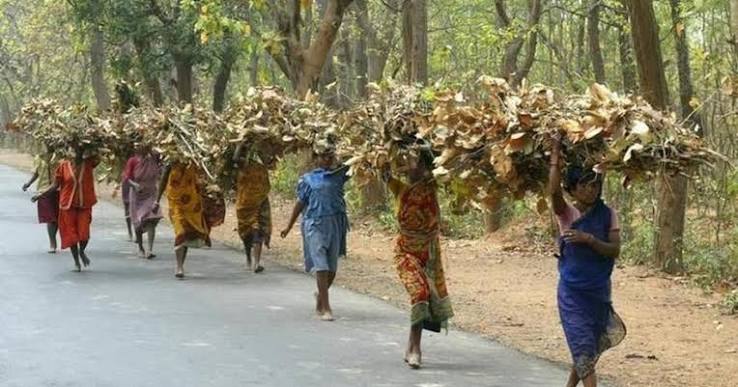
Agriculture, always the employer of last resort in India, absorbed the shock. SC and ST workers who had spent years transitioning out of agricultural and casual labour – a movement that represented real, hard-won progress – reversed course during the pandemic and returned to the lowest-return forms of work available. This reversal was not merely a temporary shock. It was a structural regression.
The Numbers That Viksit Bharat Does Not Count
The PLFS data show that the concentration of ST workers in lower-return informal employment – the most precarious tier of the informal economy, covering casual labour, own-account work without employees, and jobs simultaneously lacking contracts, paid leave, and social security – rose from 67.2% in 2017–18 to 87.7% in 2023–24, a deterioration of 20.5%. SC concentration rose from 77.0% to 82.5% over the same period. The sharpest deterioration in both cases occurs between 2019–20 and 2021–22, precisely straddling the pandemic and its immediate aftermath.
In comparison, by 2023–24, the concentration of General category workers in lower-return informal employment settled at 74.6%, a smaller increase that demonstrated a considerably greater recovery after the pandemic. Over the course of the study, the caste gap in the concentration of lower-return informal employment widened and did not appear to be reducing by 2023–24. Genuine post-pandemic difference manifests itself in the particular employment conditions of individuals who had the least cushion when the crisis struck, rather than in the overall situation. India has the fastest-growing major economy in the world, but it also has a persistent employment crisis, making the macroeconomic celebration meaningless for millions of workers who are either unemployed or stuck in low-paying, precarious work.
According to the State of Working India 2023 report, intergenerational upward mobility has increased overall, though this trend is weaker for SC/ST workers compared to general castes – 75.6% of SC/ST men in casual wage work also had sons in casual wage work in 2018, compared to 86.5% in 2004. Some progress, then. But the same report noted that in 2021, 40% of SC workers were still in casual employment as compared to 13% of general caste workers, and only 22% of SC workers were in regular wage work as opposed to 32% of general caste workers.
India has an elaborate architecture of minimum wage legislation. In practice, the ILO’s finding that seven in ten casual construction workers were paid below minimum wage in 2022 – two years after the Code was passed – is a measure of how comprehensively the enforcement infrastructure has failed the workers the legislation was designed to protect. And the workers most concentrated in casual employment, most exposed to minimum wage violations, and least able to enforce their legal entitlements are SC and ST workers.
The Recovery Narrative as Political Choice
The decline of India’s most marginalized informal workers post-pandemic has not become a national conversation for a reason. While nominal GDP increased by 8.6%, India’s real GDP growth for 2025–26 is estimated at 7.6%, higher than the 7.1% reported in 2024–25. These are aggregate headline figures. They don’t disaggregate by caste. They do not demonstrate how workers who were never in lower-return informal employment in the first place have disproportionately benefited from the rise in India’s services sector, which accounts for more than 54% of nominal GVA in 2025–26. The national income accounts were not designed to show this. However, the problem does not go away just because it is not visible.
According to civil society analyses of Budget 2026–27, despite a nominal increase in SC/ST allocations, the majority of funds are still underutilized, non-targeted, and inaccessible to the communities they claim to support. Additionally, allocations for schemes and programmes that specifically target the needs of these communities have decreased, despite their increasing vulnerability. Budget 2026–2027 did not include any funding for the promised girls’ hostels for each district, which are essential safety infrastructure for SC and ST women looking for urban employment. These are not marginal decisions. These choices are made within the context of a recovery narrative that views macroeconomic growth as evidence that the marginalized have benefited, even while employment data indicates otherwise.
Way forward
Even though the action itself calls on political will, which has not yet been there, the case for action is not complicated. First, the government must start measuring the things it says it cares about. Researchers can separate employment quality metrics by caste using PLFS data, although caste-disaggregated employment quality metrics are not frequently included in official policy documents, budget allocations, or scheme evaluations. Until they do, even though the deterioration in SC/ST lower-return informal employment concentration is evident in the data, the policy process will not be able to see it.
Second, it necessitates a sincere commitment to enforcing minimum wages in casual labour markets as an administrative function that is funded, staffed, and monitored rather than as a legislative aspiration. The strength of the Code on Wages 2019 depends on how well it is enforced. According to the ILO’s documentation, the infrastructure is currently failing the workers who most need its protection.
Third, and perhaps most importantly, it necessitates an honest accounting of what post-pandemic recovery actually entails for the 87.7% of Scheduled Tribe informal workers and the 82.5% of Scheduled Caste informal workers who, by 2023–24, were concentrated in the least secure, least paid, and least protected forms of work. A Viksit Bharat based on aggregate GDP figures that ignore the lived experiences of its most marginalized workers is not a developed India, as the India Forum has argued, and a vision of development that does not specifically address ingrained inequality cannot claim to be inclusive. At the heart of this large economy is a profoundly unanswered social question.
In 2025–26, India’s real GDP increased by 7.6%. That is true and it matters. With growth rates of 7.2% and 7.1%, respectively, in 2023–24 and 2024–25, the economy has demonstrated consistent performance, and reaching the fourth-largest economy milestone is a true accomplishment. However, there is a story that the recovery narrative is not designed to convey somewhere between that accomplishment and the 87.7% of Scheduled Tribe informal workers who are concentrated in the most precarious forms of available work. The pandemic did not merely disrupt India’s labour market. No headline GDP figure or budgetary allocation that comes five years too late can claim to have saved its most marginalized workers from a state of precarity.
By Siddharth Jogdand and Aneesh K A
Siddharth Jogdand is an intern at the Centre for Studies in Population and Development (CSPD), CHRIST (Deemed to be University), Delhi NCR Campus. Email ID: siddharth.sunil@bscemh.christuniversity.in
Dr. Aneesh K A is Assistant Professor of Economics & Fellow at the Centre for Studies in Population and Development (CSPD), CHRIST (Deemed to be University),
Courtesy : Counter Currents
Note: This news is originally published on https:/countercurrents.org/bha and is used purely for non-profit/non-commercial purposes, especially human rights