
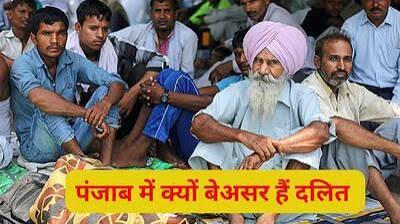
Despite constituting a third of Punjab’s population, why is Dalit politics weak? Let’s explore the reasons…
In states like Uttar Pradesh and Bihar, Dalit politics has always held sway. Whether it’s previous generation leaders like Kanshi Ram, Ram Vilas Paswan, and Mayawati, or newer leaders like Chandrashekhar Azad and Chirag Paswan, these leaders have a strong appeal, and this has led to significant Dalit votes in Bihar. However, this is not the case in Punjab, one of the country’s leading states in terms of Dalit population. It has been a matter of curiosity for people across the country as to why this community is not at the center of politics in a state with a 32 percent Dalit population.
Not only this, Dalits are also in a weak position in terms of education, social influence, and economic status. Their participation in the Punjab government’s cabinet has also been low. 96.6 percent of Dalits in Punjab do not own any agricultural land. Nearly 60 percent of these people follow the Sikh faith, yet they are considered untouchables and face discrimination. The state has a total of 117 assembly seats, and 34 of these seats are reserved for Dalits. The number of Dalit MLAs in the assembly is crucial for any government. Yet, they have never ruled Punjab.
This is because their population is divided among various castes, and there is also a divide between Hindus and Sikhs. While Dalit votes are divided, Jat Sikhs have a strong hold on the social system in Punjab. This is because they control most of the agricultural land. They also have a strong hold on various institutions and rural systems, including gurdwaras. Bhagwant Mann’s cabinet includes five Dalit leaders: Harpal Singh Cheema, Dr. Baljit Kaur, Lalchand Kataruchak, Ravjot Singh, and Mohinder Bhagat. This figure represents 27 percent of the total 18 ministers in the cabinet.
The previous Congress government had three ministers. However, it is also a fact that Charanjit Singh Channi was made the Chief Minister, becoming the state’s first Dalit Chief Minister. The Akali-BJP government that lasted until 2017 also had three Dalit ministers. Channi was subsequently appointed Chief Minister by the Congress in 2022, but this failed to significantly bolster the Dalit vote. He received only 31 percent of Dalit votes, while the AAP secured 38 percent. Punjab lost the Congress under the leadership of Charanjit Singh Channi, the only Dalit Chief Minister, and even now, he is in no position to be considered the leader of the Punjab Congress in the upcoming elections.
While the Jat community constitutes only 22 percent of the population in Punjab, they have a significant representation. Interestingly, the BSP originated in Punjab, and Kanshi Ram was also a native of the state. However, the BSP has never been very strong in Punjab. Dalits here have primarily voted for different parties. These include the Congress, the Akali Dal, and now the Aam Aadmi Party. The BSP received less than 2% of the vote here in 2022.
Why Dalits lack political dominance despite constituting 32% of the population?
Although the Dalit population in Punjab is 32%, they own only 3.5% of the total land. According to the Punjab Village Common Land Act of 1964, one-third of the land belonging to the village community is reserved for Dalits. However, this provision remains only on paper and has not been properly implemented on the ground. Due to landlessness, the development of Dalits has been hampered. 73% of Dalits living in villages are landless. Furthermore, due to lack of land, their income is low, and unlike other communities, their children are not able to go abroad. This is because they have limited means of earning. It is also true that while the Sikh faith advocates equality, casteism is a reality here as well. They are denied entry into Gurudwaras established by Jat Sikhs or other upper castes. According to a study, Dalits who converted to Sikhism have established 10,000 Gurudwaras and Ravidas Deras. This is to ensure autonomy, at least in religious matters. Furthermore, a large number of Dalits are also converting to Christianity.
Dalits in Doaba are a different story, with children also migrating abroad.
While the situation of Dalits is weak in most parts of Punjab, the situation in the Doaba region is different. There are many villages here where the Dalit population ranges from 40 to 65 percent. Exposure to urban life and employment have strengthened their position. Furthermore, a significant number of Dalits from here have migrated abroad. This has allowed them to maintain a strong position despite the decline in farming. However, this has little impact on electoral politics, as the Dalit community is divided along caste and religion lines.
Courtesy: Hindi News