
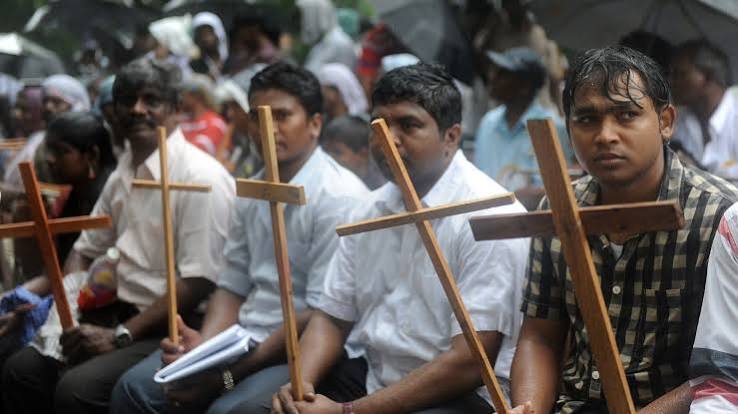
A Dalit burial dispute highlights persistent discrimination dividing Indian believers in pews and pulpit.
When A. Raju died July 17 in the southern Indian state of Tamil Nadu, a three-day standoff over his rights as a Dalit held up his burial.
As the family of the 89-year-old Catholic grieved, higher-caste Christian groups objected to having him laid to rest in their village’s common Catholic cemetery. With police keeping watch as tensions rose over the dispute, local authorities and church leaders negotiated with the groups for permission to bury Raju there. Bishop Jeevanandam Amalanathan said the protestors—which included fellow Catholics—were “vociferous” in their opposition.
Authorities finally forced opponents to step aside and allow Raju’s burial at the half-acre cemetery. But the dispute has sparked sharp reactions from across Catholic, Protestant, and evangelical groups, shedding light once again on the reality of caste divisions among Indian Christians.
“If we do not shed caste affiliations even after accepting Christ, we should be ashamed of being called Christians,” Vincet Raj, a Pentecostal Christian from Tamil Nadu, told Christianity Today.
Dalits are at the bottom of the caste pyramid in India and historically have been denied the right to own land, pushed into sanitation and menial work, and forced to live outside villages. India counts roughly 201 million Dalits but includes only Hindus, Sikhs, and Buddhists in that number—excluding Christians and Muslims in its tally.
Long spurned by dominant castes, marginalized Dalits have embraced Christianity over the past century, drawn by its message of love and equality. Missionary efforts providing education, health care, and livelihood—as well as dignity and hope—have also drawn converts among the Dalits.
Even as people from various castes have embraced the gospel, Dalit Christians continue to face discrimination among fellow believers.
Pastors, church leaders, and Dalit activists told Christianity Today that although Dalits today account for at least 70 percent of India’s 28 million Christians, they are shut out of leadership and decision-making roles across Catholic, mainline Protestant, and evangelical churches.
In recent years, Catholics have tried to rectify the issue. Earlier this year, the Catholic Bishops’ Conference of India—which includes eastern Catholics such as those of the Syro-Malabar rite—elected Archbishop Anthony Poola of Hyderabad, the first Dalit cardinal, as its president. But Dalit representation in the church hierarchy remains thin: Of India’s 200 Catholic bishops, 11 are Dalits, even though an estimated 60 percent of the nation’s Catholics are Dalits.
Meanwhile, mainline Protestant and evangelical institutions lack the organizational structure to make similar changes.
“Caste permeates through both mainline and independent Protestant churches too, yet it is implicit and hush-hush,” said Richard Devadoss, president of the National Dalit Christian Watch. “Nobody talks about it; that doesn’t mean caste is absent here.”
Leaders associated with various mainline Protestant churches revealed, on the condition of anonymity out of fear of reprisal from church committees, that care is taken during the selection processes to ensure that a Dalit bishop or a priest is not posted to head a diocese or church where non-Dalits dominate the pews.
“In cases [where] that doesn’t work, either you [as a Dalit] are co-opted by the dominant caste congregants or face discrimination in subtler ways,” said a Dalit pastor from a prominent established church in Tamil Nadu where non-Dalits are in the majority. He serves the church alongside a non-Dalit pastor.
Although both pastors are required to participate in church growth meetings, outreach activities, budget planning, and organizing Christmas and other activities, he said the church committee doesn’t allow him to attend any of them. “It deeply pains me, but I have no option but to silently finish my tenure here,” he lamented.
In some extreme cases, Dalit groups also discriminate against each other based on subcaste loyalties. One church with nearly 500 worshipers in Andhra Pradesh State holds separate Sunday services for two Dalit subgroups, said Paul David, a Dalit Christian activist. The Malas, historically considered at the top of the Dalit socioeconomic ladder in the region, worship first—and then the Madigas gather for their own service.
“This is not a one-off case,” David said. “Many churches reflect hierarchy rather than Jesus’ core teaching of love and equality.”
In major urban centers, where independent, storefront charismatic churches with large numbers of new converts have exploded, the influence of caste is less acknowledged.
“That’s because caste gets camouflaged as class,” David said. Higher-caste church members typically benefit from more education and financial resources than lower castes. “Class—which goes by another name as resourcefulness and community feeling—is a byproduct of caste.”
Unlike in established mainline churches, high-profile pastors and their family members—who are from dominant castes—make all the decisions within the church.
Sagar, a Dalit who asked to use only his first name due to fear of upsetting his church, told CT that for four years, he has volunteered as an usher at a charismatic church in Hyderabad that draws thousands across three services every Sunday. He said people who have joined the church since he first arrived have moved into key roles supporting the celebrity pastor. Sagar continues to serve, but he has since concluded that other considerations beyond commitment to the church—such as caste—determine his role there.
Outside church, Dalit Christians are caught in a legal limbo. Dalit converts to Christianity cannot claim Scheduled Caste (SC) status under Indian law, which grants access to education and employment opportunities through affirmative action. The SC status is restricted to Hindu, Sikh, and Buddhist Dalits. For decades, Dalit Christians have campaigned to have that status extended to them as well, but to no avail.
“There is enough evidence to suggest that Dalit Christians experience the same marginalization” as Dalits from other faiths, said Emanual Nahar, professor and former chair of the Punjab State Commission for Minorities. “It is a long-pending issue, and the government must make SC status religion-neutral.”
From leadership roles in churches to securing places in graveyards, Dalit Christians are still reminded of their marginalized status. Advocates for the Dalit expressed hope that the Raju case would spur further progress toward ending discrimination within churches.
Before his burial became the latest point of contention over Dalit rights, Raju had fought for equal funerary rights for all Catholics, irrespective of caste, in his village’s cemetery. He launched a legal battle in 2014 with four others that was resolved 10 years later, when Tamil Nadu’s top court ruled in their favor. But that didn’t stop dominant-caste residents from trying to defy that ruling in July.
Charismatic and evangelical pastor in India “often talk about servant leadership,” Sagar said. “What it means is that we are the servants and they are the leaders.”
Vikram Mukka
Courtesy : Christianity Today
Note: This news is originally published on https:/christianitytoday.com/bha and is used purely for non-profit/non-commercial purposes, especially human rights