
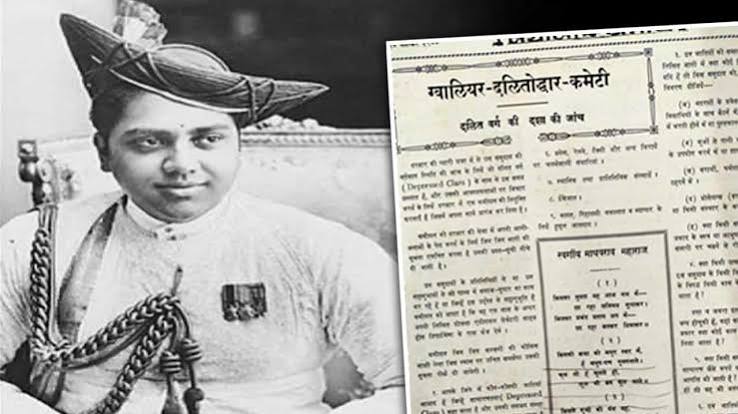
Before independence, the Scindia dynasty of Gwalior granted Dalits equal rights to temples, schools, wells, and public ghats. The 1945 order provided for action against those who discriminated.
Before India’s independence and the formation of the Constitution, many princely states across the country undertook social reform initiatives that transcended their time and laid the foundation for equality and social justice. Among these, the Scindia dynasty of Gwalior’s contribution is particularly noteworthy. The Scindia dynasty not only took important decisions to free the Dalit community from social discrimination, but also took steps to ensure equal rights in education, entry to religious sites, and the use of public facilities.
- Dalits were granted equal access to temples, schools, wells, and public ghats, including the right to ride horses and palanquins, and to wear whatever clothing they desired.
- 11 schools and three free hostels were established for the education of tribal children, and special schemes were also launched for the upliftment of the Bhil and Bhilala communities.
On May 4, 1945, the then Maharaja of Gwalior State, Jivajirao Madhavrao Scindia, issued a historic declaration explicitly recognizing the rights of the Dalit community. This declaration stated that those considered untouchables or Harijans in the then social system, like other citizens, were entitled to all the fundamental rights to which they were born. The significance of this decree is further enhanced because at that time, in many parts of the country, the Dalit community was denied basic social rights such as entry into temples, drawing water from public wells, studying in schools, and even riding a horse or palanquin.
Equal rights from temples to schools, with penalties for discriminators
Maharaja Jivajirao Scindia’s May 4, 1945, proclamation granted the Dalit community the freedom to wear clothing and jewelry, use modes of transportation of their choice, follow marriage customs, and access public spaces. The proclamation clarified that Dalits would be able to use wells, canals, river ghats, and state-run educational institutions. Furthermore, they were also granted the right to enter and worship in state-owned or state-managed temples, like other Hindus.
The most significant aspect of this proclamation was that it provided for punitive action under existing state laws against those who obstructed the exercise of these rights. This meant that social equality was not limited to mere ideals or preaching, but rather an attempt was made to link it with administrative orders and legal action.
11 schools and three free hostels for the education of tribal children
The contribution of the Scindia dynasty was not limited to Dalit upliftment. Significant efforts were also made for the education and social development of tribal communities. According to available historical records, by 1938, 11 schools and three free hostels operated for Bhil and Bhilala tribal children in the Gwalior State. In the Sheopur region, there were also schools and three free hostels for children from the Sahariya community.
In addition to connecting tribal children to education, plans were also developed to teach them practical and employable skills. Initiatives were taken to train Bhil and Bhilala children in handicrafts and crafts that would improve their daily lives and livelihoods.
Hostels were built for tribal children in Tanda and Bagh. A model school for tribal children was established on Pandav Gufa mountain in the Bagh area of Manawar Pargana under the supervision of the Forest Department. Scholarships were also provided to students. Furthermore, efforts were made to understand the problems of communities through tribal conferences and to establish a Panchayat system in villages.
Formation of a Commission for Social Reform
There is also historical mention of the formation of a commission to study the conditions of backward and disadvantaged communities in the Gwalior State. Its objective was to assess the actual circumstances, problems, and needs of these communities. The commission sought suggestions from representatives of the concerned communities and those involved in social reform work. They were invited to submit their written proposals to the Additional Secretary of the Home Department. This initiative demonstrates an effort to advance social reform at an institutional and administrative level, rather than solely through individual efforts.
The Gaekwad Maharaja of Baroda assisted Baba Saheb Ambedkar in higher education.
While discussing the social reforms of the Scindia dynasty, the contributions of other Maratha princely states are also noteworthy. Maharaja Sayajirao Gaekwad of Baroda provided significant support to social reform pioneers like Mahatma Jyotiba Phule and Dr. Bhimrao Ambedkar. On April 4, 1913, Maharaja Sayajirao Gaekwad and the young Bhimrao Ambedkar had a very close relationship. Ambedkar was provided financial assistance and scholarships for higher education. With this support, he pursued further studies at Columbia University in the United States. This support is an important example for understanding the importance of social justice and education in Indian history.
The Legacy of the Maratha Princely States in the Advancement of Social Equality
At various times, the princely states of Maratha rulers such as the Scindias of Gwalior, the Gaekwads of Baroda, and the Bhonsles of Kolhapur spearheaded efforts for social reform and the upliftment of marginalized communities. These initiatives must be viewed in the context of the prevailing social conditions, when caste discrimination was a significant challenge in Indian society.
The 1945 declaration of the Gwalior princely state is particularly significant because it explicitly recognized the rights of Dalits in religious, educational, and public life. The provision of schools, hostels, and scholarships for tribal children also paved the way for social empowerment through education.
The Indian Constitution later established equality, freedom, and social justice as the foundation of the country’s democratic structure. However, such initiatives undertaken in various princely states before independence bear witness to the growing awareness of social change even before the Constitution was enacted. This historical chapter of the Scindia dynasty not only chronicles the achievements of a dynasty, but also commemorates the efforts made during that period for social equality, education, and human dignity.
Edited By: Varun Chauhan
Courtesy: Scindia Research Centre