
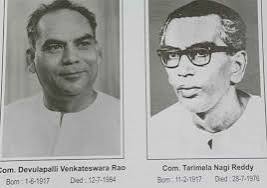
DV Rao, while dealing with politics of caste and casteism, commented on Dalit Panther movement (founded in 1972 May by Namdeo Dhasal, Raja Dhale, JV Pawar and others) and wrote on it way back in March 1974 issue of Proletarian Path, a journal published for sometime from Kolkata (then spelled as Calcutta) and edited jointly by DV Rao and Moni Guha.
The article is of historic interest and importance at a time a new book (see cover page below) appeared 50 years after the dalit panthers appeared. In the context of assertions by some people that communists ignored the caste question, and in the background of some confessions made by some communists, including those of ML groups, this article draws attention to what com DV Rao wrote more than half a century ago, much before the subaltern and identity movements entered India.
In fact, DV Rao discussed the related issues ever since his earliest available writings of 1946, during the Telangana struggle (1939-51 Oct) days. So did com T.Nagi Reddy (1917-1976 July 28), whose 50th death anniversary was observed in the two Telugu states recently. Several articles on these two comrades and their revolutionary contributions were published and archived by the countercurrents.org (See at the end of this article).
The latest book is titled:
Dalit Panther : The Truth Underlined by Arjun Dangle
( Translated from the original Marathi by Maya Pandit, Rs 990.
Published by Orient Blackswan Private Limited, 2026… 3-6-752 Himayatnagar, Hyderabad, Telangana 500 029, India. .. info@orientblackswan.com).
The blurb of the book says:
The Author Arjun Dangle is a major writer of the Dalit literary, socio-cultural and political movements in Maharashtra. He was a founder member of the the Dalit Panthers, and later was also the president of the State Unit of the Bharatiya Republican Party of India. His published works include Dalit Sahitya: Ek Abhyas (1978), his poetry collection Chhavani Halte Ahe, which won the Maharashtra State Award in 1978, and the edited volumes of translations from modern Marathi Dalit literature, Homeless in My Land (1992) and Poisoned Bread (2009).
About the movement it says:
Led by powerful writer-activists such as Namdev Dhasal, J. V. Pawar, Raja Dhale, Bhai Sangare, Avinash Mahatekar and Arjun Dangle, the Panther mounted a fierce challenge to the casteist political and literary establishment of Maharashtra, while sharing solidarity with the struggles of workers, women and farmers. In documenting this history, Dangle also revisits the enduring debate on the relationship between the Dalit movement and the Left, and between Ambedkarism and Marxism.
A Review of the book by scholar-activist Dr Anand Teltumbde is cited toward the end of this article.
DV Rao (1917 June -1984 July 12) discussed the caste question and dealt with atrocities against dalits from his earliest available writings of 1946. DV called for militant resistance against the same as an inseparable part of the agrarian revolution, which includes the struggle for abolition of landlordism and for distribution of land to the tiller. The dalit question is inseparable from the land question, without which it remains merely formal and verbal.
Words such as ‘Harijans’ and ‘Negroes’, it may be noted, were common in the political literature of those days, including this article of 1974, replaced later by the words ‘dalit’ and ‘Blacks’. The full text of the article, with its title, is given below (all emphases added).
*** ***
Dalit Panther movement and atrocities of landlords against the down-trodden
That the Indian society is stinking with caste divisions from time immemorial is a fact beyond dispute. That the religions and social reformist movements, which claimed and still claim preaching equality between one and all, failed to dismantle these divisions is also a fact which cannot be disputed. Therefore, a new approach is needed to solve the problem.
That there is a need to carry out an intense ideological struggle against the caste system cannot be denied by any one, who is for abolition of the system. Casteism intensifies caste division. A social reformist movement has some form of casteism as its content, or else it reduced itself into an idealist talk. Therefore, a revolutionary ideology is needed to fight it to the finish.
Caste system, a survival of slavery and feudalism, is linked with the present-day political system in India. Though the Constitution provides equality for all citizens, economic inequality (capitalist and labour, landlord and landless) i.e., legal and social inequality is practised.There is a law prohibiting untouchabi’ity, but it is practised. In the name of providing facilities, existence of scheduled and backward classes is legalised. All the parliamentary parties have their own share in encouraging casteism for the sake of votes, representation in parliament and legislatures, jobs and other facilities etc. To expect abolition of casteism from such parties is nothing sort of hoping against hope. On the other hand, a revolutionary power, which enforces the abolition of caste system with all the force at its command, can alone do away with it.
Behind the ideological-political frame work, there is the economic foundation of semi-slavery and semi-feudal relations in our country. The overwhelming majority of rural and urban poor, in which agricultural labour, poor peasants and industrial labour are included, come from certain castes in which the so-called Harijans ( ‘untouchables’ ) constitute considerable number. The landlords and the urban rich come from certain castes, in which poor and middle classes form a major part, as the rich is always smaller in number. There are some rich persons, though small in number, from the former category of caste, which are legally called as backward and scheduled castes.
The backbone of the casteism consists of this upper strata of society which is exploiting it for its ends, political as well as economic. Therefore abolition of landlordism is the first essential task to root out the caste division and untouchability. Hence the need of an agrarian revolution.
Not a day passes when we do not see the news of a landlord or a group of landlords harassing, torturing and killing the agricultural laborers and poor peasants in general, and untouchables and adivasis in particular. Not a single state is an exception. Such incidents are often described as atrocities committed by upper castes on the so-called lower castes. True, the landlords, by using their political power and economic domination, are able to divide the poorer strata. They are able to use the poor of the upper castes—often their own castes—for the purpose of committing such atrocities. Though the element of casteism is present in all these classes, they are essentially the atrocities by the landlords on the rural poor.
It is easy for the landlords to crush the resistance by the poor, as the former have arms while the latter have no arms and are disorganized. To characterise the clashes as inter-caste rivalries is to divert the attention of the people from the agrarian revolution for which conditions are matured.
The latest event, which has drawn the attention of the entire people in our country is the resistance put up by Dalit Panthers against the police and the poorer strata of upper castes in Bombay. Maharastra is the birth place of Dr. Ambedkar who has fought against untouchability in his own way, with the help of social reformist movement. He advised his followers to adopt Buddhism as their religion which is opposed to caste-division. A sizeable section has readily agreed and adopted it. They are called new-Buddhist. The Republican Party consists of Dr. Ambedkar’s foilowers. As a parliamentary party, it has become a victim of opportunism and careerism which the ruling Congress Party could utilise to split it so that it is no longer a force to reckon with. A section of the younger generation has organised itself into Dalit Panthers on the pattern of Black Panthers in USA, which is a Negro movement against the racial discrimination practised by the whites in that country.
Dalit Panthers are for the unity of the oppressed, irrespective of caste or creed. They are putting up a militant resistance to the atrocities of the upper caste Hindus and the police, a major part of whose officer-cadre belongs to the former. They have boycotted the parliamentary elections in the Central Bombay. For this they have had to face the wrath of the Congress in the form of police repressions. These are welcome features of their policy. They are yet to clarify their attitude towards ruling classes and the democratic revolution.
Experience has shown that social reformist movements and statutory safeguards can never emancipate the oppressed castes as long as the present political system continues because it defends the foreign interests and their native agents among whom landlords occupy an important position. One must adopt a revolutionary programme and policy and unite with all revolutionary forces which are working for emancipation of the oppressed people, to achieve abolition of casteism.
Agrarian Revolution- forms the axis of Peoples Democratic Revolution in India, for which revolutionary communists are working. Agrarian revolution alone can emancipate the rural poor from landlordism.
A revolutionary working class movement uniting all the oppressed in the urban areas, irrespective of castes or creed will have a leading role not only for the emancipation of the urban poor but for agrarian revolution also. Untouchables, being the most oppressed and forming the major part of the poor, have a key role to play among the poor.
Ruling classes and their party Congress are not sitting idle with folded hands. They are wooing the leadership of the Dalit Panthers. They do desire to retain its reformist and caste character, while the overwhelming majority of the Dalit Panthers are for a revolutionary line. This demands vigilance on their part against the machinations of the ruling party.
All the parliamentary parties have their own share in encouraging casteism for the sake of votes, representation in parliament and legislatures, jobs and other facilities etc. To expect abolition of casteism from such parties is nothing sort of hoping against hope.
They (Dalit Panthers) must unite with the revolutionary forces, which are working in our country.
The first and foremost task of the revolutionaries in India, is to organise these oppressed sections into a revolutionary movement and unite with them wherever they are organised on the basis of genuine anti-imperialist, anti-landlord programme. Revolutionaries will not only oppose but organise resistance against all sorts of oppression either by the upper strata or upper castes and help the oppressed (to) realize that the path of the emancipation lies in the path of revolution.
*** ***
Both comrades DV Rao and T.Nagi Reddy discussed the caste issue and dalit oppression in their writings, as also in their court statements of 1971.
The above article was written in 1974. We can today see, more clearly than ever, how this wooing by the ruling classes, which DV Rao mentioned in 1974, increasingly enticed and entrapped the later-day Ambedkarites, in UP, Maharashtra, Bihar, Jharkhand, Tamilnadu etc., who joined hands with forces they called as reactionary and brahminical. BSP joined hands not only with Congress but also with BJP in UP, more than once. RPI factions, as well as some successors of Dr. BR Ambedkar, joined hands alternatingly with Congress-led UPA as well as NDA led by BJP, and are working under PM Modi too. Some of them even merged into BJP. Ram Vilas Paswan and Manjhi of Bihar were typical opportunists. Udit Raj is another. Even some leaders from Dalit Panthers joined chauvinist, rabid ‘Hindutva tigers’ of Shiv Sena. Both the Congress and BJP played Hindutva card in relation to reservations that were extended to converts into Buddhism and Sikhism, but denied to those who converted to Christianity or Islam. Some Ambedkarites fell in line and opposed reservations for such converted dalits.
In such a context, one can examine DV Rao’s suggestions for unity among genuine forces on both sides.
*** ***
DV Rao contemplated the need for proletarian dictatorship in relation to casteism.
DV Rao was well aware of the deep roots of casteism. Even while he narrated experiences of unifying oppressed masses and revolutionary classes, dalits, adivasis, as well other rural poor, through revolutionary movements and struggles, with agrarian revolution as the principal task, he saw the possible need for the use of revolutionary state power when, in the same passage, he wrote:
“On the other hand, a revolutionary power, which enforces the abolition of caste system with all the force at its command can alone do away with it….”
*** ***
Scholar-activist Anand Teltumbde wrote a Review of the book, captioned,
Dalit Panthers: Beyond the Battle of the Founders, published by The india forum, JULY 06, 2026.
“ For readers unfamiliar with the period, it offers an invaluable introduction to one of the most remarkable episodes in post-Ambedkar politics; for those who lived through those years, it revives memories of an extraordinary political moment..
“Arjun Dangle’s memoir of the Dalit Panthers attributes their decline to personality clashes b/w founders. But the deeper crisis was structural: an inherited political culture of personalised authority, doctrinal Ambedkarism, and weak democratic structures that equality movements struggle to overcome,” he wrote in the review.”
Teltumbde points out:
“The Panther manifesto was intellectually bold: it expanded the category “Dalit” to encompass all oppressed and exploited people, drawing simultaneously on Ambedkar, Marxism, anti-caste radicalism, and Third World liberation struggles. It sought to transcend the limitations of conventional Ambedkarite politics without abandoning its emancipatory core. It was the first serious attempt to rethink Dalit politics for a new historical moment..
“That this project faltered is the central fact. Explaining why requires going beyond personalities.”
Despite all their divisions, the ruling classes are united with the urge for power, Teltumbde notes,and adds: .
“Movements of the oppressed possess no such adhesive. Their cohesion must be consciously constructed through democratic structures, ideological clarity, and shared strategic purpose. Where these are weak or underdeveloped, personal rivalries quickly acquire organisational significance, leadership becomes personalised, factionalism proliferates, and fragmentation follows almost as a structural tendency rather than an accidental outcome.”
“Understanding their significance requires looking back still further. Towards the end of his life, Ambedkar recognised with increasing clarity that the constitutional safeguards he had fought to secure would primarily benefit a relatively small stratum of educated urban Dalits.
“ The overwhelming majority remained in villages as landless agricultural labourers trapped in relationships of economic dependence that constitutional equality alone could not dissolve. It was this recognition that led him to contemplate a struggle for land—a shift from the politics of representation to the politics of material transformation..”
However, most Ambedkarites remained grooved, as noted by Teltumbde, who stresses as below :
“ Yet such economic struggles were routinely viewed with suspicion within Ambedkarite circles—communist terrain, not Dalit terrain—and the politics of dignity increasingly overshadowed the politics of material transformation.”
“Whenever Dalit mobilisation moved towards questions of land, labour and economic redistribution, it acquired an expansive social character capable of forging wider alliances among the oppressed.”
(For full text of the review, visit:
https://www.theindiaforum.in/. )
*** ***
It is in this background, DV Rao’s message, rooted in Telangana peasant armed struggle, assumes all importance:
“The backbone of the casteism consists of this upper strata of society which is exploiting it for its ends, political as well as economic. Therefore abolition of landlordism is the first essential task to root out the caste division and untouchability. Hence the need of an agrarian revolution.”
By MA Krishna
Courtesy : Counter Currents
Note: This news is originally published on https:/countercurrents.org/bha and is used purely for non-profit/non-commercial purposes, especially human rights