
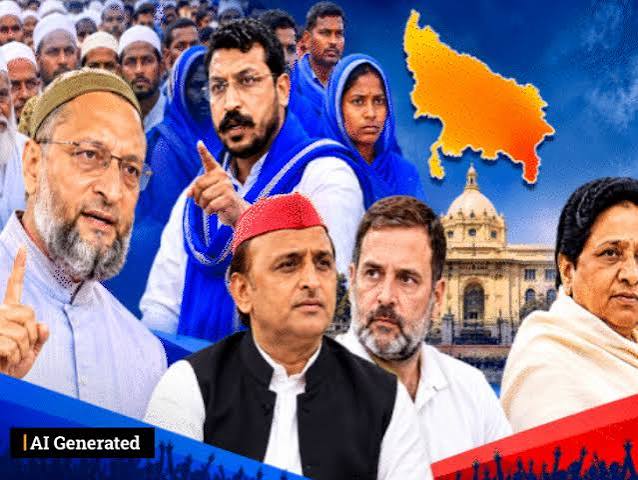
A fresh attempt to consolidate Dalit and Muslim voters is taking shape in Uttar Pradesh ahead of the 2027 Assembly elections. The newly formed alliance between Asaduddin Owaisi and Chandrashekhar is also based on this electoral strategy.
With BSP chief Mayawati’s political influence weakening, sections of the Dalit community are looking for new leadership. Although the BSP has expressed confidence in repeating its 2007 electoral performance, it has so far failed to inspire confidence even among its core voters.
The BSP is hoping for a turnaround through the rally scheduled for December 6 to mark the death anniversary of Dr BR Ambedkar. Meanwhile, Chandrashekhar is trying to fill the political space left by the party’s declining influence through his Azad Samaj Party (Kanshi Ram).
Jatav voters are also moving away from Mayawati
In the 2017 Assembly elections, the BSP secured 87% of Jatav votes and 44% of non-Jatav Dalit votes. The voting pattern changed in 2022. Among Jatavs, 65% voted for the BSP, 9% for the SP, 20% for the BJP and 1% for the Congress.
Among non-Jatav Dalits, 40% voted for the BJP, 27% for the BSP, 23% for the SP and 4% for the Congress.
This showed a shift in Dalit voters’ preferences within just five years. Between the two elections, the BJP gained the support of 22% of Jatav voters and 17% of non-Jatav voters, as indicated by the figures.
The 2024 Lok Sabha elections brought another shift in Dalit voting patterns, driven by the narrative that the Constitution was under threat.
Around 56% of Dalit votes went to the INDIA bloc, while the NDA secured 29% and the BSP 15%. The impact of the SP’s PDA (Backward Classes, Dalits and Minorities) formula was also visible.
However, the BSP remained the leading choice among Jatav voters, securing 44% of their votes. The INDIA bloc received 25%, while the NDA got 24%. This indicated that even among Jatavs, parties other than the BSP had begun finding support.
In effect, 20% of Jatav voters and 11% of non-Jatav voters who had supported the BJP moved towards the SP-Congress alliance within two years. This shift helped the SP-Congress alliance bridge a gap of 70–80 lakh votes and move ahead in Uttar Pradesh.
Muslim voters remain firmly aligned with the SP
In the 2022 Uttar Pradesh Assembly elections, around 79% of Muslim voters supported the Samajwadi Party (SP), while the BSP received 6% and the Congress 3%. In the 2024 Lok Sabha elections, 92% of Muslim voters backed the SP-Congress alliance.
This indicates that a large section of the state’s Muslim electorate has rallied behind the parties seen as the main challengers to the BJP.
Senior journalist Harshvardhan Tripathi says Muslim voters in Uttar Pradesh tend to unite behind the candidate they believe has the strongest chance of defeating the BJP nominee. This varies from constituency to constituency, but the INDIA bloc is currently their preferred choice.
He adds that in Muslim-majority constituencies, the presence of several Muslim candidates could lead to some division of votes, but the split is likely to be marginal and may not significantly affect the election result.
Muslim votes can influence outcomes in SC-reserved constituencies
Around 80% of Uttar Pradesh’s Muslim population is Sunni. In several of the state’s 84 Scheduled Caste (SC)-reserved Assembly constituencies, Muslim voters play a decisive role.
In seats such as Nagina, Purqazi, Dhanaura and Nohjhil, candidates may belong to the Dalit community, but the outcome can depend on the 35–40% Muslim electorate.
Like Mayawati, Chandrashekhar belongs to the Jatav community. Jatavs account for around 12% of Uttar Pradesh’s Dalit population. There are five reserved constituencies where Jatav voters make up more than 25% of the electorate.
Their share stands at around 33% in Agra Cantt, 31% in Rampur Maniharan, 28% in Chunar, 28% in Saharanpur Dehat and 25% in Rasoolabad, making them an important factor in these constituencies.
Owaisi and Chandrashekhar face the challenge of bringing Dalit and Muslim voters together
The biggest challenge for Asaduddin Owaisi and Chandrashekhar will be to consolidate Dalit and Muslim voters behind their alliance. Chandrashekhar will need to strengthen his political base among Dalit youth, particularly within the Jatav community.
Owaisi, meanwhile, will have to challenge the SP’s strong hold over Muslim voters. If Chandrashekhar manages to attract a section of Jatav voters along with non-Jatav Dalits, the BSP’s support base could weaken further. A split in Muslim votes, on the other hand, could affect the SP-Congress alliance.
Owaisi and Chandrashekhar are planning to demonstrate their political strength through a joint rally at Lucknow’s Ramabai Ambedkar Park on November 26.
Their message is that Dalits, who account for 21% of the state’s population, and Muslims, who make up 19%, can come together to choose their own government.
Projecting Chandrashekhar as the alliance’s chief ministerial face is also an attempt to attract Dalit voters. Sources indicate that AIMIM’s Uttar Pradesh president, Shaukat Ali, could be projected as the alliance’s deputy chief ministerial face at the rally.
Senior journalist Siddharth Kalhans believes the Owaisi-Chandrashekhar alliance could affect the INDIA bloc’s electoral prospects. He points out that in the 2022 Assembly elections, 114 constituencies recorded victory margins of fewer than 10,000 votes.
Of these, the BJP won 63 seats and the SP 41. In 10 constituencies, the winning margin was less than 500 votes.
Congress’s declining core vote base strengthened the SP and BSP
The Congress last came to power in Uttar Pradesh with a full majority in 1985, winning 269 seats. Although the party remained part of coalition politics in the years that followed, it never regained the strength to form a government on its own.
Until 1989, the Congress’s core voter base comprised Dalits, Muslims and Brahmins. However, the Ram Janmabhoomi movement and the OBC reservation agitation in the 1990s led to a shift in these voting groups.
Brahmin voters moved towards the BJP, Dalits gravitated towards the BSP, while OBC voters increasingly backed the Samajwadi Party.
Muslim voters, meanwhile, began rallying behind whichever party they believed had the best chance of defeating the BJP, depending on the political circumstances.
Author: Santosh Singh
Courtesy : Bhaskar English
Note: This news is originally published on https:/bhaskarenglish.com/bha and is used purely for non-profit/non-commercial purposes, especially human rights