
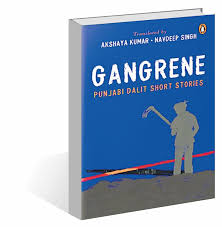
‘Gangrene — Punjabi Dalit Short Stories’ is a ready compendium to understand the psyche of both Punjabi Dalits and their oppressors
The works of poets such as Kabir, Ravidas and Namdev have resonated for centuries, but it is only recently that Dalit literature has come to occupy centre stage. With the rise of subaltern studies, literature has developed many a niche segment, where hitherto invisible or suppressed groups have asserted their literary presence. Dalit writing, particularly under the influence of Marathi pioneers like Babasaheb Ambedkar and Namdeo Dhasal, started showing its prowess some 60 years ago, and has now become an irrepressible voice in almost all states of the country.
Punjab has a very large presence of Dalits and an equally large body of Punjabi Dalit literature, yet not much has been translated so far to give it readership beyond Punjabi. The anthology ‘Gangrene’ offers for the first time a set of 12 stories in English to fill that gap.
Translated by Akshaya Kumar and Navdeep Singh, the book comes with an elaborate introduction that gives an insight into the development of Punjabi Dalit writings as well as the dynamics of Dalit narratives of exploitation, discrimination and oppression. The translators claim that in contrast to progressive writers’ narratives of the poor and the underprivileged, these stories by Dalits themselves explore more authentically their lived experience.
Veracity apart, the stories in the collection stand out for the diversity of experience, both in terms of physical and mental trauma, as perceived by Dalits and as enacted by their oppressors. If there are stories like ‘Cry of the Sky’, ‘My Story’, and ‘Everybody’s Story’, in which crimes like rape and violence against Dalits are portrayed, then there are also stories like ‘Doomsday’, ‘Cancer’ and ‘Cactus’, where the dominant caste characters have been shown to harbour deep-seated hatred, but not without giving us a peep into their mental and emotional conflict.
The stories are equally divided between rural and urban settings. If the vehra (Dalit colony in a village) is the site of open disdain and exploitation by Jats and other village heads, then the city is an equally inhospitable place where Dalits, even after education and economic progress, cannot live without hiding their identity.
A cobbler’s son will remain a cobbler’s son and a Dalit rising up to become a landlord will find trust and strength only in his own community, as in the story ‘Gaurjan’.
Religion, the much-touted causa prima of the caste divide, figures in three stories — ‘Gangrene’, ‘Doomsday’ and ‘Roots’. Though Hindu Brahmins’ attitude towards Dalits is well known, in these stories, even Dalits who converted to religions like Sikhism and Buddhism find no respite.
One muted theme that runs through almost all the stories is that for a Dalit, there is no escape from being a Dalit. Even if they try to override it with professional progress, pecuniary leap or physical prowess, the Dalit identity does not leave them. It will continue to lead them to misery and humiliation.
I particularly liked two stories: ‘Bathloo’ and ‘Aatu Khoji’. Both are proud and professionally skilful workers, yet one ends up dead because of his sense of internalised lowliness, and the other in an effort to save Dalit honour.
The book is a ready compendium to understand the psyche of both Punjabi Dalits and their oppressors. At times, it also portrays the Dalit reaction where violence and highhandedness of the dominant caste are met with equal aggression. But the stories largely remain clueless about how the conflict can be reduced or resolved.
The book is translated well despite the usual intrusion of local terms here and there. It is going to prove to be a good resource material for comparing the Punjabi Dalit experience with other regional writings, particularly in Marathi and South Indian languages.
Article_Author Gurupdesh Singh
Courtesy : The Tribune
Note: This news is originally published on https:/thetribune.com/bha and is used purely for non-profit/non-commercial purposes, especially human rights