
Most of the families living in the Bhusur Kocha settlement belong to the Nayak community, which falls under the Scheduled Caste (SC) category in Jharkhand. Many of the families living here are originally from Gumla. Their ancestors came to work decades ago and later settled in this area.
Ranchi: Recently, the district administration launched an anti-encroachment drive in the Bhusur Kocha settlement near Birsa Chowk in the city to remove settlements built along the main road from DPS School to Birsa Chowk Highway in the Bhusur area. During this, several houses were demolished, leaving the poor families living there homeless. The encroachment removal drive has left many Dalit athletes who won medals for Jharkhand in national and state-level competitions while living in these huts.
However, amid public protests following this action, the Jharkhand High Court ordered an immediate halt to the anti-encroachment drive on September 18th. The court directed the Ranchi Deputy Commissioner and Senior Superintendent of Police to halt the ongoing action. The court also gave the alleged encroachers until December 31st to vacate the government land on their own.
Geographical Context
Hearing the case, Justice Anand Sen’s bench stated that, given the upcoming festival season, any immediate action by the administration should be postponed. Following the High Court’s intervention, the bulldozing operation has been halted, but the residents will have to vacate the settlement within three months.
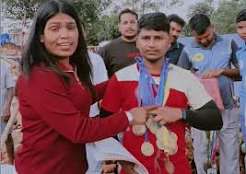
The medals and certificates scattered among the dilapidated huts here tell the story of the children who, despite poverty and limited resources, brought glory to Jharkhand and the country in the sports arena. But after the destruction of dozens of families from the Nayak community during the encroachment removal operation, these athletes now face the challenge of both advancing in their sports and maintaining their homes.
This settlement has produced approximately seven to eight national-level and over 12 state-level athletes. These include kho-kho players Shivam Nayak, Ayush Nayak, and Rohan Nayak, as well as mallakhamb player Rakesh Nayak and national player Anushka Lohara.
The athletes’ medals and certificates, standing amid the slum’s dilapidated houses, bear testimony to their achievements. But with the very homes from which they achieved these accomplishments destroyed, they now face the challenge of survival and continuation of their sports.
A settlement settled for 50-60 years, now questions about the future
Most of the families living in the Bhusur Kocha settlement belong to the Nayak community, which falls under the Scheduled Caste (SC) category in Jharkhand. Many families living here are originally from Gumla. Their ancestors came decades ago for labor and later settled in the area.
According to locals, many families had been living here for 50 to 60 years. Documents like electricity bills, Aadhaar cards, and voter ID cards also prove their long-standing connection to the settlement.
However, the administration demolished the houses, claiming the land belonged to the government and the HEC. This action has left many families facing a housing crisis. Following a court order, further demolitions are prohibited until December 31st. Consequently, the families living in the houses threatened with action are also in uncertainty.
Sunny Sharad of The Follow-Up visited the site and understood the plight of these athletes from the Nayak community. National-level Mallakhamb player Rakesh Nayak explained that he grew up in the sports world while living in this hut. He said, he represented Jharkhand in various competitions and won medals for the state.
Rakesh said, “I earned my name from this hut. My name was known everywhere, and so was Jharkhand’s name. But today the Jharkhand government has treated us unfairly.”
Rakesh, upset by the demolition of his house, said that the administration should have made arrangements for his accommodation before demolishing it. He said, “If they had provided him with housing before demolishing his house, and then demolishing it later, it would have felt somewhat like they had provided housing before demolishing it. He didn’t get even that.”
According to Rakesh, his family and other players from the slum have made a name for themselves in sports while living with limited resources. He said that approximately seven to eight national-level players lived in his hut, while the number of players playing at the state level was over 12.
Rakesh, a native of Gumla, said that his family has lived here since childhood. His ancestors came here in search of work and later settled here. Rakesh said that he started playing at the district level, then progressed to the state and national levels. His next goal was to play internationally. He said that he won over 15 medals at the national level and approximately 18 at the state level in his athletic career.
Kho-kho player Shivam Nayak is among those who began their careers in this slum and represented Jharkhand in various competitions. His medals and certificates demonstrate his achievements, but his house has also been demolished.
Shivam’s fellow Kho-kho player, Ayush Nayak, explained that his own house is currently intact, but it is also at risk of demolition. He said that he has been given three months to rebuild his house.
Ayush explained that the players in the slum whose houses have been demolished have also been struggling during the rains. If his teammates had come to stay at his house, he would have taken them in.
When asked where he would go if his house was also demolished, Ayush said, “If it gets demolished, we will stay here.”
Ayush also explained that he plays Kho-kho alongside his studies and has traveled to Rajasthan and Bokaro for competitions. At present, he has not received any information about any assistance from the government.
This action has affected not only the players but also their families. Shivam Nayak’s mother sits on the threshold of her ruined home. The biggest question before her is where the family will live now and what will be her son’s sporting future.
She explained that the family worked hard to make their son an athlete with the hope that he would progress and improve the family’s situation. She said, “We made him with thought. What should we do now?”
According to Shivam’s mother, she has lost her job and lost her income. She explained that Shivam was supposed to play in a competition next month, but after the destruction of their home, they now face the challenge of raising the money to send him.
She said that she doesn’t even know exactly where her son was going to play, but he did tell her that he was going next month.
This situation highlights the difficulties faced by families for whom children’s sports are not just a means to win medals but also a hope for a better future.
The issue of athletes being rendered homeless in the Bhusur Kocha slum comes at a time when Jharkhand Chief Minister Hemant Soren, during a review of the Sports Department, stated that no athlete should be forced to sell vegetables on the roadside.
Earlier, the issue of athletes’ financial situation and employment came to the fore after reports emerged of international throwball player Amardeep Kumar and three-time gold medalist para-athlete Pushpa Minj selling vegetables in Ranchi. Following these reports, the state government directed the state government to take steps to provide athletes with financial assistance and employment under the sports policy.
However, the athletes in Bhusur Kocha face a different situation. They face not only financial difficulties but also the challenge of finding shelter and continuing their sports.
National-level athlete Radhika Nayak also visited the slum and met with the affected families. She said she came to inquire about the athletes’ plight after seeing videos on social media.
Speaking to The Mooknayak, Radhika Nayak, a former national-level athlete, expressed concern over this situation, saying that the children living in Bhusur Kocha have won medals at the national and state levels despite playing in extremely difficult conditions, but no concrete measures have been put in place to support them.
Ethnicity and Identity Groups
Radhika herself is a former athlete. However, due to poor financial circumstances and family constraints, she was forced to abandon the team sport of football and pursue individual sports like javelin and discus throw. However, due to lack of resources for training, Radhika was unable to participate in competitions and is now preparing to become a sports coach. She says this is why she understands the plight of these children more closely.
She said that she couldn’t help but see the plight of the children who brought glory to Jharkhand and the country through their sports while living in slums, after their homes were destroyed.
Radhika cited the Chief Minister’s statement that athletes should not be forced to sell vegetables. She questioned why no minister or MLA came to their aid when the players were drenched in the rain and their houses were destroyed.
Letter to Minister of State for Defense Sanjay Seth
Radhika stated that, considering the plight of the affected players and children, she has also written a letter to Minister of State for Defense Sanjay Seth, requesting assistance.
Merit Awards and Competitions
She says that the families whose houses have been destroyed are facing immediate housing problems, and the players face the challenge of continuing their training and participation in competitions. Radhika wants the government and public representatives to recognize these children’s achievements and provide them with special assistance and rehabilitation.
She said, “These children should not be left behind just because they come from poor families. It is important to preserve their talent.” She added, “My hero, this is a grave injustice to society. We will not sit silent.” Radhika spoke about standing with the affected athletes and raising their issues. She appealed to Bahujan leaders, especially Azad Samaj Party chief Chandrashekhar Azad, to visit Bhusur Kocha and meet these children.
“Come here and see these children. They have won so many medals. Living in such difficult circumstances, they are bringing glory to the country and their community, yet they are receiving no help.”
Medals, certificates, and household items scattered among the dilapidated huts of Bhusur Kocha highlight a paradox: athletes who have brought glory to the state are struggling to find a place to live in their own city. For these athletes, the question now is not just about winning the next medal, but also about living under a safe roof with their families and progressing in the world of sports.
Geographical Context
Summary
The Jharkhand High Court’s order has certainly given some time to the families whose homes are currently under the action. But for families whose homes have already been destroyed, the question remains: where should they go now?
And for athletes whose medals still tell the story of their broken homes, there’s another question: Will anyone reach into the rubble of their homes to save their talent?
Geetha Sunil Pillai
Courtesy: Hindi News