
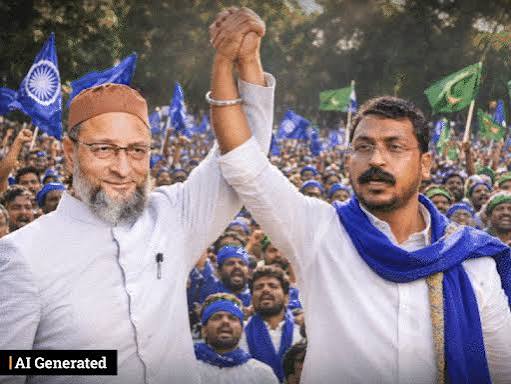
Uttar Pradesh politics has long revolved around three major political forces. However, after the decline of the Bahujan Samaj Party (BSP), the last two Assembly elections have largely seen a direct contest between the BJP and the Samajwadi Party-led opposition.
Now, the alliance between Chandrashekhar Azad, national president of the Azad Samaj Party (Kanshi Ram), and Asaduddin Owaisi’s AIMIM has brought a new player into the race for the 2027 Assembly elections. The alliance has named Chandrashekhar as its chief ministerial face. He has emerged as a popular leader among Dalit youth.
The two leaders will hold a joint rally at Lucknow’s Ramabai Maidan on November 26, Constitution Day. The rally is expected to give an idea of their support on the ground.
The big questions are who will benefit from this alliance, who could lose votes, and how much impact it will have on the Dalit-Muslim vote combination.
Chandrashekhar has emerged as a known Dalit leader
Azad Samaj Party chief Chandrashekhar has become a well-known name among Dalit voters. In the 2024 Lok Sabha elections, he won the Nagina seat without an alliance with any other party. Nagina has a large Muslim population.
Chandrashekhar has been raising Dalit issues across the country, and he enjoys strong support among Dalit youth.
He is also trying to attract voters who have traditionally supported the BSP. As the BSP’s influence has weakened, Chandrashekhar is trying to fill the political space left behind by the party.
So far, his party has announced 87 Assembly constituency in-charges in two phases. Although all its candidates lost their security deposits in the 2022 Assembly elections, Chandrashekhar’s victory in the 2024 Lok Sabha elections has made it difficult for other parties to ignore him.
Owaisi trying to build support among Muslim voters
AIMIM chief Asaduddin Owaisi’s influence among Muslim voters is well known. The large crowds at his eight rallies in Uttar Pradesh so far suggest that many Muslim youngsters see him as an important leader.
Owaisi has also tried to connect with Muslim voters through his statement, “Ab Abdullah dari nahi bichhayega” (Abdullah will no longer lay the carpet). The statement was aimed at encouraging Muslims to demand a stronger political role.
Muslims make up around 19% of Uttar Pradesh’s population. If they unite behind the alliance, Owaisi may be able to repeat the kind of success his party achieved in Bihar.
The alliance could have an impact on 40-41 seats in western Uttar Pradesh, where Muslims account for more than 50% of voters.
AIMIM showed its strength in Muslim-majority areas in 2023 civic polls
AIMIM may not have made a major impact in the 2024 Lok Sabha elections in Uttar Pradesh, but it performed well in the 2023 civic elections.
In Meerut, the party’s mayor candidate, Mohammad Anas, received 1.28 lakh votes and finished second. The BJP won the mayor’s post, while the Samajwadi Party came third and the BSP fourth.
AIMIM also won five posts of municipal president and town council chairperson. The winners were:
Asia Musheer from Sambhal.
Mohammad Musheer from Sikandra Rao in Hathras district.
Ghazala Tabassum from Ghatampur in Kanpur district.
Zeenat Mehdi from Kundarki Nagar Panchayat in Moradabad district.
Imran Khan from Thiriya Nizamat Khan Nagar Panchayat in Bareilly district.
The party also won 75 councillor and member seats in different urban local bodies. In Meerut alone, 11 AIMIM candidates won councillor seats, while nine others finished second.
AIMIM has identified 49 Muslim-majority seats
Although seat-sharing was not discussed when Chandrashekhar and Owaisi announced their alliance, sources said Owaisi had handed over a list of 49 Muslim-majority Assembly seats in Uttar Pradesh.
AIMIM has put forward its claim on these seats.
Dalit-Muslim combination could give the alliance strength
AIMIM and Chandrashekhar’s Azad Samaj Party have come together to form the Samajik Parivartan Morcha. Their main focus is on bringing Dalit and Muslim voters together.
According to the figures mentioned in the analysis, Dalits make up around 21% of Uttar Pradesh’s population, while Muslims account for around 19%.
Owaisi belongs to the Sunni Muslim community and the Ashraf group, which is considered an upper or socially influential section among Muslims. Around 80% of Muslims in Uttar Pradesh are Sunni.
Of the state’s 84 Assembly seats reserved for Scheduled Castes, there are several where Muslim voters can play an important role in deciding the winner.
Seats such as Nagina, Purkazi, Dhanaura and Nahataur have a large number of Muslim voters. Although candidates contesting these seats belong to the Dalit community, the result often depends on Muslim voters, who account for around 35-40% of the electorate in these areas.
Chandrashekhar, like BSP chief Mayawati, belongs to the Jatav community. Jatavs account for around 12% of Uttar Pradesh’s population.
There are five reserved seats in the state where Jatav voters make up more than 25% of the electorate. These include:
Agra Cantonment: 32.64%
Rampur Maniharan: 30.78%
Chunar: 28.02%
Saharanpur Dehat: 27.78%
Rasulabad: 25.27%
The Jatav vote can play a major role in deciding the results on these seats.
Who stands to gain and who could lose?
Senior journalist Siddharth Kalhans believes the alliance between Owaisi and Chandrashekhar could directly hurt the INDIA bloc.
He said both leaders are trying to attract voters who are currently being targeted by the INDIA bloc. In the 2024 Lok Sabha elections, many non-Jatav Dalit voters who moved away from the BSP supported the Samajwadi Party, while a section of Jatav voters shifted towards the Congress.
Kalhans believes Muslim votes may not split significantly. However, the alliance could make a difference on seats where the winning margin is small.
He also said the BJP is unlikely to suffer much because of this alliance. According to him, Samajwadi Party chief Akhilesh Yadav’s statement that the alliance could hurt the NDA was an attempt to create a political narrative. The BSP could also lose some of its support.
114 seats had a winning margin of less than 10,000 votes in 2022
In the 2022 Uttar Pradesh Assembly elections, there were 114 seats where the difference between the winning and losing candidates was less than 10,000 votes.
The BJP won 63 of these seats, while the Samajwadi Party won 41.
On 15 seats, the winning margin was less than 1,000 votes. In 10 of these seats, the result was decided by fewer than 500 votes.
The BJP and its allies won nine of these 15 seats, while the Samajwadi Party alliance won six.
Chandrashekhar may not emerge as a major political force in the 2027 elections, but the election could help his party move closer to becoming a recognised state-level party.
To get state-party recognition, a party needs to win at least three Assembly seats and secure at least 6% of the total votes.
‘BJP could benefit from a split in opposition votes’
Senior journalist Siddharth Kalhans said the alliance between Chandrashekhar and Owaisi could lead to three-way or four-way contests in Dalit-Muslim dominated seats.
“He believes the BJP could benefit the most from such contests. If opposition votes are divided among different parties, the BJP’s chances of winning these seats could increase,” he said.
Santosh Singh | Lucknow
Courtesy : Bhaskar English
Note: This news is originally published on https:/bhaskarenglish.com/bha and is used purely for non-profit/non-commercial purposes, especially human rights