
“Kanshi, your noble earnings, you awakened the sleeping community.” This slogan gave political voice to Dalit consciousness. But sometimes, more than the noise, someone’s silence is disturbing. This is the situation of the Dalit community regarding the BSP’s silence.
“Kanshi, your noble earnings, you awakened the sleeping community.” This slogan gave political voice to Dalit consciousness. But sometimes, more than the noise, someone’s silence is disturbing. This is the situation of the Dalit community regarding the BSP’s silence. The party that fought for them under the leadership of Kanshi Ram, teaching them the lessons of existence and identity, is today silently witnessing its own decline. Today, BSP supporters may be thinking, “Mayawati, your leadership has sunk the BSP party.” The BSP and Dalit politics in Uttar Pradesh must be viewed in this light.
The election atmosphere in Uttar Pradesh politics has once again heated up. Caste-based mobilization is once again gaining momentum. But this time the picture is a little different. Traditional voters of all parties are in a moral and political dilemma. The BJP is trying to appease its upper caste voters, angered by the UGC Act and neglect. The Samajwadi Party is striving to win back OBC and Muslim voters. The Congress is trying to regain lost ground. Some new players are also making their presence felt in the arena. Owaisi arrived as an electoral tourist, while Chandrashekhar, like a tourist guide, grabbed him and formed an electoral alliance.
BSP’s Ideology: The creation of a ‘new’ and ‘just’ social order is the cornerstone of BSP’s ideology. The formation of BSP as a political force helped redefine concepts of social justice. BSP’s history begins with Kanshi Ram. Ultimately, on April 14, 1984, Kanshi Ram founded the Bahujan Samaj Party (BSP) to provide a strong political platform for Dalits and backward classes. This marked a historic turning point in the caste-based identity politics of Uttar Pradesh and India. Initially, most leftist and progressive forces ignored the BSP, claiming that it had no other goal than winning political power. In fact, Kanshi Ram deliberately pursued a clear social agenda rather than adopting a conventional economic program. The BSP united all Dalits and the underprivileged under the category of “Bahujan,” raising the Ambedkarite slogan of “We have to become the ruling class.”
Who are the oppressed and the oppressors? The BSP advocated a single-point program: “Proportional representation for all groups in government, bureaucracy, and educational institutions.” The BSP defined Dalits as a “community of oppressed and humiliated masses” who could be liberated not merely through material benefits but by achieving “their own” political power. While poor Dalits were deprived of both social respect and political representation, poor Brahmins felt politically marginalized. It became clear that the “Bahujan” category itself suffered from internal contradictions. In particular, OBCs were facing a political crisis. A large section of the OBCs (Other Backward Classes), including Yadavs, Kurmis, and Lodhs, has gravitated toward the Samajwadi Party and the BJP. Today, these communities are at the forefront of violence and atrocities against Dalits. In rural areas, economic and social conflicts between land-owning OBC castes and landless Dalits have weakened the concept of “Bahujan unity.”
The emerging OBC peasant class continued the culture of Shudra dominance and oppression, as they too sought to take advantage of the cheap labor force. In post-colonial India, Dalits were still left at the mercy of upper castes and land-owning peasant intermediate castes. Thus, Uttar Pradesh society witnessed a new “class of oppressors.” Furthermore, sub-caste divisions within Dalits (e.g., Jatav/Chamar versus non-Jatavs like Pasi, Valmiki, Dhobi, etc.) began to emerge, leading to fragmentation in Dalit politics. During this evolutionary phase of identity politics in Uttar Pradesh, the BSP lacks the political maturity to formulate a roadmap for long-term Dalit politics.
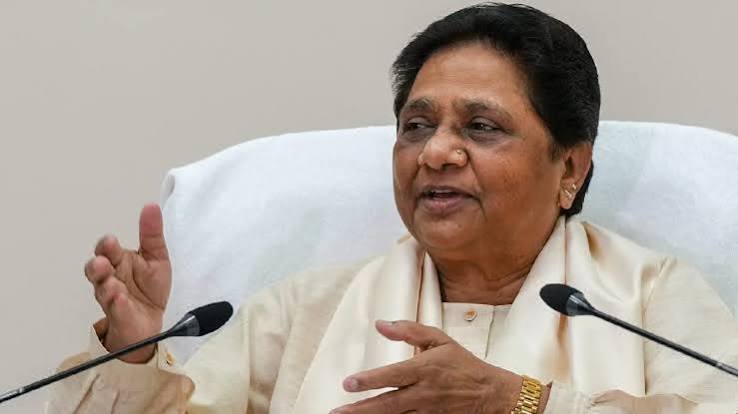
Questions about Mayawati’s leadership: In terms of leadership style, Mayawati has emerged as the party’s sole and undisputed supreme leader after Kanshi Ram. Any decision within the party, be it ticket distribution, coalition formation, or ministerial appointments, is ultimately taken by Mayawati. Critics often criticize her style as “dictatorial” or “personality cult,” as she has not allowed any independent second-line leadership to develop within the party. However, from the Dalit community’s perspective, Mayawati’s centralized and rigid leadership symbolizes their pride and security. However, her silence for a decade has left Dalit voters confused.
Dalits in the political psyche: Dalits vote for their caste for both symbolic and substantive reasons. This is certainly why Dalit voters are attracted to the BSP. But in the current electoral situation, if Mayawati fails to deliver any material benefits, they will stop supporting her. Chandrashekhar could directly benefit from this. This is where the question of identity arises, and therefore, it provides political parties and activists, including the BJP, SP, and Congress, with an opportunity to capitalize on the delicate and uncertain nature of identity politics. – Ravi Rameshchandra
Courtesy: Hindi News