
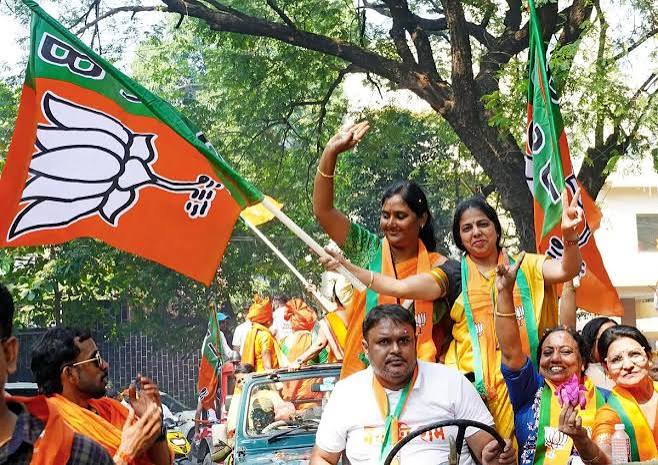
Lucknow: In a move aimed at strengthening its presence among Dalits ahead of key electoral battles in Uttar Pradesh and Punjab, the BJP on Tuesday launched its ambitious ‘Samrasta Yatra’ from Varanasi. UP Chief Minister Yogi Adityanath and state BJP president Pankaj Chaudhary flagged off 131 urns carrying soil from Dalit icon Sant Ravidas’s birthplace at Seer Govardhanpur in Varanasi, is being seen as an attempt to strengthen the party’s influence among Dalit communities in UP while making significant political inroads in Punjab.
The yatra, which began on Guru Purnima, will continue for six months until February 20, 2027, making it one of the BJP’s longest social outreach campaigns. Although BJP national president Nitin Nabin was scheduled to attend the launch, his visit was cancelled at the last moment.
Of the 131 urns, 75 will be distributed across villages and hamlets in UP, while the remaining will be sent to other states, with Punjab receiving special attention.
Political observers believe the campaign’s impact could be more pronounced in Punjab than in UP. Sant Ravidas enjoys deep reverence among Jatavs, one of the largest Dalit communities, and Dalits constitute nearly 34% of Punjab’s population. In UP, Dalits account for around 21% of the population and hold significant electoral influence through 84 Assembly constituencies reserved for scheduled castes.
However, the BJP faces challenges in attracting Jatav voters in UP. Despite its efforts and also by the SP-Congress alliance and Chandrashekhar Azad’s Azad Samaj Party to consolidate their support, a large section of Jatavs continues to remain aligned with the Bahujan Samaj Party (BSP). Analysts say this leaves limited room for the BJP to make rapid gains among the community in the state.
Punjab presents a different political landscape. Though BSP founder Kanshi Ram hailed from Punjab and began his political journey there, the party has struggled to establish itself as a major electoral force in the state. The vacuum has allowed national and regional parties to compete for Dalit support, making the BJP’s Sant Ravidas outreach politically significant.
Within UP, party insiders say the campaign reflects a broader strategy to strengthen ties with Dalit communities. BJP leaders are reportedly working on literature and outreach programmes centred on Dalit icons as part of preparations for the 2027 Assembly elections.
The urgency stems from the BJP’s performance in the 2024 Lok Sabha elections, when sections of its traditionally supportive non-Jatav Dalit base, including Valmikis, Sonkers and Pasis, drifted away from the party. The SP-Congress alliance made significant gains, with the Samajwadi Party winning 37 seats and the Congress six, while the BJP’s tally dropped sharply from 62 to 33 seats in the state.
Political observers attribute part of this shift to the Congress-SP alliance, while SP leaders argue that sustained grassroots engagement and the emergence of Dalit leaders within the party helped reduce long-standing mistrust among Dalit voters toward the SP.
SP insiders say the party plans to further expand Dalit representation in the 2027 Assembly polls and may field Dalit candidates even from general seats where electoral conditions favour such a move.
The political importance of Sant Ravidas’s birthplace has steadily grown over the years. Prime Minister Narendra Modi attended Ravidas Jayanti celebrations in 2016 and 2019 and visited the temple again in 2023. Congress leaders Rahul Gandhi and Priyanka Gandhi, AAP chief Arvind Kejriwal and former Punjab chief minister Charanjit Singh Channi have also paid visits in recent years.
The site’s political symbolism dates back to 1997, when then chief minister Mayawati attempted to develop a grand park at Sant Ravidas’s birthplace. The proposal, however, faced local resistance and could not be completed. Nearly three decades later, the temple and Sant Ravidas’s legacy remain at the centre of competing political efforts to win over Dalit voters.
Courtesy : TOI
Note: This news is originally published on https:/timesofindia.com/bha and is used purely for non-profit/non-commercial purposes, especially human rights