
Brahmin girl marries a dailt boy in the Chapay village of Bihar
Purnia: Riya Goswami, 18, from Bihar’s Purnia district, wanted to marry a boy of her choice. She had little idea that the family with whom she had spent eighteen years would perform her last rites for marriage outside her caste.
“I, too, wanted to marry someone I lived with. But parents often intimidate their children by threatening to kill them if they marry outside their caste. That is why we are forced to take such a step,” said Riya. She entered into an inter-caste marriage with Milan Paswan, 23, evoking resistance from her family, which performed the girl’s last rites.
“Parents fight for the sake of caste and society, but they fail to consider their own daughter,” rues Riya.
Brahmin Girl Marries Dalit Boy
Riya, the Brahmin girl, married Milan from the Paswan community in the Chapay village in the Gangeli Panchayat under the Maranga police station area of Purnia. According to Riya, she and Milan married at the Purnia court on September 9. A few days later, without informing her family, Riya left for her in-laws’ home with the boy and after searching for her, her family filed a complaint with the police. The police subsequently recovered the girl and had her statement recorded in court under Section 183 of the Bharatiya Nagarik Suraksha Sanhita. According to her family, Riya stated in the court that she wished to go with Milan.
Family Carries Out Funeral Procession
After the marriage of Riya with Milan, villagers convened a Panchayat meeting in the Chapay village, where members of the boy’s side were asked to return the girl. Her family explained that Milan used to visit their home and was a good friend of Riya’s brother. As the boy would visit the family, love developed between the two following which they decided to marry.
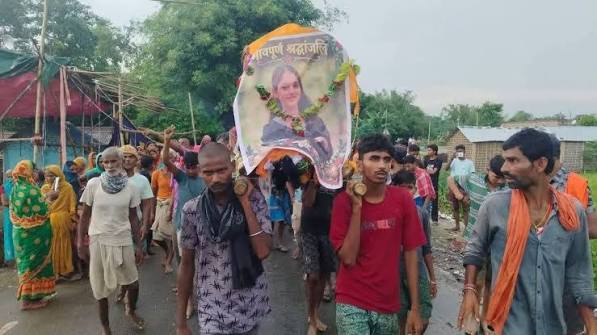
Following the marriage, the family fashioned an effigy of the daughter, decorated a funeral bier, took out a procession, and performed her last rites. A large number of villagers were present during the proceedings. Riya’s parents also announced throughout the village that their daughter was now dead. “My daughter has left. For us, she is dead now. Her last rites have been performed. We are Brahmins. In our community, accepting water from that household is forbidden. If someone in our society does something like this, this is the inevitable consequence. If we don’t do this, we would have to leave the village. Tell me, how would we live here then?,” asked Raja Ram Goswami, the girl’s grandfather.
The girl’s father, Manoj Goswami, stated that on the night of September 9, around midnight, his daughter left home with Milan—who lives about 100 meters away—and contracted a court marriage. He said that they would no longer have any ties with the girl.
Subsequent rituals, including the “Nakhabal” (hair and nail trimming), “Dashvi” (tenth-day ritual), and “Terahvi” (thirteenth-day ritual), would be performed in accordance with traditional customs, the family said.
Girl Gets Emotional
Following the marriage, Riya remains miffed with her parents. “If parents simply asked their children if they liked someone, why would we take such a step? That is why I no longer have any relationship with my parents; my in-laws are my family now, I have no one else in the world,” she said.
As she spoke, tears welled up in Riya’s eyes. “I am pursuing a BA degree, and I do not believe in the caste system; casteism does not exist. I am very happy today.”
Not Afraid Of Society
When asked if he feared society, Milan said, “Society won’t run my household or earn a living to feed me. So, I don’t care what people think.”
Milan’s father, Dilip Paswan, said, “The villagers were pressuring us, but both the boy and the girl insisted they wanted to be together. They said they would die if they couldn’t get married. So, we agreed. Now, we will treat Riya as both a daughter-in-law and a daughter.”
Courtesy : ETV Bharat
Note: This news is originally published on https:/etvbharat.com/bha and is used purely for non-profit/non-commercial purposes, especially human rights