
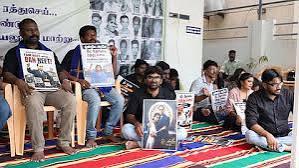
A group of hunger strikers in Chennai are on an indefinite fast, demanding a complete ban on the National Eligibility-cum-Entrance Test (NEET) and demanding that education be moved from the concurrent list to the state list. The protest, led by S Manirathinam — brother of the late S Anitha — is taking place at Thiruvaliur Illam in Koyambedu, even as nationwide student protests that forced the resignation of Education Minister Dharmendra Pradhan have been called off.
The Ban NEET Movement – Tamil Nadu released an official statement hailing Pradhan’s resignation on July 25 as “the triumph of the people and the principles of democracy over an autocratic government.” The movement, which describes itself as fighting for a “deeply unequal and corrupt education system,” acknowledged the symbolic weight of the resignation but warned that it brings “no concrete change” for students.
The context for this achievement was a remarkable wave of student protests led by the self-styled “Cockroach Janata Party” (CJP), sparked by the leak of the 2026 NEET medical entrance exam paper.
The movement forced an unprecedented political concession in India: Dharmendra Pradhan became the first cabinet minister to resign due to social protests in recent history. In his resignation letter, Pradhan stated he stepped down “considering the situation” and to ensure that “anti-national forces should not take advantage,” urging students to focus on their studies.
Despite the victory in Delhi, the Ban NEET Movement insists the struggle is far from over. Their statement expresses deep disappointment that protests were dispersed before concrete policy changes were enacted. They have now escalated their campaign with an indefinite hunger strike, which began on August 1.
The movement states, “We have two demands. 1) The union government must ban NEET and allow states to evaluate medical college entrances on the basis of 12th standard/plus two marks. 2) The union government must move education from the concurrent list to the state list, allowing states to shape their own education policy. The strike will continue until these demands are met.”
The movement also invokes the memory of S Anitha, a student who died by suicide in 2017 after failing to secure a medical seat under the NEET system, a tragedy that has become a rallying cry for opponents of the exam.
The hunger strikers are drawing attention to the findings of the Justice AK Rajan Committee, a government-commissioned body in Tamil Nadu that studied the impact of NEET. According to the movement’s statement, the 2021 report provides “abundant proof” that NEET has had a devastating effect in the state.
The movement alleges that NEET reduces access for students from poor, rural backgrounds and those educated in government schools, drastically reduces access for SC, ST, and OBC students, has led to the suicide of almost 100 young Indians (most of them Dalits) who dreamed of becoming doctors, and forces students to depend on a “new ecosystem of costly private coaching centres,” making wealth a barrier to education.
The AK Rajan Committee, as reported by The Hindu, concluded that NEET is “anti-poor, anti-social justice and favoured students from affluent families” and those who could afford expensive coaching.
The movement has framed its struggle as a constitutional and federalist issue. They argue that NEET “prevents states of the Indian union from deciding how their own educational institutions are run and therefore stands in violation of the principle of federalism.”
This echoes the long-standing position of the Tamil Nadu government, which has consistently sought an exemption from NEET. The activists’ second demand — moving education from the concurrent list to the state list — is a fundamental restructuring of India’s federal system that would grant states the sole power to shape their education policies.
In their statement, the Ban NEET Movement is urgently reaching out to “all movements, political parties, unions, student organizations and individuals interested in protecting our democracy” to join them. They are calling for supporters to come to the protest site at Thiruvaliur Illam in Koyambedu, spread the word through social media, and organize solidarity protests across the country.
As the hunger strike continues, the movement’s stance poses a fundamental challenge to the Indian government. While the resignation of Dharmendra Pradhan is a major victory for the youth protest movement, the activists in Tamil Nadu insist that until NEET itself is abolished and states gain full control over education, the fight for a “democratic” and “equal” education system is not over.
By A Representative
Courtesy : Counterview
Note: This news is originally published on https:/counterview.com/bha and is used purely for non-profit/non-commercial purposes, especially human rights