
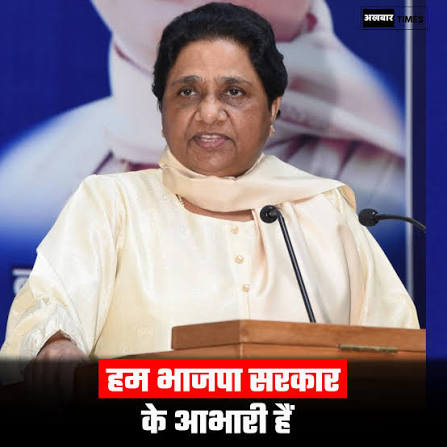
UP CM’s amazing kisses, Mayawati’s BJP support: Mayawati is a prominent figure in Uttar Pradesh politics. There are many stories related to her political life that are still discussed today. But there is one incident when the political equations changed in just one day and it took her to the position of Chief Minister of Uttar Pradesh. In 1995, after the alliance with the Samajwadi Party broke, the BJP supported Mayawati. On June 3, she took oath as Chief Minister and became the first Dalit woman Chief Minister of Uttar Pradesh. So, in ‘Amazing Stories of the UP CM’, read the entire fascinating story of Mayawati becoming the Chief Minister of Uttar Pradesh for the first time with the support of the BJP.
Mayawati’s First CM Story: Mayawati’s name needs no introduction in Uttar Pradesh politics. She has served as Chief Minister of Uttar Pradesh four times. But the most important milestone in her political journey was the year 1995, the year she became the Chief Minister of Uttar Pradesh for the first time. At that time, she was around 39 years old. Significantly, Mayawati’s government was formed with the support of the BJP. She took the oath of office as Chief Minister on June 3, 1995. With this, she became the first Dalit woman Chief Minister of Uttar Pradesh. This alliance between the SP and BSP had broken. Subsequently, with the support of the BJP, Mayawati’s path to power was paved. In this part of “Amazing Stories of UP CMs,” read the entire story in detail, when a Dalit woman became the Chief Minister of Uttar Pradesh with the support of the BJP, bringing about a major change in the state’s politics.
Mayawati Entered Politics with Kanshi Ram
Mayawati’s political journey was not easy. During her studies and employment in Delhi, she met Kanshi Ram. Kanshi Ram inspired her to enter politics. Mayawati then entered active politics with the Bahujan Samaj Party. Kanshi Ram founded the Bahujan Samaj Party in 1984. Mayawati gradually became a prominent face of the party. She began to be recognized as a vocal leader of the Dalit community, particularly in the Dalit community. Mayawati won the Bijnor seat in the 1989 Lok Sabha elections. After this, her name began to rise rapidly in national politics.
UP’s politics changed in 1993
Now the story turns to the 1993 assembly elections. At that time, the BJP had emerged as the dominant force in UP. However, Mulayam Singh Yadav and Kanshi Ram joined forces after the elections. The Samajwadi Party and the Bahujan Samaj Party formed a government together. Mulayam Singh Yadav became the Chief Minister, and Mayawati’s party became a partner in the government. However, this alliance between the two parties did not last long. Tensions between the two parties grew, and eventually the alliance broke.
A major political turning point occurred on June 2, 1995
In 1995, a development occurred in UP politics that captured national attention. Mayawati decided to withdraw support from Mulayam Singh Yadav’s government. This completely changed the power dynamics in the state. Mayawati staked claim to form the government, but she lacked a majority on her own. This is where the BJP came into play.
BJP Supports Mayawati
At that time, the Bharatiya Janata Party decided to support Mayawati. With the BJP’s support, the path was cleared for Mayawati to become Chief Minister. On June 3, 1995, Mayawati was sworn in as Chief Minister of Uttar Pradesh. She became the first Dalit woman Chief Minister of Uttar Pradesh. This was a historic moment in Indian politics. A Dalit woman’s rise to the top position of power in the country’s largest state was a major political event in itself.
Mayawati’s first term was short.
For the first time, Mayawati failed to remain Chief Minister for long. Her government, formed with the support of the BJP, lasted only about four months. In October 1995, her government fell. Following this, President’s rule was imposed in Uttar Pradesh. However, in these few months, Mayawati demonstrated such political strength that she later became one of the most prominent leaders in Uttar Pradesh politics.
The Politics of the BJP and the BSP Changed From Here
This experiment of 1995 was not only significant for Mayawati. It also marked the beginning of a political relationship between the BJP and the Bahujan Samaj Party. In the following years, the two parties formed several alliances. Sometimes Mayawati became Chief Minister with the support of the BJP, and sometimes the BJP supported her government. This alliance is considered one of the most interesting political events in Uttar Pradesh politics during that period.
Mayawati became Chief Minister four times again
After 1995, Mayawati became Chief Minister of Uttar Pradesh three more times. She also became Chief Minister in 1997. After this, her government was formed with the support of the BJP in 2002. However, in 2003, the BJP withdrew its support, and her government collapsed. Subsequently, in 2007, Mayawati secured a majority on her own. This was the strongest phase of her political career. She formed a government with an absolute majority and completed a full five-year term.
An alliance changed her entire political journey.
Mayawati’s first Chief Ministership is also special because she came to power at a time when forming a government in Uttar Pradesh was difficult for any single party. On one hand, the Samajwadi Party and BSP alliance had broken down. On the other hand, the BJP had emerged as the most powerful political force. Meanwhile, the BJP’s support catapulted Mayawati to the position of Chief Minister. The same Mayawati, who became Chief Minister in 1995, later became a leader who surprised all political parties by forming a majority government in Uttar Pradesh in 2007. The woman who first assumed the Chief Ministership with the support of the BJP, a few years later, came to power on her own. This is the biggest and most interesting turning point in Mayawati’s political journey.
Written by:Krishna.Pandey
Courtesy: Hindi News