
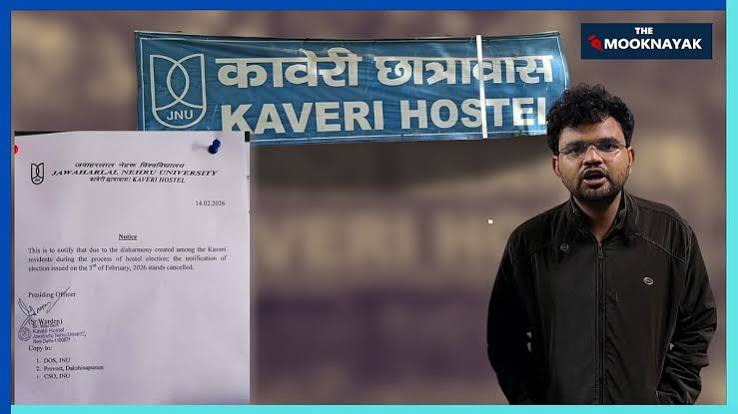
Students say that those with a casteist and Manuwadi mindset could not tolerate the candidacy of a Dalit candidate, so they hacked the democratic system and disrupted it.
New Delhi – A major controversy has erupted over the student union elections at Jawaharlal Nehru University’s (JNU) Kaveri Hostel. The hostel election process has been cancelled, following allegations of casteism and violence surrounding a Dalit candidate’s candidacy for the post of president. This is the same Kaveri Hostel where hateful casteist slogans like “Chamar, Dalit, leave India” and “Brahmin, Baniya, Zindabad” were recently painted on the walls, drawing widespread condemnation.
Kaveri Hostel houses a total of 308 students, including PG, UG, and PhD students. Every year, the Student Union (Students’ Body) is elected to address issues related to student welfare, such as improved infrastructure, quality food, cleanliness, mess facilities, and other student interests. This year, after 12 years, a Dalit student contested for the position of president. For all these years, there have been no SC community representatives on the hostel committee. There have been students from the tribal community, but they are considered to be staunchly RSS-oriented.
Ajay Kumar Rao, a PhD student in Hindi literature, a candidate for president from the Progressive Panel, shared his experience with The Mooknayak. He said that elections are held every year to improve hostel infrastructure, protect students’ interests, and address welfare issues.
The hostel election process is completely democratic and transparent. The Election Committee presents the names of nominated candidates for various positions (such as president, member, etc.) to the General Body Meeting (GBM).
At this meeting, students’ support is sought against each candidate’s name. Students show their support by raising their hands. The candidates who receive the most hands, or a majority, are elected to the respective position.
This process is based on consensus and direct democracy, allowing all resident students to participate. This method is common at the hostel level in campuses like JNU, where decisions are made by raising hands instead of using ballot papers, ensuring a speedy, fair, and universal participation. This method clearly expresses the collective will of the students, and in the event of any dispute, a decision is immediately reached within the GBM.
This year, the election process began as follows: the election notification was issued on February 3rd. The body conducting the elections is the Election Committee, which consists of six students with neutral and open ideologies. The election committee was elected at the hostel’s General Body Meeting (GBM), in which Talha Ansari was elected. The election of the remaining five students, Vijay Jaiswal, Anubhav Tripathi, Priyanshu Chaturvedi, Ritul Joshi, and Animesh Kumar, was not democratic because they adhere to the RSS ideology, and an investigation is underway against some of them by the Proctor.
Ajay Kumar Rao alleges that the election of the remaining members, except for Talha Ansari, was not conducted democratically and by consensus. The opposition, enraged by the idea of a Dalit student becoming president, created a ruckus. A scuffle and fight broke out between the students. Ajay’s glasses were broken during the altercation, and some others suffered minor injuries. The students complained to the warden, following which the election process was cancelled.
Bahujan students say that those with a casteist and Manuwadi mindset could not tolerate the candidacy of a Dalit candidate, so they hacked the democratic system and disrupted it. Citing incidents of caste discrimination occurring on campuses across the country, Ajay said that Kaveri Hostel is no exception. South Asians and Expatriates
The two major student organizations active in the hostel are the ABVP and the Progressive Panel. The Progressive Panel is a joint alliance of students from the Congress, Left, and Ambedkarite ideologies, seeking a system based on the principles of social inclusion, equity, and equality. Meanwhile, students with opposing ideologies are stuck in the age-old narrow-minded notions of superiority and inferiority.
Non-vegetarian food is available in the hostel mess five days a week, but there have been debates and protests over not preparing non-vegetarian food on festivals. Religious events like Ram Navami and processions on campus are events that violate constitutional values and the principles of equality in an academic campus. This incident exposes the deep roots of casteism on a supposedly progressive campus like JNU, where attempts to suppress the voices of Dalit students continue. Ajay Kumar and his colleagues have appealed for the restoration of democratic processes.
Geetha Sunil Pillai
Courtesy: Hindi News