
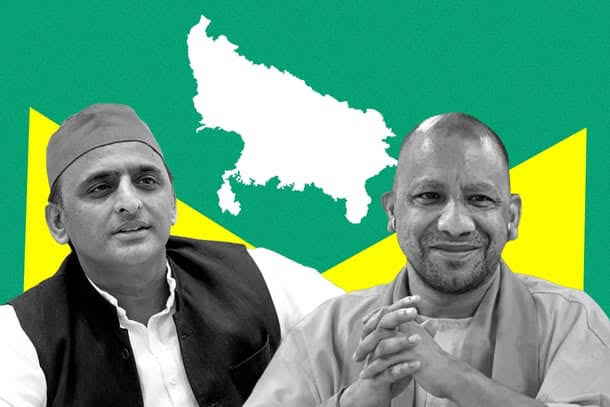
The BJP will have to fight to protect its own vote bank in the UP Assembly elections. Akhilesh Yadav’s new caste arithmetic will be a major test. The SP will target Brahmins, non-Jatav Dalits, and non-Yadav OBCs. This new strategy by the SP has increased the BJP’s concern.
The SP’s strategy now aims to break the social alliance that has helped the BJP win election after election in Uttar Pradesh. After the success of the new caste arithmetic in the Lok Sabha elections, the SP’s strategy is to move beyond its image as a Muslim-Yadav party and give more priority to non-Yadav OBCs, non-Jatav Dalits, and Brahmin communities in ticket distribution.
If this segment prioritizes caste over party, as in the Lok Sabha elections, the contest will be interesting. The BJP will face the challenge of maintaining its base vote bank and breaking through this SP’s maze.
This new strategy by the SP has increased the BJP’s concern. According to a senior state leader and former state president, the party’s biggest challenge is to re-engage the non-Yadav OBCs and non-Jatav Dalits, a large portion of whom sided with the SP in the last Lok Sabha elections.
This segment, which supported the BJP in the 2014, 2019, and the last two assembly elections, no longer displayed its previous commitment to the BJP in the last Lok Sabha elections.
Since the SP’s ticket distribution formula for 2024 has been successful, it will not only favor the Kurmi, Nishad, Gurjar, Pal, Saini, Prajapati, and Pasi communities among Dalits to deal a blow to the BJP in the assembly elections, but will also woo Brahmins in eastern UP and Awadh. Therefore, to blunt this SP move, the BJP will have to make a major change in its strategy.
What is the SP’s strategy?
In the last election, the SP alliance distributed approximately 125 tickets among Muslim Yadavs. This made it easier for the BJP to woo the non-Yadav OBCs. This time, the SP plans to limit the number of tickets for Yadavs and Muslims to 80-85 seats.
The plan is to field Dalit candidates in some general seats where the combination of Muslim, Yadav, and Dalit voters can create a formidable position. Furthermore, the plan is to provide bulk tickets to Brahmins among the upper castes, Kurmis and Nishads among the OBCs, and to give greater representation to Sainis, Gurjars, Rajbhars, Pals, and Prajapatis. In the Lok Sabha elections, the SP fielded only five candidates from the Yadav community and four from the Muslim community.
Last Election Equation
The SP alliance fielded approximately 128 Yadav-Muslim candidates, the same number of non-Yadav OBC candidates, 86 Dalits, and approximately 60 upper caste candidates. The NDA fielded approximately 135 non-Yadav OBC candidates, 15 from the Yadav community, approximately 140 from the upper castes, 85 from the Dalit community, and approximately 30 to 35 from the Vaishya community.
Law and order will be a key issue for the BJP.
A section within the BJP believes that as the elections approach, the contest will become Yogi versus Akhilesh. This will directly benefit the BJP. For example, in Bihar, the initial situation was against the NDA, but as the election approached, when the contest became Nitish versus Tejashwi, the NDA won a landslide victory on the issue of better law and order.
In Uttar Pradesh too, there is a general public support for better law and order. Therefore, the BJP will have to find a counter to the SP’s new social equation with law and order and Hindutva.
Himanshu Mishra, New Delhi Published by: Sharukh Khan
Courtesy: Hindi News