
A call to solidarity: Why queer movements need broader alliances

There is much to learn from the recent student-led protests, specifically the need for the queer community to build broader, cross-movement coalitions rooted in an organic politics of resistance. As young people took to the streets across India last month, asking for accountability and justice, it all felt familiar for the transgender community On March 13, when the Union Government tabled its amendments to the Transgender Persons (Protection of Rights) Act, 2019—the principal legislation governing the rights of transgender persons in India—in the Lok Sabha, the transgender community was rightfully outraged. Among other things, the Bill sought to narrow the legal definition of a transgender person, which would further bureaucratize the process of gender recognition, and, more worryingly, roll back key aspects of the rights to privacy, autonomy, and selfdetermination of gender as recognised by the Supreme Court in multiple prior judgments. What followed were weeks of public protests on the streets, consultations organised by queer rights groups, and press conferences led by leaders of the queer and transgender community. And yet, the Bill was passed barely two weeks later. Fast forward a few months, in May, groundwork was being laid for a movement that would go on to leave a stubborn mark on the country’s socio-political space. The Cockroach Janta Party (CJP) emerged as a social media page, a response to a derogatory remark directed at India’s unemployed youth. Initially centred on the 2026 NEET paper leak and demands for systemic education reforms, the movement moved beyond CJP to encompass broader concerns around youth unemployment. Lessons from recent protests Compared to the protests against the Transgender Persons (Protection of Rights) Amendment Bill, 2026, this movement has arguably been far more successful in achieving tangible political outcomes in a much shorter span of time. After weeks of sustained, multi-city protests, a prolonged sit-in at Jantar Mantar, and the moral support generated by activist Sonam Wangchuk’s indefinite fast, the protesters ultimately secured one of their principal demands: the resignation of the then-Union Education Minister, Dharmendra Pradhan, on July 25. They did so despite police crackdowns, internet shutdowns, online and offline harassment, and repeated attempts to suppress dissent. A significant reason for this success was the movement’s ability to build broad-based solidarities with people across regions, languages, age groups, professions, and, in some cases, even the political spectrum. The movement was no longer just about students; it instead became a broader struggle for transparency and accountability from the Union Government. To be clear, the queer community has frequently found itself on the receiving end of hostility and insults from leaders of various social movements, including this one. Former CJP spokesperson Vijeta Dahiya, while commenting on the 2026 amendments to the Transgender Persons (Protection of Rights) Act, remarked that “some rich folks bored with their purposeless existence want to identify themselves as a man on Monday, woman on Tuesday, gender-fluid and 86 other categories.” Such language not only trivialises the struggles of transgender people but also reinforces the very stereotypes they have long fought to dismantle. Despite this hostility, transgender and queer people continued to participate in the Jantar Mantar protests in Delhi and other cities. Need for better alliances This tension is not unique to the “cockroach” movement. Early iterations of the women’s movement in India similarly marginalised lesbian and bisexual women. Many feminists even today continue to espouse biological essentialist views that exclude transgender women from women’s spaces. Religious leaders in India, too, have remained largely hostile to queer issues, as have most mainstream political outfits. Given this history, the queer movement’s hesitation to build alliances with other social movements is somewhat understandable. And yet, this bridge needs to be crossed if the movement ever hopes to achieve meaningful political change in the near future. One way of doing so is by broadening the movement’s political imagination beyond issues largely seen as queer, and bringing them into conversation with ancillary debates around governance, rights, and democratic accountability for everyone. Take for example the passage of the Transgender Persons (Protection of Rights) Act 2026. While it directly affect transgender persons, the questions raised are far broader. If the State can, almost overnight, shrink the legal definition of transgender and roll back rights that had been recognised by the Supreme Court, what is to stop it from redefining other contested legal categories such as citizenship? The same is true of the struggle for same-sex marriage. Far from being only about gay rights, the issue was fundamentally about the freedom to choose one’s partner and to have that choice respected by the State. Those concerns should have resonated with live-in, interfaith, inter-caste, transnational, intergenerational, and countless other heterosexual couples in India who have faced similar familial and state interference in their relationships—across regions, generations, and political affiliations. And yet, for the most part, the same-sex marriage litigation was mostly seen as not just a “queer issue” but also an “urban elitist” one. So, where do we go from here? As many people in the country continue to celebrate Pradhan’s resignation, the queer community must pause for a moment and remember that building broader, cross-movement coalitions rooted in an organic politics of resistance will be necessary if meaningful change is to happen in the near future. Otherwise, the State will continue to dilute queer people’s rights as they keep fighting (mostly) alone. Kanav Narayan Sahgal (The author is a communications manager at Nyaaya, the Vidhi Centre for Legal Policy and can be reached at sahgalkanav@gmail.com) Courtesy : DH Note: This news is originally published on https:/deccanherald.com/bha and is used purely for non-profit/non-commercial purposes, especially human rights
Parliament passes Transgender Persons Amendment Bill, 2026 with Rajya Sabha approving it today
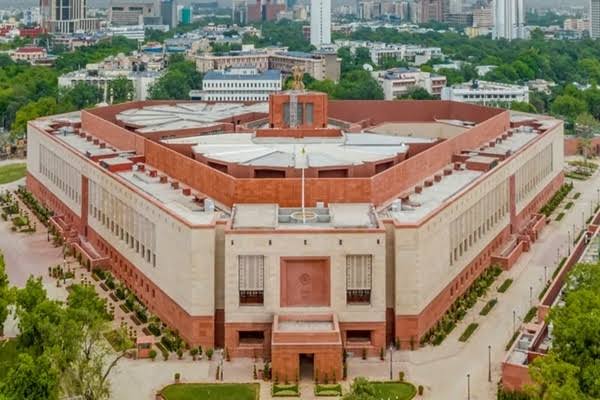
Parliament has passed the Transgender Persons (Protection of Rights) Amendment Bill, 2026, with the Rajya Sabha approving it today. The bill was passed by the Lok Sabha yesterday by a voice vote amid an Opposition-led walkout. The bill seeks to redefine the category of transgender, removes the provision of self-perceived gender identity and excludes several socio-cultural identities as well as transmasculine individuals from its ambit. It also further defines transgender persons within a biological framework, based on intersex variations and differences in sexual development. Replying to the discussion on the Bill in the Rajya Sabha, Social Justice and Empowerment Minister Dr Virendra Kumar said the government is compassionate towards the well-being of the transgender community. He said the Bill has provisions to empower the transgenders and give them dignity. The Minister said that the NDA government has taken several initiatives to bring transgender people to the mainstream and stop discrimination against them. Starting the discussion in the Upper House, Congress MP Renuka Chowdhury said this bill dilutes the privacy of an individual provided under the Constitution. Opposing the Bill, Ms Chowdhury said self-identification cannot be taken away through bureaucratic certification. Criticizing the government, she said that the proposed bill undermines the fundamental rights and dignity of transgender persons. Calling such a move wrong and illegal, she argued that forcing transgender persons to provide their identity through official certificates is against the spirit of equality and dignity guaranteed by the constitution. She also questioned the government’s approach for not properly consulting with the transgender community before bringing the Bill. She also referred to the Supreme Court’s landmark NALSA judgement of 2014, which recognized the right of transgender persons to self-identify their gender. Ms Chowdhury said the proposed Bill violates the principles laid down in that judgement and fails to respect an already established legal framework. DMK MP Tiruchi Shiva also opposed the Bill, saying that even if the Bill is passed in Parliament with a majority, it will be struck down by the Supreme Court. He further added that the Bill violates Articles 14, 15, 19 and 21 of the Constitution and it deprives the community of the right to freedom, dignity and self-determination. Supporting the Bill, BJP MP Medha Vishram Kulkarni said, ” This Bill ensures justice, dignity, protection from criminalisation and legal safeguards for transgender persons. She also thanked Prime Minister Narendra Modi for bringing this bill with certain amendments in order to ensure that the benefits reach the deserving people in a proper manner. She said there is a need for a law that brings justice to real transgender individuals and punishes fake ones. Mrs Kulkarni said the benefits should be extended to those who are transgender by birth. She said that the amendment to extend punishment will bring down the rate of crime and forced identities. TMC’s Saket Gokhale said that 31% of Transgender people in India have attempted suicide because of the discrimination that they are facing. He alleged that now the government is going to start discriminating against them as though social discrimination were not enough. He called it unacceptable. Mr Gokhale expressed concern that gender is going to be decided by the Chief Medical Officer and a District Magistrate, and the bill does not prescribe any qualifications for the Chief Medical Officer. Sanjay Singh of AAP said the Bill is a big let-down for the transgender community. He accused the government of not doing anything for the community. RJD’s Manoj Kr Jha said that prejudices against transgender people should stop, and they should be able to live with dignity. He added that self-determination of gender should not be taken away. CPI(M)’s John Brittas said it is a black-letter day and the Bill is taking India a century back. He pleaded with the government to either withdraw the Bill or refer it to a Select Committee. Jaya Bachchan of the Samajwadi Party also questioned the government over the legislation. She sought to know what the urgency was in bringing the Bill, without examining it with the depth and care that it deserved. Courtesy : NOA Note: This news is originally published on https:/newsonair.com/bha and is used purely for non-profit/non-commercial purposes, especially human rights
Adivasi-Dalit convention seeks justice for Jogi, Muthanga violence victims

Adivasi-Dalit convention and Declaration of Rights held at Sulthan Bathery in Wayanad on Sunday. Bommi Amma of Cheeral, the oldest surviving participant in the Muthanga struggle, inaugurated the gathering Bommi Amma, the oldest surviving participant in the Muthanga agitation, inaugurating the Adivasi-Dalit gathering at Sulthan Bathery in Wayanad on August 9. Bommi Amma, the oldest surviving participant in the Muthanga agitation, inaugurating the Adivasi-Dalit gathering at Sulthan Bathery in Wayanad on August 9. | Photo Credit: Special Arrangement As part of intensifying protests demanding a comprehensive inquiry into the death of Yogi (Jogi), who was reportedly killed in police firing during the 2003 Muthanga land agitation and the alleged human rights violations in connection with the stir, an Adivasi-Dalit convention and Declaration of Rights were held at Sulthan Bathery in Wayanad on Sunday (August 9) on the occasion of the International Day of the World’s Indigenous Peoples. The gathering was inaugurated by Bommi Amma of Cheeral, the oldest surviving participant in the Muthanga struggle. Several people who participated in the land stir shared their experiences at the meeting, organised by the Adivasi Gothra Mahasabha (AGMS) and the Ambedkarite Democratic Front (ADF). In the evening, a cultural procession was taken out through the town under the leadership of the Adi Shakti Summer School, followed by a public meeting at the Municipal Town Hall. It was inaugurated by ADF State working chairperson K. Ambujakshan. AGMS general secretary P.G. Janardhanan made the Declaration of Rights. The resolution demanded a fair investigation into Jogi’s death, implementation of the direction issued by the National Human Rights Commission calling for a comprehensive inquiry into the human rights violations during the Muthanga agitation and adequate compensation for all those affected by the violence. Sivan Yogi, son of Jogi, and others attended. The Muthanga land agitation has returned to the limelight after the Kalpetta Principal Sessions Court, on July 31, acquitted all the accused who stood trial, including social activist M. Geethanandan, in the case relating to the murder of police constable K.V. Vinod. However, the court convicted Geethanandan and three others on other charges related to the case and sentenced each to five years of rigorous imprisonment. The Hindu Bureau Courtesy : The Hindu Note: This news is originally published on https:/thehindu.com/bha and is used purely for non-profit/non-commercial purposes, especially human rights
15-year-old girl missing in Umri Begamganj: Case registered based on father’s complaint
A case of kidnapping of a 15-year-old Dalit girl has come to light in the Umri Begamganj police station area. Based on the girl’s father’s complaint, police have registered a case against Vishram Chauhan, son of Shyamu Chauhan, a resident of Umri, and have begun an investigation. Family members stated that after the girl went missing, they searched for her extensively, but no trace of her was found. Following this, the father submitted a written complaint to the police, demanding action. Station House Officer Pawan Mishra informed that a case has been registered in this matter. Police are searching for the girl based on the location of the accused’s mobile phone. He also stated that the girl will be recovered soon and the accused will be arrested. Ravi Prakash Mishra | Belsar (Gonda), Gonda Courtesy: Hindi News
TM Special | IRS officer Netra Pal’s 10 arguments against the ‘creamy layer’ and generational reservation ban for SC/STs: What do the data reveal?
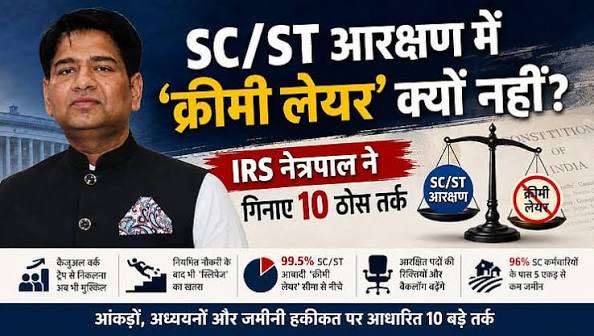
The claim that wealthy Dalits are enjoying the benefits of reservation is not supported by statistics. The Bihar Caste Census revealed that 99.5 percent of the Scheduled Caste/Tribe population is below the economic creamy layer threshold. Even in national income tax data, the number of people earning more than ₹1 crore is negligible in the total population; this number is statistically almost zero in the Scheduled Caste/Tribe community. New Delhi – Amidst the debate over implementing a ‘creamy layer’ in reservations for Scheduled Castes (SC) and Scheduled Tribes (STs) and excluding the next generation from reservation benefits after one generation of a family has received it, senior IRS officer Netra Pal has put forward 10 key arguments against it. He argues that the socio-economic status of the SC/ST community cannot be judged solely on the basis of current income, employment, or success of a single individual. The data he cites draws attention to factors such as intergenerational employment, the possibility of moving from regular jobs to the informal sector, lack of assets, a high share of casual employment, social differences in higher education, and vacancies in reserved positions. Netrapal argues that before implementing a “creamy layer” or generational restriction, it is important to understand its impact based on solid empirical data. Escape from the “Casual Work Trap” Remains Effortless Netrapal’s first argument is based on intergenerational employment data provided in the “State of Working India 2023.” The report clearly demonstrates caste-wise differences in the distribution of the workforce and income, where social identity impacts labor market outcomes. In 2018, among SC/ST men who worked as daily wage laborers, 75.6% of their sons also worked as daily wage laborers. According to these data, in 2018, among “other” caste groups, if the father was a casual worker, the probability of his son also remaining a casual worker had decreased to approximately 53 percent. In contrast, among the SC/ST community, this probability was approximately 75 percent. In comparison, this figure was 86.5% in 2004, suggesting that the sons of SC/ST daily wage laborers have now moved into other forms of employment, especially informal, regularly paid work, but this growth is very slow. According to Netrapal, this difference indicates that it remains more difficult for SC/ST families to break the cycle of casual and temporary employment than for other social groups. Without continued government support, such as reservations, the cycle of manual labor and irregular employment is difficult to break. He argues that if one generation gains access to employment and education through government support or reservations, then the next generation is excluded from reservations, the true nature of this intergenerational mobility may be overlooked. The risk of ‘slippage’ even after achieving regular employment The second argument is that a member of an SC/ST family securing a regular salaried job does not in itself guarantee lasting socio-economic security. According to data provided by Netrapal, even children of SC/ST parents who achieve regular employment are at risk of moving into the informal sector, casual work, or self-employment. This means that regular employment for one generation does not guarantee the continuation of that status for the next generation. Limiting reservation to one generation ignores the fragility of this social climb for Dalits. On this basis, Netrapal argues that excluding the next generation from reservation based solely on the first generation’s access to regular employment may ignore the instability of social progress. How large is the ‘creamy layer’? The argument in favor of implementing a creamy layer in reservation is that economically well-off SC/ST families are consistently benefiting from reservation. Netrapal, in response, questions the actual size of the creamy layer. He cites data from the Bihar Caste Survey, which shows that 99.5 percent of the SC/ST population falls below the creamy layer threshold. Furthermore, the national income tax data also shows a very low number of people with incomes exceeding ₹1 crore compared to the total population. According to Netrapal, the number of people falling within this income bracket within the SC/ST community is even more limited. On this basis, he argues that the presence of a very small economic group should not be used as a basis for limiting reservation eligibility for the entire SC/ST community. The Creamy Layer Threatens to Increase Vacancies in Reserved Positions Netrapal’s fourth argument relates to the vacancies in reserved positions and seats. According to him, the problem of many positions and seats remaining vacant within reserved categories already exists. In such a situation, if creamy layer or second-generation candidates are excluded from reservation, the pool of eligible candidates will narrow further. This could reduce the number of candidates available for reserved positions and increase backlog vacancies. According to Netrapal, before limiting the scope of reservation beneficiaries, it is important to assess how many reserved positions are being filled and how many are vacant under the current system. Increasing income does not necessarily mean generational wealth According to Netrapal, it is not appropriate to consider the current income of SC/ST employees as an indicator of their family’s generational wealth. He cites a study on government employees. According to this, 96 percent of SC employees owned less than five acres of land. Similarly, among rural SC graduates, 82 percent owned less than 1.23 acres of land. Based on these data, Netrapal argues that many SC employees who have entered government service come from families that do not own large amounts of land or family property. Therefore, a person’s current income and their family’s generational wealth cannot be viewed on the same scale. Reserved categories already face a crisis of vacant seats. Excluding the so-called creamy layer or second-generation educated youth will further shrink the pool of eligible graduates. This is likely to further increase backlog vacancies, defeating the very purpose of representation. Casual employment is very high among SC workers Netrapal’s sixth argument relates to the employment patterns of the SC community. According to 2021-22 data, approximately 40 percent of SC workers were in casual employment. In comparison, the share
Mayawati attacks the creamy layer in SC/ST reservations, urges RSS to stop advocating for any tampering with reservations.
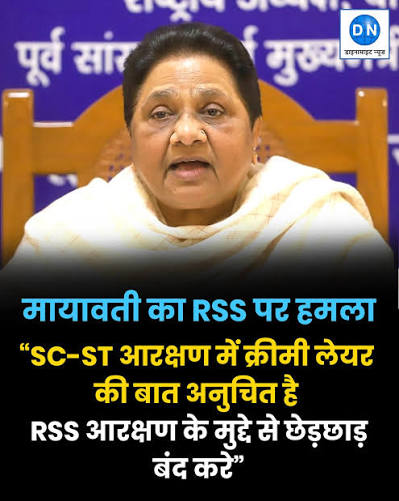
The BSP chief appealed to the central government that if it effectively and properly advocates, based on valid arguments, and persuades the court to exclude SC and ST communities from the creamy layer, it would be completely justified and constitutional. New Delhi: Bahujan Samaj Party chief Mayawati has strongly opposed the issue of the “creamy layer” in Scheduled Caste (SC) and Scheduled Tribe (ST) reservations. Mayawati stated that bringing SC/ST reservations under the creamy layer is not only unfair but also against the humanitarian objectives of Dr. Bhimrao Ambedkar’s Constitution. She also accused the Rashtriya Swayamsevak Sangh (RSS) of politicizing the reservation issue and urged the RSS to stop advocating for any tampering with reservations. In a social media post on Sunday, Mayawati described reservations as a very important and sensitive issue related to “social transformation and economic liberation” and self-respect for the SC, ST, and OBC communities. Mayawati stated that SC and ST communities have faced caste-based discrimination, exploitation, oppression, and social exclusion for centuries. According to her, caste hatred, injustice, and atrocities have not completely ended even today. She argued that in such circumstances, it is inappropriate to talk about a creamy layer in SC/ST reservations. She stated that reservation cannot be viewed solely on the basis of economic status, as the impact of caste discrimination can persist despite economic advancement in various areas of a person’s life. Mayawati stated that the purpose of reservation is not merely to provide financial assistance, but to ensure social equality, respect, and constitutional rights for historically disadvantaged communities. Mayawati’s comments follow RSS chief Mohan Bhagwat’s recent statement regarding reservations. Bhagwat had stated that reservations should continue as long as social discrimination exists. He also stated that those who have already benefited from reservations should consider voluntarily relinquishing them, so that its benefits can reach those who are currently deprived. She also criticized the politicization of reservations as a cause of social tension. Challenging Bhagwat’s view, Mayawati said that such statements about reservation undermine constitutional objectives. She accused the RSS of claiming that such views on reservation may serve narrow political interests, but undermine the constitutional goal of social equality. The BSP chief stated that it would be inappropriate to measure reservation solely by economic status. According to her, the problems faced by SC/ST communities are not only poverty but also caste discrimination and social inequality. She stated that caste-based discrimination does not automatically disappear even if an individual or family’s economic status improves. Based on this, she opposed the concept of implementing a creamy layer in SC/ST reservations. Referring to the current stance of the central government, Mayawati said that if the government effectively advocates in court, based on its arguments, to exclude SC/STs from the creamy layer, it would be a just and constitutional step. Indeed, the central government, in its recent submission to the Supreme Court, opposed the implementation of a creamy layer in SC/ST reservations. The government argues that the historical and social discrimination faced by SC/ST communities differs from the creamy layer concept applied to OBCs, and that caste discrimination can persist despite economic progress. Mayawati stated that weak legal advocacy by governments often fails to achieve the desired results in matters related to social change. Therefore, she urged the central government to provide strong legal support for its position on excluding SC/STs from the creamy layer. In a direct message to the RSS, Mayawati said that it should respect Dr. Bhimrao Ambedkar’s humanitarian and welfare-oriented Constitution. She urged the RSS to stop politicizing reservations and refrain from advocating for any changes to reservations. According to Mayawati, the Constitution’s objective is to establish an “egalitarian social system” in the country, and all organizations should cooperate in achieving this goal. Geetha Sunil Pillai Courtesy: Hindi News
Yavatmal Murder Case | Dalit woman elected Sarpanch on a general seat, then murdered her husband out of enmity: Bombay High Court upholds life imprisonment for 10 convicts!
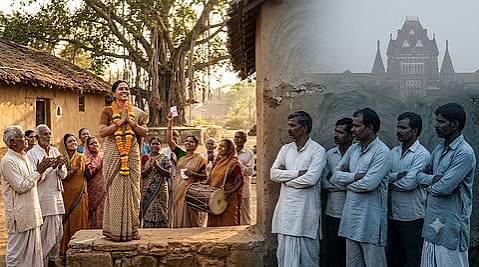
The division bench stated in its 179-page judgment that a comprehensive consideration of the oral evidence, medical and forensic evidence, and other proven facts establishes beyond reasonable doubt that the accused assembled unlawfully and, with a common objective, committed the murder of Mahesh Gawande out of political enmity. Yavatmal – The Nagpur bench of the Bombay High Court has delivered a major verdict in the highly publicized 2018 Sarpanch-husband murder case in Parwa village, Yavatmal district. The division bench of Justice Urmila Joshi-Phalke and Justice Nivedita Mehta dismissed the appeals of the ten convicts, upholding the life imprisonment sentences awarded by the Special (Prevention of Atrocities) Court in Yavatmal. The verdict was delivered on August 4. The murder of a woman’s husband in broad daylight by multiple assailants in a village political battle, and the subsequent eight-year legal battle, has reached a crucial juncture with this High Court decision. What is the whole matter? Nalini Gawande, a resident of Parwa village in Yavatmal district, was elected as a Gram Panchayat member in April 2015. In January 2016, after a no-confidence motion was passed against the then Sarpanch, Rama Chimurkar. The post of Sarpanch was reserved for the general category, and Nalini, who belonged to the Dalit Buddhist community, became Sarpanch, a move opposed by a faction in the village. Munna Thakur, a prominent among the accused, openly objected to this election, and since then, a continuous conflict has erupted between the two factions. In December 2017, the accused abused Nalini’s husband, Mahesh Gawande, on the basis of caste, while in January 2018, a dispute erupted again over the distribution of hand pumps in the village. On January 27, 2018, accused Munna Thakur directly threatened over the phone that “her husband would be killed.” The very next day, on January 28, the accused attacked Nalini’s home, vandalized household items, and also assaulted Prafull Shabarkar. Fed up with this constant harassment, Nalini Gawande and her family moved to Yavatmal city. Murder in broad daylight On March 27, 2018, at around 1 p.m., Nalini returned to Parwa village with her husband Mahesh, son Mayur, and nephew Samyak to carry out repairs. At around 1 p.m., Mahesh Gawande left the house to have a snack with Sheikh Imran and Sheikh Israel, the repairmen. Mahesh was talking to Prashant Shabarkar, Nitin Lokhande, Raju Kawale, and Prakash Bhagat, who were playing cards near the Anganwadi, when the accused, armed with deadly weapons, formed an unlawful assembly and attacked Mahesh Gawande. Hearing the noise, son Mayur and nephew Samyak rushed to inform Nalini of the incident. Nalini then rushed to the scene and witnessed the accused attacking her husband with weapons. She screamed for help, which drew a crowd, and the accused fled the scene. Police arrived at the scene, and Mahesh was rushed to the Yavatmal District Hospital, where he had already died by the time they arrived. Nalini filed a police complaint that evening. According to the post-mortem report, a total of seventeen wounds were found on Mahesh Gawande’s body, including stab wounds near the left eye, on the cheek, on the jaw, on the forehead, on the chest, and on the abdomen, and a slit wound was also found. Medical officials concluded that these wounds were caused by sharp and sharp weapons, such as a knife, chopper, sword, and sickle, and determined the cause of death to be multiple stabbings and slashing of the throat. What the Investigation Revealed During the investigation, police recovered swords, sickles, and other weapons from the accused. The chain of custody of these weapons was established by the police through various panchnamas. Samples of soil collected from the crime scene and the nails of the body matched, which was confirmed by forensic examination and strengthened the eyewitness testimony. A total of eighteen witnesses were examined during the investigation, including Nalini Gawande, her son Mayur, and key eyewitnesses Sharda Narayane and Prashant Shabkar. Following the completion of the investigation, the police filed a charge sheet, and the trial was held in the Special (Prevention of Atrocities) Court of Additional Sessions Judge-2 in Yavatmal under Special Case No. 18/2018. On January 20, 2020, the Sessions Court convicted the accused under sections 302 (murder), 149 (unlawful assembly, offence committed with common intention), 120-B (conspiracy), 143, 147, 148, and 201 of the Indian Penal Code and sentenced them to life imprisonment. The accused appealed to the High Court. Ten convicts—Sunil Deotale, Hanuman Pendor, Shubham Tekam, Raj Thakur, Munna Thakur, Vinod Chapriya, Sumit alias Pandya alias Sumedh Meshram, Praveen Bhagat, Bhimrao Awathare, and Swapnil Kumbhekar—filed five separate criminal appeals against the Sessions Court’s decision. Defense lawyers argued that there were inconsistencies in the eyewitnesses’ statements, that their testimony was unreliable because they were relatives of the complainant, and that the guilt of the accused had not been proven beyond a reasonable doubt. However, the High Court rejected these arguments. The court noted that eyewitness Nalini Gawande, a woman from a rural background, could not be expected to provide an accurate and photographic account of an incident that unfolded over a few minutes when multiple attackers were attacking with deadly weapons. Citing the Supreme Court’s decision in State of Punjab vs. Hakam Singh, the division bench clarified that minor inconsistencies are not appropriate when evaluating the testimony of rural witnesses. The bench also elaborated on the thirteen principles of evidence evaluation laid down in the Supreme Court’s decision in Balu Sudam Khalde v. State of Maharashtra (2023). The court stated that the testimonies of Nalini Gawande, Mayur Gawande, Sharda Narayane, and Prashant Shabkar were corroborative, consistent, and reliable, and that minor discrepancies, despite their existence, did not affect the fundamental facts of the case. The judgment noted that the post of Sarpanch was held by the general category, and Nalini belonged to the Scheduled Castes. The accused party opposed her election as Sarpanch. This background was seen as the origin of the political rivalry that arose in the case. The court’s observations on unlawful
Huge rally in Nanded against Scheduled Caste sub-classification
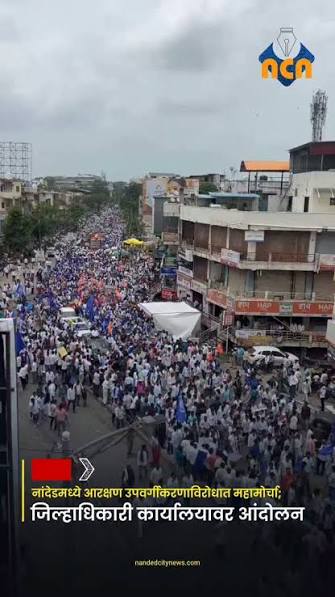
Chhatrapati Sambhajinagar: A massive rally opposing the alleged move to sub-classify the Scheduled Caste (SC) category was held in Nanded on Sunday, with Dalit activists accusing state govt of trying to divide the community and warning of intensified protests if the proposal goes ahead. The rally, attended by several Dalit and social leaders, culminated in a public meeting where speakers expressed strong opposition to reservation sub-categorisation and called for unity among SC communities. Republican Sena functionary Anandraj Ambedkar alleged that govt was creating social divisions under the pretext of implementing a Supreme Court ruling. “We are not fighting against any elements of the society, but govt. To achieve the success, we have to remain united,” Ambedkar said. He further accused chief minister Devendra Fadnavis of misleading people on the issue of reservation sub-categorisation. Former minister Chandrakant Handore said the move would create divisions within the Dalit community and warned of stronger resistance if govt failed to reconsider its stand. Courtesy : TOI Note: This news is originally published on https:/timesofindia.com/bha and is used purely for non-profit/non-commercial purposes, especially human rights
Factionalism mars Punjab Congress campaign as clashes erupt across State

A senior Congress leader, speaking on condition of anonymity, said the ‘Harr booth mazboot’ campaign by Bhupesh Baghel had failed to strengthen the party’s booth-level organisation. CHANDIGARH: Open factionalism, slogan shouting, clashes and poster wars marked the Punjab Congress’s 10-day Harr booth mazboot campaign, which ended on Saturday after party in-charge and AICC General Secretary Bhupesh Baghel toured 18 districts to assess preparations for the 2027 Assembly elections. The campaign ended in Ludhiana, the parliamentary constituency of Punjab Congress president Amarinder Singh Raja Warring. The incidents during the tour highlighted continuing differences within the state unit, with “go back” slogans and protests reported at several programmes. Ludhiana emerged as a major centre of discord as Baghel’s tour ended with a programme at Khanna. Supporters of former Cabinet minister Bharat Bhushan Ashu raised slogans, prompting Warring to accuse them of being backed by the RSS. The unrest was also reported in Malerkotla, where rival factions allegedly clashed on stage. The dispute turned physical, forcing police to intervene and use batons to separate the groups. At Khanna, a section of Congress workers raised slogans in support of former Chief Minister Charanjit Singh Channi. When attempts were made to stop the slogan-shouting, the group reportedly walked out of the meeting. Similar protests and disagreements were reported during party programmes in Patiala, Sangrur, Ferozepur, Bathinda, Muktsar and Mansa, highlighting the factionalism within the state unit. Harr booth mazboot campaign ended in Ludhiana, the parliamentary constituency of Punjab Congress president Amarinder Singh Raja Warring. Punjab Congress rift resurfaces as ex-CM Channi skips Rahul Gandhi’s Parliament speech A senior Congress leader, speaking on condition of anonymity, said the campaign had failed to strengthen the party’s booth-level organisation. “Repeated clashes during party meetings have sent a negative message to voters. It gives the impression that Congress leaders are more focused on internal power struggles than public issues,” he said, adding that leaders with personal differences should approach the high command and resolve them instead of creating scenes at party programmes. Throughout his 10-day tour, Baghel repeatedly warned that there would be zero tolerance for indiscipline. He said those who disrupted party programmes would be identified and action would be taken against them. Baghel also said the party’s external enemies were visible and identified, while those working within the organisation as “sleeper cells” and “internal saboteurs” needed to be exposed and removed. The Punjab Congress has been facing factionalism despite repeated efforts by its leadership to strengthen organisational unity ahead of the 2027 elections. The differences came to the fore after the Congress leadership on July 1 retained Warring as Punjab Congress president and appointed former Chief Minister Charanjit Singh Channi as chairman of its campaign committee. A section of leaders led by Channi opposed Warring’s continuation as state unit chief and sought his removal. Harpreet Bajwa Courtesy : TNIE Note: This news is originally published on https:/thenewindianexpress.com/bha and is used purely for non-profit/non-commercial purposes, especially human rights
‘You’ll have to answer for this crime’: Rahul slams PM Modi, HM Shah over police action on students

NEW DELHI: Leader of opposition in Lok Sabha Rahul Gandhi on Sunday upped the ante against Prime Minister Narendra Modi and Union home minister Amit Shah, accusing them of “doling out pardons” instead of apologising to the students for the alleged police brutality against them during the protest march in Delhi on July 20.A day after his “Chaatron Ki Goonj” event at Prayagraj, Rahul, in a social media post on X, said that students are the light of the nation and he stands with them with “full strength.” “‘I have no way out left now’ – This is what a student said to me yesterday in Prayagraj. Years of preparation, sold the family land, parents’ debts, and still nothing to show for it. This defeat is not his. This is the defeat of that system which refused to reward his hard work,” Rahul Gandhi said. — RahulGandhi (@RahulGandhi) “Thirteen days have passed – not a word has come from home minister Amit Shah’s mouth. Instead of apologizing, Modi ji is doling out pardons. Amit Shah ji, don’t think for a moment that we will stop demanding accountability. Lathis and pellets rained down on children on the streets of the capital – and you didn’t say a word. Whether today or tomorrow, you will have to answer for this crime. Students are the light of the nation, and I stand with them with my full strength,” he added. Earlier on Saturday, Rahul Gandhi said the country’s youth were being trapped in a “chakravyuh”, with youngsters spending lakhs and crores on educational certificates that offered no guarantee of employment. “Today, education certificates have no meaning in India because they cannot give you a job,” the Congress leader said. Addressing the ‘Chhatron Ki Goonj’ programme at KP College Ground, Rahul cautioned youngsters against getting trapped in the “intoxication” of making Instagram reels, saying social media was being used to keep them occupied as jobs and opportunities shrink. “You make reels and work on Blinkit-like platforms because there is no job for you in this country,” he said, describing the trend as a “dreaded intoxication” and warning that youngsters were being turned into “bandhua mazdoor” (bonded labourers). The Congress leader said that avenues in manufacturing, entrepreneurship, public and private sector jobs, corporate, IT and banking were shrinking, with AI increasingly being used by influential corporate houses. He also alleged that people associated with RSS ideology had been appointed to head various institutions, affecting the entire system. Despite his criticism, Rahul said the country’s youth had “lighted the path” towards a promising future. Courtesy : TOI Note: This news is originally published on https:/timesofindia.com/bha and is used purely for non-profit/non-commercial purposes, especially human rights