
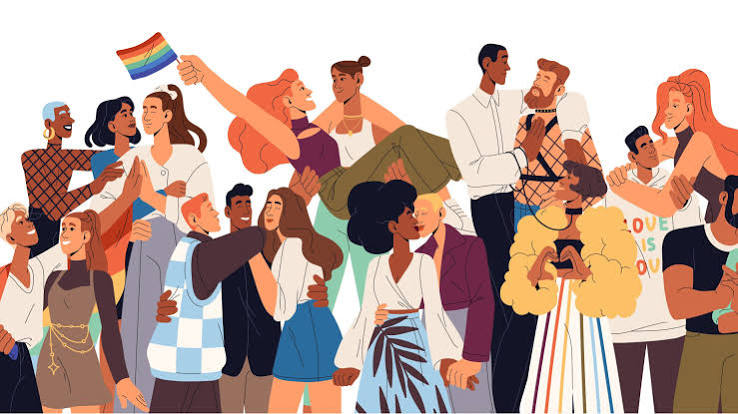
There is much to learn from the recent student-led protests, specifically the need for the queer community to build broader, cross-movement coalitions rooted in an organic politics of resistance.
As young people took to the streets across India last month, asking for accountability and justice, it all felt familiar for the transgender community
On March 13, when the Union Government tabled its amendments to the Transgender Persons (Protection of Rights) Act, 2019—the principal legislation governing the rights of transgender persons in India—in the Lok
Sabha, the transgender community was rightfully outraged. Among other things, the Bill sought to narrow the legal definition of a transgender person, which would further bureaucratize the process of gender recognition, and, more worryingly, roll back key aspects of the rights to privacy, autonomy, and selfdetermination of gender as recognised by the Supreme Court in multiple prior judgments.
What followed were weeks of public protests on the streets, consultations organised by queer rights groups, and press conferences led by leaders of the queer and transgender community. And yet, the Bill was passed barely two weeks later.
Fast forward a few months, in May, groundwork was being laid for a movement that would go on to leave a stubborn mark on the country’s socio-political space. The Cockroach Janta Party (CJP) emerged as a social media page, a response to a derogatory remark directed at India’s unemployed youth. Initially centred on the 2026 NEET paper leak and demands for systemic education reforms, the movement moved beyond CJP to encompass broader concerns around youth unemployment.
Lessons from recent protests
Compared to the protests against the Transgender Persons (Protection of Rights) Amendment Bill, 2026, this movement has arguably been far more successful in achieving tangible political outcomes in a much shorter span of time. After weeks of sustained, multi-city protests, a prolonged sit-in at Jantar Mantar, and the moral support generated by activist Sonam Wangchuk’s indefinite fast, the protesters ultimately secured one of their principal demands: the resignation of the then-Union Education Minister, Dharmendra Pradhan, on July 25. They did so despite police crackdowns, internet shutdowns, online and offline harassment, and repeated attempts to suppress dissent.
A significant reason for this success was the movement’s ability to build broad-based solidarities with people across regions, languages, age groups, professions, and, in some cases, even the political spectrum. The movement was no longer just about students; it instead became a broader struggle for transparency and accountability from the Union Government.
To be clear, the queer community has frequently found itself on the receiving end of hostility and insults from leaders of various social movements, including this one. Former CJP spokesperson Vijeta Dahiya, while commenting on the 2026 amendments to the Transgender Persons (Protection of Rights) Act, remarked that “some rich folks bored with their purposeless existence want to identify themselves as a man on Monday, woman on Tuesday, gender-fluid and 86 other categories.” Such language not only trivialises the struggles of transgender people but also reinforces the very stereotypes they have long fought to dismantle. Despite this hostility, transgender and queer people continued to participate in the Jantar Mantar protests in Delhi and other cities.
Need for better alliances
This tension is not unique to the “cockroach” movement. Early iterations of the women’s movement in India similarly marginalised lesbian and bisexual women. Many feminists even today continue to espouse biological essentialist views that exclude transgender women from women’s spaces. Religious leaders in India, too, have remained largely hostile to queer issues, as have most mainstream political outfits.
Given this history, the queer movement’s hesitation to build alliances with other social movements is somewhat understandable. And yet, this bridge needs to be crossed if the movement ever hopes to achieve meaningful political change in the near future. One way of doing so is by broadening the movement’s political imagination beyond issues largely seen as queer, and bringing them into conversation with ancillary debates around governance, rights, and democratic accountability for everyone.
Take for example the passage of the Transgender Persons (Protection of Rights) Act 2026. While it directly affect transgender persons, the questions raised are far broader. If the State can, almost overnight, shrink the legal definition of transgender and roll back rights that had been recognised by the Supreme Court, what is to stop it from redefining other contested legal categories such as citizenship?
The same is true of the struggle for same-sex marriage. Far from being only about gay rights, the issue was fundamentally about the freedom to choose one’s partner and to have that choice respected by the State.
Those concerns should have resonated with live-in, interfaith, inter-caste, transnational, intergenerational, and countless other heterosexual couples in India who have faced similar familial and state interference in their relationships—across regions, generations, and political affiliations. And yet, for the most part, the same-sex marriage litigation was mostly seen as not just a “queer issue” but also an “urban elitist” one.
So, where do we go from here? As many people in the country continue to celebrate Pradhan’s resignation, the queer community must pause for a moment and remember that building broader, cross-movement coalitions rooted in an organic politics of resistance will be necessary if meaningful change is to happen in the near future. Otherwise, the State will continue to dilute queer people’s rights as they keep fighting (mostly) alone.
Kanav Narayan Sahgal
(The author is a communications manager at Nyaaya, the Vidhi Centre for Legal Policy and can be reached at sahgalkanav@gmail.com)
Courtesy : DH
Note: This news is originally published on https:/deccanherald.com/bha and is used purely for non-profit/non-commercial purposes, especially human rights