
Rahul Gandhi enjoys ‘appam and omelette’ with UDF leaders ahead of Kerala Assembly polls

NEW DELHI: Congress MP and Leader of Opposition Rahul Gandhi on Friday shared a video on social media showing him having snacks with United Democratic Front (UDF) leaders in Kerala ahead of the 2026 assembly elections. In the video, Gandhi is seen enjoying local delicacies like Appam, Puttu and omelette while engaging with UDF leaders on the ground realities of the upcoming polls. In a post on X, he wrote: “In between bites of Appam, Puttu and omelette the UDF leaders and I had a very interesting conversation on the ground realities of the Keralam election. It’s evident that Keralam deserves change – an overhaul of the education system, real opportunities for youth and a government that supports its people in sickness and old age. UDF is renewed hope for the people of Keralam – our team is strong, united and ready to lead.” The ruling Left Democratic Front (LDF) is expected to face a stiff challenge from the opposition United Democratic Front (UDF) led by the Indian National Congress. Meanwhile, the Bharatiya Janata Party (BJP)-led National Democratic Alliance (NDA) is also trying to expand its footprint in the state, aiming to turn the contest into a three-way fight. The 2026 Kerala Legislative Assembly elections will be held in a single phase on April 9, as announced by the Election Commission of India on March 15. The counting of votes is scheduled for May 4, while the tenure of the current assembly is set to end on May 23. Courtesy : TOI Note: This news is originally published on https:/timesofindia.com/bha and is used purely for non-profit/non-commercial purposes, especially human rights
85% candidates finalised, 15% pending: Congress to seal Tamil Nadu list at CEC meet today
NEW DELHI: The Indian National Congress is set to finalise its candidates for the upcoming Tamil Nadu Assembly elections at a Central Election Committee (CEC) meeting in Delhi, with 85 per cent of names already decided, according to state unit chief K Selvaperunthagai. Selvaperunthagai said discussions involving senior leaders, including Mallikarjun Kharge and Rahul Gandhi, have largely concluded, with only a small portion of seats left to be finalised. “All India Congress President Mallikarjun Kharge, Opposition leader Rahul Gandhi and senior leaders discussed the candidates. 85% have been decided, 15% are pending. Today we are going to decide,” he said. The Congress will contest 28 constituencies as part of the alliance led by the Dravida Munnetra Kazhagam, which heads the Secular Progressive Alliance (SPA). The DMK has retained the lion’s share, deciding to contest 164 of the 234 seats, while allocating the remaining 70 seats to its partners. Apart from Congress, key allies include the Communist Party of India (CPI) and Communist Party of India (Marxist) (CPI-M) with five seats each, Viduthalai Chiruthaigal Katchi (VCK) with eight seats, and Marumalarchi Dravida Munnetra Kazhagam (MDMK) with four seats. Other alliance partners include the Desiya Murpokku Dravida Kazhagam (DMDK) with 10 seats and the Indian Union Muslim League (IUML) with two seats, along with smaller regional players. Tamil Nadu chief minister and DMK president M K Stalin has already unveiled candidates for several key constituencies. Stalin will contest from Kolathur, while Deputy chief minister Udhayanidhi Stalin has been fielded from Chepauk-Thiruvallikeni. Other prominent candidates include Mahesh from Kanyakumari, Appavu from Radhapuram, Vahab from Palayamkottai, Kalaikathiravan from Tenkasi, and KKSSR Ramachandran from Aruppukottai. Additional names include Velu from Mylapore and Ma Subramanian from Saidapet. The main contest in the state is expected between the DMK-led SPA and the NDA led by the All India Anna Dravida Munnetra Kazhagam, which includes the BJP and PMK. A recent survey by polling agency Lok Poll projected a strong performance for the DMK alliance, estimating 181 to 189 seats with a vote share of 40.1 per cent. The AIADMK-led alliance was projected to secure 38 to 42 seats. Tamil Nadu will go to polls in a single phase on April 23, with counting scheduled for May 4. The last date for filing nominations is April 6, scrutiny will take place on April 7, and candidates can withdraw nominations until April 9. With candidate lists nearing completion and alliances finalised, political parties are entering the final phase of preparations for what is expected to be a closely watched electoral contest in the state. Courtesy : TOI Note: This news is originally published on https:/timesofindia.com/bha and is used purely for non-profit/non-commercial purposes, especially human rights
Bhadohi Crime News: Elderly Dalit Man Murdered in Bhadohi; Attacker Stabs Him to Death in Broad Daylight, Arrested

In Bhadohi, Uttar Pradesh, a deranged young man publicly stabbed a 60-year-old elderly Dalit man to death. A live video of this heart-wrenching incident has also surfaced. Acting with promptness, the police have arrested the accused, Shravan Kumar, seizing the blood-stained knife from his possession. Bhadohi News: A spine-chilling report has emerged from Bhadohi, Uttar Pradesh. The authority of the law appeared to crumble here when a deranged youth publicly stabbed a 60-year-old elderly Dalit man to death in a bustling market. A “live video” of this bloody crime has surfaced, leaving everyone who witnessed it in shock. This daylight murder has spread terror throughout the entire locality. However, demonstrating swift action, the police have arrested the killer—recovering the “blood-stained knife” from him—and have commenced further investigations. The events that unfolded at Pal Crossing in Jagdishpur village have put humanity to shame. The images captured on camera bear witness to how a 32-year-old youth chased after the elderly Bachhan Ram—a man twice his age—wielding a “knife of death.” The elderly man pleaded for his life and begged for mercy, but the attacker, Shravan Kumar, was consumed by a murderous rage. He continued to strike the elderly man in the middle of the street until he breathed his last. In the ensuing chaos, several bystanders who attempted to intervene and save the victim also sustained injuries, yet the killer’s brutality remained undiminished. Knife Attack in the Middle of the Market A blood-soaked Bachhan Ram was rushed to the hospital in a frantic effort to save him, but fate had other plans. He breathed his last moments before even reaching the hospital’s doorstep. As soon as the news of his death reached the village, it was met with an outpouring of grief and wailing. The protective shadow of a father has now been lifted forever from over the heads of the deceased’s four sons. There is widespread outrage throughout the entire Dalit settlement over this audacious act. This broad-daylight murder has shaken the Bhadohi police department to its core. Deputy SP (CO) Prabhat Rai personally took charge of the situation and stepped into the field to lead the operation. He stated that, thanks to the police cordon, the prime accused—32-year-old Shravan Kumar—was apprehended within just a few hours. From the killer now in police custody, the police have recovered the very “blood-stained knife” used to carry out this bloody crime. **Police Arrest the Accused** Circle Officer Prabhat Rai stated that, according to preliminary investigations, the aforementioned incident appears to stem from an old feud and a personal dispute. Prabhat Rai emphasized that intense interrogation of the accused is currently underway, and anyone who takes the law into their own hands will not be spared at any cost. Currently, police personnel are patrolling the village streets, and appeals are being made to maintain peace. Rohit Gupta Courtesy: Hindi News
AIADMK functionary arrested for assaulting dalits
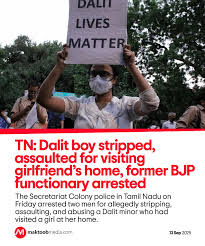
Trichy: An AIADMK functionary was arrested for allegedly assaulting a group of dalit youths campaigning for a DMK candidate in Mannachanallur constituency and was later released on bail following a protest by his supporters on Thursday. The complainant, S Rahul, 26, of Mahalikudi near Samayapuram, along with two others, was campaigning near Maniyampatti on Tuesday in support of DMK candidate S Kathiravan when the incident occurred. Police said a group of AIADMK cadres led by P Kumar, 47, confronted them, allegedly abused them using casteist slurs, threatened them and assaulted them. Rahul sustained injuries in the attack. Based on the complaint, Pulivalam police registered a case under relevant sections of the Bharatiya Nyaya Sanhita for assault, abuse and criminal intimidation, along with provisions of the SC/ST (Prevention of Atrocities) Act, and arrested Kumar on Wednesday. Following the arrest, AIADMK workers and locals staged a road blockade on the Trichy–Thuraiyur State Highway near Peramangalam on Thursday, demanding his release. Traffic was disrupted for about an hour before police intervened and pacified the protesters. Kumar was later released on bail. Courtesy : TOI Note: This news is originally published on https:/timesofindia.com/bha and is used purely for non-profit/non-commercial purposes, especially human rights
Five Dalit stories that changed how I read
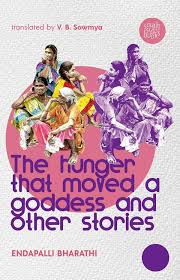
These books pushed me to confront what I thought I understood and to sit with discomfort I am still reading to learn. But this year, I am learning to heal. Healing is not always soft. Sometimes, it comes with a lot of pain. Sometimes, it burns before it soothes. Through these books I’m not just gathering my scattered pieces of history, I am also sharpening them. The Hunger That Moved a Goddess and Other Stories (Hyderabad Book Trust) by Endapalli Bharathi, trs. V.B. Sowmya Bharathi’s stories are demographically rooted in rural Andhra Pradesh, but ideologically they travel far beyond geography. They centre women’s lives from Dalit communities with an honesty that refuses pity. There is hunger, yes, but also defiance, humour, and small, everyday rebellions. The “goddess” in the title doesn’t sit in temples; she walks in bodies that endure and resist. What struck me most is how quietly radical these short stories are. And in between these lives, almost gently, the book teaches you how to eat, how to cook, how to remember through food. Recipes and eating habits appear not as instructions but as stories — of survival, of scarcity, of community. Exquisite Cadavers (Context/Westland) by Meena Kandasamy This is not a conventional novel. It is not biographical or fictional. It is fragmented, self-aware, almost impatient with storytelling itself. Kandasamy weaves together multiple narratives: a love story, a political landscape, a writer’s struggle with form. The title itself suggests bodies — broken, rearranged, reimagined. It feels like a response to violence, not by narrating it cleanly, but by refusing coherence. The book asks: how do you write when language itself has been wounded? Untouchable Goa (Panther’s Paw Publication) by Dadu Mandrekar, trs. Nikhil Baisane Mandrekar disrupts the postcard image of Goa. Through essays and reflections, he exposes the deep entrenchment of caste in Goan society — within Catholic communities, within everyday social structures, within spaces that claim modernity. The writing is sharp, almost journalistic at times, but never distant from storytelling. It forces you to confront how caste adapts, survives, and hides behind narratives of progress, liberalism, and tourism. Pulayathara (OUP India) by Paul Chirakkarode, trs. Catherine Thankamma Set in Kerala, Pulayathara documents the life of the Pulaya community with a depth that feels archival and intimate at once. It engages with landlessness, bonded labour, and generational trauma, but also with community, memory, and continuity. The novel doesn’t rush; it lingers. It allows you to sit with the weight of history. What stays is not just the suffering, but the persistence of life despite it. My Father’s Garden (Speaking Tiger) by Hansda Sowvendra Shekhar This collection of stories is deeply tied to Santhal Adivasi life. Shekhar writes about land, family, migration, and loss with a quiet, observational style. There is no spectacle here — just layered, lived realities. The “garden” becomes a metaphor for belonging and rupture. Development, displacement, and memory intersect in ways that feel both personal and political. It made me think about how landscapes hold histories we are often taught to ignore. Special mention: Ek Dalit Banker Ki Atmakatha by Nimesh Gautam For Hindi readers, this autobiography brings us into a very different terrain — the formal, bureaucratic world of banking. Gautam traces his journey as an employee of the State Bank of India, navigating the institution that claims meritocracy but is structured by caste. He reveals how discrimination operates subtly: in postings, promotions, everyday behaviour, and silence. It’s a rare account that connects caste to white-collar spaces, showing that oppression doesn’t disappear with education or employment. These books didn’t just meet me where I am. They pushed me further. To learn more. To heal more. Siddhesh Gautam The writer is an artist, thinker, and Ambedkarite. Courtesy : The Hindu Note: This news is originally published on https:/thehindu.com/bha and is used purely for non-profit/non-commercial purposes, especially human rights
Dalit History Month | Shocking RTI Revelation from IIM Ahmedabad: Out of 100 Filled Faculty Positions, 99 Belong to Upper Castes—Not a Single Dalit or Adivasi!

This situation stands in stark contrast to the reservation policy, which was designed to promote diversity and social equity. According to the policy, positions for the OBC, SC, and ST categories should ideally constitute 27%, 15%, and 7.5% of the total, respectively; however, in this instance, there is absolutely no representation from these categories. New Delhi—A recent Right to Information (RTI) response from the Indian Institute of Management Ahmedabad (IIM-A) has revealed the category-wise distribution of faculty positions within the institute. The findings are startling: the entire faculty belongs to the ‘General’ category, with not a single member hailing from the Bahujan community. Gaur Kiran Kumar, National President of the All India OBC Students Association (AIOBCSA), had filed the RTI application in January 2026. In its response, IIM Ahmedabad stated that the institute has a total of 120 sanctioned faculty positions across the ranks of Professor, Associate Professor, and Assistant Professor. Of these, 100 positions are currently filled, while 20 remain vacant. According to the data provided in the RTI response, out of the 100 filled positions, 99 belong to the General category, while only one position belongs to the OBC category—and that, too, at the Assistant Professor level. No filled positions were reported from the SC, ST, EWS, or PwD categories. This RTI revelation comes amidst the ongoing struggle regarding the implementation of reservation policies in higher education institutions. On January 29, 2026, the Supreme Court stayed the University Grants Commission (Promotion of Equity in Higher Education Institutions) Regulations, 2026, thereby allowing the 2012 regulations to remain in force. Multiple RTI applications filed by Kiran Kumar Gaur across various IITs and IIMs nationwide have consistently highlighted the overwhelming dominance of the General category in faculty positions. In these premier institutions, more than 80 percent of the faculty members belong to the General category, while in several institutions, this figure exceeds 90 percent. *The Mooknayak* has previously reported on similar facts, highlighting cases involving several IIMs where reserved posts for the SC, ST, and OBC categories have remained vacant for years. **The Situation in Other IIMs** A response received from IIM Indore in 2024 revealed that out of 150 faculty positions, numerous vacancies reserved for specific categories have not been filled. Of these, 106 positions have been filled by General category candidates, leaving 41 positions vacant. In the OBC category, there were only two Assistant Professors, while in the Scheduled Caste/Scheduled Tribe category, there were none. According to an RTI response received in October 2024, the total sanctioned strength of faculty members at IIM Calcutta stood at 126. However, the data reveals significant discrepancies in filling these positions in accordance with the reservation policy. 53 positions were allocated for Unreserved (UR) candidates. The RTI revealed that a total of 73 UR faculty members were recruited—exceeding the allocated limit by 20 positions—and, additionally, 20 UR positions remain vacant. Another RTI inquiry directed at IIM Tiruchirappalli brought to light startling figures: 83.33% of faculty positions for OBCs, 86.66% for SCs, and 100% for STs remained vacant, whereas all positions in the General category were filled. Multiple reports indicate that in many premier institutions, over 80 percent of the faculty members belong to the General category, with some institutions recording a representation of over 90 percent from this category. **Upper Castes Dominate in IITs as Well** Data obtained from IIT Delhi, Kharagpur, Kanpur, Roorkee, BHU, Guwahati, Hyderabad, Gandhinagar, Ropar, Palakkad, Mandi, Jodhpur, Bhubaneswar, Indore, Tirupati, Dharwad, Goa, and Patna reveals a consistent pattern: representation from the General category is disproportionately high, while there is a severe deficit in the representation of OBC, SC, and ST communities. IIT Palakkad: Out of 161 faculty members, 121 (75.15%) belong to the General category; OBC members number 24 (14.9%), SC members 15 (9.31%), and there is only 1 (0.62%) from the ST category. The institute does not have a single SC or ST professor. IIT BHU (Varanasi): Out of 344 faculty members, 79.36% belong to the General category, 11.63% to OBC, 7.85% to SC, and only 1.16% to ST. Out of 608 sanctioned posts at the institute, 260 remain vacant; however, the institute failed to provide a category-wise breakdown of these vacant positions. IIT Kharagpur: This large institution has 775 faculty members, with the General category holding the largest share at 91.22%. Representation for OBC stands at a mere 5.55%, for SC at 2.71%, and for ST at a negligible 0.26%. Out of 1,600 sanctioned posts, 825 are vacant, and no category-wise data has been provided. IIT Gandhinagar: Out of 135 faculty members, 85.93% belong to the General category, while OBC members constitute 5.93%, SC members 5.91%, and ST members 2.96%. At the professor level, representation for OBC, SC, and ST categories is zero. IIT Ropar: Out of 177 faculty members, 78.53% belong to the General category, 14.69% to OBC, 5.65% to SC, and 1.69% to ST. IIT Patna: One of the few institutes that has provided data on category-wise sanctioned posts. Out of 390 sanctioned posts, 228 have been filled. Among the filled posts, 38.16% belong to OBC, 21.49% to SC, and 12.72% to ST; these figures are significantly better compared to other IITs. IIT Roorkee: Here, there are 939 sanctioned posts, but only 533 have been filled. The institute has not provided any category-wise breakdown of sanctioned, filled, or vacant posts. IIT Tirupati: Out of 114 faculty members, 69.30% belong to the General category, 18.42% to OBC, 8.77% to SC, and 2.63% to ST. IIT Mandi: Out of 175 faculty members, 81.14% belong to the General category, 11.43% to OBC, 5.71% to SC, and 1.71% to ST. At the Professor level, the number of faculty members belonging to the OBC, SC, and ST categories is zero. IIT Bhubaneswar: Out of 213 faculty members, 80.28% belong to the General category, 13.15% to OBC, 5.63% to SC, and only 0.46% to ST. IIT Jodhpur: Out of 244 faculty members, 79.10% belong to the General category, 13.11% to OBC, 6.15% to SC, and 0.82% to ST. IIT
Why Did the UNHRC Outrage Over India’s Transgender Amendment Bill? Expressing Opposition, It Warned of Far-Reaching Consequences

In India, the Transgender Persons (Protection of Rights) Amendment Bill, 2026, has received Presidential assent. This amendment bill had faced significant opposition within India. Now, the United Nations Human Rights Council (UNHRC) has also weighed in on the matter, expressing regret over the passage of the Transgender Amendment Bill. Geneva: The United Nations Human Rights Council (UNHRC) has issued a sharp reaction regarding India’s legislation concerning transgender persons. It has alleged that this law was passed in haste, without adequate consultation with stakeholders. The UNHRC further stated that this Indian law would have far-reaching implications for the right to privacy and poses a risk of further marginalizing transgender individuals. However, this is not the first instance in which the UNHRC has attempted to interfere in India’s internal affairs; the Council has previously adopted an aggressive stance toward India regarding the issue of Kashmir. What Did the UNHRC Say Regarding the Transgender Law? Writing on X (formerly Twitter), the UNHRC stated: “We regret that the Transgender Persons (Protection of Rights) Amendment Bill, 2026, was passed so rapidly without adequate stakeholder consultation. These amendments risk eroding the hard-won rights of transgender persons by replacing ‘self-identification’ with mandatory medical examination procedures. India has historically been a leader in upholding the rights of transgender and gender-diverse individuals. This Bill will have far-reaching implications for the right to privacy and poses a risk of further marginalizing transgender persons.” What Is the Transgender Amendment Bill? In India, the Transgender Persons (Protection of Rights) Amendment Bill, 2026, recently received Presidential assent. This amendment primarily seeks to narrow the definition of a transgender person, rendering it more “medically-based.” Under this framework, a certificate from a medical board has been made mandatory for obtaining an identity card. Now, to receive legal recognition as a transgender person, one must obtain a certificate from a Medical Superintendent or a Chief Medical Officer (CMO), following which the District Magistrate (DM) will issue the identity card. What is the United Nations Human Rights Council? The United Nations Human Rights Council is a principal inter-governmental body of the United Nations. Its primary objective is to promote and protect human rights worldwide, as well as to investigate human rights violations. The United Nations Human Rights Council was established in 2006. Its headquarters are located in Geneva, Switzerland. The United Nations Human Rights Council comprises 47 member states, which are elected by the General Assembly for a three-year term. Globally, the United Nations Human Rights Council works on issues such as freedom of expression, freedom of religion, women’s rights, and the rights of racial and ethnic minorities. Provision for Stricter Punishment for Violence Against Transgender Persons Furthermore, the punishment for sexual, physical, or economic abuse committed against transgender persons has been increased; the sentence can now range from 2 years up to 14 years of rigorous imprisonment. There is a provision for imprisonment ranging from 5 to 10 years for anyone who forces a transgender person into begging or bonded labor. The government states that the objective of this amendment is to ensure the safety and welfare of the transgender community. Reported by: Priyesh Mishra About the Author Priyesh Mishra, He currently serves as a Principal Digital Content Producer at Navbharat Times Online. He is associated with the ‘World’ section of Navbharat Times. He possesses 10 years of experience in digital journalism, during which he has worked in various roles involving both reporting and desk operations. Courtesy: Hindi News
Assam polls: Rahul Gandhi unveils Congress manifesto, focus on governance, identity

NEW DELHI: Congress MP Rahul Gandhi on Thursday unveiled the party’s manifesto for the upcoming Assam Assembly elections, outlining commitments across 11 key sectors including governance, identity and healthcare. The manifesto was released at an election rally in the presence of Assam Congress president Gaurav Gogoi and other senior party leaders, reported PTI According to the party, the document lays out 11 resolutions covering governance, identity, healthcare, infrastructure development, industrialisation, agriculture, rural and urban development, climate change, and a “secured Assam.” The release comes days after the Congress announced its “five guarantees” during the March 29 visit of party chief Mallikarjun Kharge. Polling for the 126-member Assam Assembly is scheduled for April 9, with counting of votes to take place on May 4. The manifesto release marks a key step in the party’s campaign as it seeks to consolidate support ahead of the single-phase election in the state it has been out of power for a decade. Courtesy : TOI Note: This news is originally published on https:/timesofindia.com/bha and is used purely for non-profit/non-commercial purposes, especially human rights
Cong pledges ST tag to 6 groups, Rahul unveils 100-day action plan
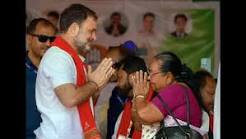
Guwahati: Congress leader Rahul Gandhi on Thursday released the party’s manifesto for the 2026 Assam assembly election in Karbi Anglong, while AICC leader Pawan Khera released it almost simultaneously in Tezpur. The manifesto promises Scheduled Tribe status for tea tribes and five other communities. BJP, in its manifesto released earlier, said it will actively pursue the central govt to implement the recommendation of the Group of Ministers in respect of ST status to the six communities of Koch Rajbongshi, Tai Ahom, Adivasis and Tea Tribes, Chutia, Moran and Matak. Titled “Raijor Istahar”, the document adds to the five guarantees earlier announced by Congress. The manifesto says the BTC, KAAC and Dima Hasao councils will be strengthened with greater financial and administrative powers, and displaced tribal communities will be rehabilitated. “Within the first 100 days, along with ensuring justice for Zubeen Garg, the party has committed to completing five key tasks to build public trust. This will be followed by institution-building within one year and structural transformation within five years,” the party said in a release. Congress said the Assam Accord would be fully implemented to ensure constitutional safeguards. “Tribal lands will be protected under the Sixth Schedule and Forest Rights Act, and encroachment will be prevented.” The manifesto also says that Assam will be developed as a major education hub, with AI-enabled govt schools. “The “Tuition Baideu” programme will reduce private tuition costs. Under the “Porhiba Card”, education loans up to Rs 5 lakh at 4% interest will be provided, repayable after employment.” The five tasks promised to be completed in the manifesto within the first 100 days are: publication of a White Paper on the state’s financial condition and creation of an anti-corruption commission; a transparent land records, revenue and taxation system; priority for local people in jobs and govt contracts; immediate flood relief and the start of erosion control measures; and fast-track recruitment to fill vacancies in hospitals and schools. Within one year, the party promises institution-building measures, including guaranteed annual grants and accountability dashboards for Panchayati Raj institutions, district-level single-window citizen service centres, police reforms and fast-track courts for corruption, land and women-related cases, MSME clusters and entrepreneurship missions, and upgraded district hospitals along with expanded digital classrooms. Its five-year transformation goals include fully decentralised and performance-linked governance with public reporting, an integrated and fully digital governance system for all services, universal healthcare and 100% school enrolment, major reduction in flood and erosion impact, and doubling income with sustained employment growth. The manifesto also announces the “Karmayogi Udyogi” initiative for men. Under it, a Rs 1,000 crore Assam Youth Entrepreneur Venture Fund will support first-time startups. Through the “Udyami Card”, first-generation entrepreneurs will get collateral-free loans up to Rs 10 lakh at 4% interest. For widows, the manifesto promises priority in housing, ration and healthcare schemes. The party also said, “An Advocates’ Welfare Fund will be created for lawyers and legal workers. Travel and logistical expenses for lawyers affected by High Court relocation will be covered. More than 500 judicial clerks will be appointed in district and sessions courts to speed up judicial processes.” Congress further promised a Smart Parking Policy in Guwahati and other cities to ease congestion. It promised that a “Zubeen Garg Fellowship” will be introduced for youth in cultural fields. Courtesy : TOI Note: This news is originally published on https:/timesofindia.com/bha and is used purely for non-profit/non-commercial purposes, especially human rights
Selling India to Trump: Rahul Gandhi accuses Modi of compromising India’s agriculture and data; Claims the Prime Minister has weakened the nation’s security

Guwahati: Rahul Gandhi on Thursday accused Prime Minister Narendra Modi of selling India to Donald Trump and the United States, alleging at campaign rallies in Assam that the BJP-led govt had opened India’s agriculture sector to American farmers, weakened the country’s energy independence and compromised its data. Addressing rallies in Karbi Anglong and Jorhat in support of united opposition alliance candidates, the Leader of Opposition said the India-US deal signed by Modi had put pressure on Indian farmers and businesses. Campaigning in Karbi Anglong for opposition candidate and APHLC leader JI Kathar from the Diphu seat, Rahul said, “Narendra Modi initiated and signed the India-US deal. You will say why Rahul is talking about the US-India deal in Assam’s elections. But there is a reason for this, because you need to understand where the pressure on you is coming from. Narendra Modi signed the US deal. He gave four to five things to America. Hindustan’s agricultural system, the hard work of our farmers — Narendra Modi opened it up for American farmers.” He said no previous Prime Minister had taken such a step and added, “Soybean, dal, fruits, cotton — all of this, Narendra Modi opened up for American farmers. Indian farmers have small fields, they have less mechanisation, while America has farms spanning thousands of acres with extensive mechanisation. Indian farmers will be crushed, trampled, and wiped out.” At both rallies, Rahul also alleged that Modi had compromised India’s energy security by allowing the US to influence crude oil purchases. He said, “The oil we purchase — Narendra Modi handed it over to America. Today, if India wants to buy oil from other countries, permission is needed — whose permission? Donald Trump’s, America’s. Today, if we want to buy oil from Russia, Iran, or Iraq, we cannot buy it without asking Donald Trump.” He further alleged that India’s data had been handed over to the US. “They can do whatever they want with our data, store it wherever they want,” he said. Rahul also claimed Modi had committed India to buying goods worth Rs 9 lakh crore annually from American companies, which he said would hurt small businesses and medium industries. “Narendra Modi gave a lot to America, but America gave nothing to India — nothing at all. Their taxes were reduced, our taxes were increased, they took our data, took our oil, took away our agriculture. So the question arises — why this deal?” he said. In a fresh attack, Rahul referred to the Epstein files and alleged, “Narendra Modi’s entire character is contained within those files. Donald Trump abuses Modi, and Modi cannot say anything. Donald Trump publicly says that I will destroy Narendra Modi’s career — ‘I will destroy him whenever I want.” And then in a tweet he says Narendra Modi “calls me Sir” — India’s Prime Minister calls me Sir.” Rahul also accused Assam CM Himanta Biswa Sarma, Modi and Union home minister Amit Shah of working together to transfer land in Assam to big corporates. “And the job of the Prime Minister and chief minister is to loot you. It is straightforward — Prime Minister ji, Amit Shah, and Himanta ji have together set up an ATM here — an ATM of your land. Whatever land they need, they take it,” he said. He added, “Without asking you, he himself snatches your land. Adani’s solar project (18,000 bigha), Ambani (13,000) bigha, Adani thermal project (6,000 bigha), Adani power plant (1,400) bigha land, Ramdev — 7,000 bigha — they are directly snatching your land and giving it to them.” In Titabor, Rahul raised the issue of tea garden workers’ wages and accused BJP of failing to fulfil its promise of Rs 350 per day. “During the elections, they said you (tea garden workers) will be given Rs 350 rupees as wage per day. How much do you get, how much money do you get? They (BJP) now say they will give Rs 500 rupees. They didn’t fulfil the promise made 5 years ago, they lied to you, and then after that, 5 years later, they are lying again,” he said. Courtesy : TOI Note: This news is originally published on https:/timesofindia.com/bha and is used purely for non-profit/non-commercial purposes, especially human rights