
Allahabad High Court’s Important Directive: A QR Code-Based System Should Be Implemented to Prevent Fake Caste Certificates in Uttar Pradesh

To curb the circulation of fake caste certificates in Uttar Pradesh, the Allahabad High Court has given the Yogi government a crucial suggestion to implement a new system based on QR codes and software. Uttar Pradesh: Expressing serious concern over the increasing number of fake caste certificates, the Allahabad High Court has issued a crucial suggestion to the Uttar Pradesh government. The court believes that a software and QR code-based certification system should be implemented for Scheduled Castes (SC), Scheduled Tribes (ST), and Other Backward Classes (OBC). This new technology will directly combat fraud. The High Court clarified that this technology-based verification system will bring transparency to the entire process, eliminate arbitrary powers held by officials, and curb the issuance of fake caste certificates. The court also noted that adopting such innovative measures will facilitate proper audits and provide a reliable means of verifying the authenticity of issued certificates. This significant observation was made by a division bench of Justice Saumitra Dayal Singh and Justice Swarupama Chaturvedi while hearing a Public Interest Litigation (PIL). The PIL was filed by the UP Koli Kori Pratinidhi Sabha. The petition drew the court’s attention to a serious ground reality. The petitioner organization alleged that Scheduled Caste certificates were being issued to members of the “Koli” caste, even though this caste is not recognized in the Scheduled Caste list. This was happening simply because its pronunciation resembles that of the “Kori” caste, which is actually listed as a Scheduled Caste. The petition alleged that local officials were issuing certificates to the wrong people based solely on similar names or spellings, a direct violation of the President’s orders. No one appeared on behalf of the petitioner during the hearing. However, Additional Advocate General Manish Goyal presented his case on behalf of the state government. Given the gravity of the matter, the division bench strongly criticized the flaws in the current verification process. The court stated that the current system empowers lower-level officials with excessive privileges. Prima facie, it appears that modern technology is so capable that the state government can provide a robust and transparent software-based system for SCs, STs, and OBCs. This will eliminate the unnecessary and unchecked powers held by officials up to the tehsildar level, which often lead to the issuance of questionable or incorrect certificates. Following these strong and important observations by the High Court, Additional Advocate General Manish Goyal sought time from the court to obtain necessary instructions from the relevant officials. In its July 2 order, the division bench directed the matter to be listed for further hearing on July 23. Rajan Chaudhary Courtesy: Hindi News
CJP’s protest continues for the 16th day, hunger striker Sonam Wangchuk loses 6 kg.
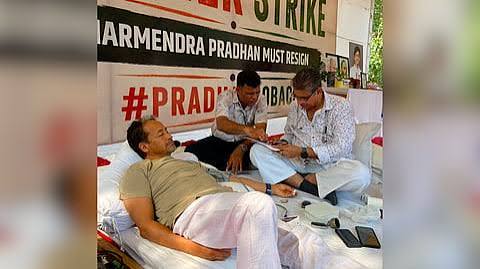
Students’ anger continues at Jantar Mantar over the NEET paper leak and exam malpractice. Climate activist Sonam Wangchuk’s indefinite hunger strike has added a new edge to the movement amid demands for the Education Minister’s resignation. New Delhi: The Cockroach Janata Party (CJP)’s protest at Delhi’s Jantar Mantar against the alleged exam malpractice and paper leak entered its 16th day on Sunday, July 5. Protesters continue to demand the resignation of Education Minister Dharmendra Pradhan and accountability of the government. Meanwhile, this was the eighth day of renowned climate activist Sonam Wangchuk’s indefinite hunger strike. Due to this rigorous fast, he has lost approximately 6 kg. According to a health bulletin issued by doctors, Wangchuk’s blood pressure while lying down was recorded at 112/70 mm Hg. Her heart rate remains at 72 beats per minute and her blood sugar level is 67 mg/dL. The medical report clearly states that her hydration is normal and she is mentally alert. However, her current weight has dropped to 60.95 kg, representing a loss of approximately six kg in seven days. The CJP has been demanding the resignation of the Education Minister. They allege that repeated exam irregularities and paper leaks have ruined the lives of countless students and their families. In this regard, CJP founder Abhijeet Dipke informed on the social media platform ‘X’ that on Sunday (July 5), the parents of NEET candidate Riya Kumari Thapa arrived at the protest site. The organization claims that Riya’s dreams were shattered due to the alleged paper leak, leading to her tragic death. Dipke explained that Riya’s father is a former soldier and joined the protest with the plea that no other family should suffer the pain that his family has endured. He urged the central government to ensure that such incidents do not recur in the future. In another post, the CJP clarified that it stands firmly with Thapa’s parents in this hour of grief and will continue to fight against the corrupt system that failed their daughter. The National Eligibility-cum-Entrance Test (NEET) for admission to medical colleges was held on May 3, but was cancelled amid serious allegations of paper leaks. A re-examination was subsequently held on June 21. On the other hand, the Samyukta Kisan Morcha (SKM) has already expressed its support for the CJP’s movement. The farmers’ organization is now sending a delegation to Jantar Mantar on July 7. Earlier, in its letter to the CJP, the SKM had stated that its delegation would visit the protest site on Sunday (July 6). The farmers’ body expressed solidarity with the agitating students and youth, stating that a transparent, fair, and credible examination system is every student’s fundamental right and that it is the government’s duty to ensure accountability. On a separate platform at the protest site, several members of the left-wing student organization, the All India Students Association (AISA), are also continuing their indefinite hunger strike. On Saturday (July 4), Danish Ali, joint secretary of the Jawaharlal Nehru University Students Union (JNUSU), had to be admitted to Ram Manohar Lohia Hospital. On the seventh day of the hunger strike, her blood sugar level dropped dangerously to 46 mg/dL. Meanwhile, Neha, Manish, Rishikesh, Deepak Kumar Verma, and Amin continue their indefinite fast at the protest site. The CJP’s protest, which began on June 20th over alleged irregularities in the country’s examination system, has already garnered widespread support from several prominent political leaders, social activists, and members of civil society. Rajan Chaudhary Courtesy: Hindi News
A shameful incident in Ballia, Uttar Pradesh: Dalit maid raped for years under false pretenses of marriage, threatened with death if forced to convert.
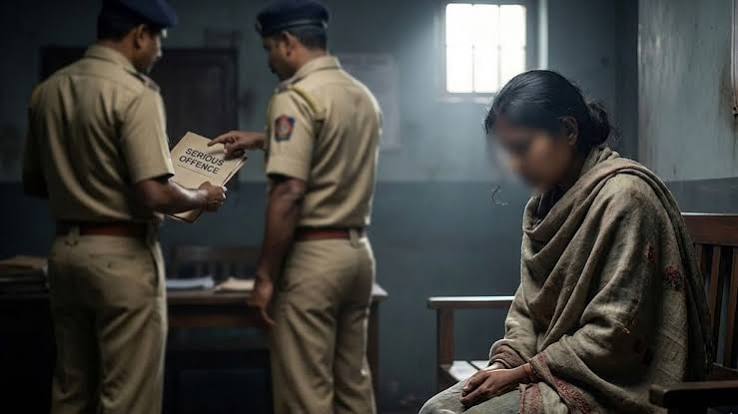
In Ballia, an orphan Dalit girl was raped for seven years after a marriage agreement was signed, and pressure was now being exerted to convert. A case has been filed against the accused, Jalaluddin, under the Protection of Children from Sexual Offences (POCSO) Act. Uttar Pradesh: A shocking incident has come to light from Ballia district. A Dalit woman has accused her employer of raping her for years after falsely promising marriage. The victim also alleges that the accused was constantly pressuring her to convert. Considering the seriousness of the matter, the police have registered a case against the accused and initiated an investigation. According to the police complaint, the 24-year-old accused, Jalaluddin, took advantage of the victim’s orphanhood and poverty. He kept her at his home under the pretext of providing domestic work. The woman alleges that the accused began molesting her while she was working and gradually subjected her to his lust. According to the victim, she had been subjected to forced sexual intercourse since 2017. The complaint also reveals a shocking revelation. The victim says that when she threatened to speak out against this abuse, Jalaluddin resorted to a trick to silence her. On August 10, 2021, he entered into a “written agreement” with her and allegedly staged a marriage. The girl was only 17 years old at the time. During this written agreement, the victim was assured that when she turned 20, the accused would formally marry her. She was also lured with a share in his property. However, as time passed, these promises proved to be a fraud. According to the complaint, when the woman pressured Jalaluddin to marry her as promised, he imposed the condition of religious conversion. It is alleged that when the victim flatly refused to convert, she was threatened with death. Furthermore, the woman also claims that the accused is now planning to marry another woman. Rasra Circle Officer (CO) Rajneesh stated that a case was registered against Jalaluddin on Saturday based on the victim’s complaint. The accused has been charged under sections related to rape in the Indian Penal Code (IPC), as well as the Protection of Children from Sexual Offences (POCSO) and the SC/ST Act. The police are currently conducting a thorough investigation into the matter. The legal process of recording the victim’s statement in a local court in Ballia is underway. In compliance with the Supreme Court’s clear directives and the right to privacy in sexual assault cases, the victim’s identity has been kept strictly confidential. Rajan Chaudhary Courtesy: Hindi News
Tamil Nadu: Woman allegedly abducted by kin for marrying Dalit man; four arrested

Days after seeking police protection for their inter-caste marriage, a Trichy couple allegedly came under attack, with the husband assaulted and the woman forcibly taken away by her relatives. A 26-year-old woman was allegedly abducted by members of her own family for marrying a Dalit man against their wishes in Tamil Nadu’s Trichy district. Police rescued her within hours and arrested four people, including her relatives, in connection with the incident. The woman, M Chithiravalli, from Mudukkupatti, belongs to the Most Backward Class (MBC) community. She had married P Ajith Kumar, who belongs to the Scheduled Caste (SC) community, on June 25 despite opposition from her family. The couple had met while working at a plastic and vessels store owned by Chithiravalli’s brother-in-law, P Murugesan, in Manapparai. Following their marriage, the couple approached the Manapparai All Women Police Station seeking protection. Police conducted an inquiry with members of both families. After Chithiravalli stated that she wished to live with her husband, she was allowed to leave with Ajith Kumar. On July 1, however, Murugesan lodged a complaint with the Manapparai police, alleging that Ajith Kumar had threatened him. Police summoned both parties for an inquiry on July 4. While Ajith Kumar, Chithiravalli and his mother appeared before the police, Murugesan did not. After recording their statements, Ajith Kumar, Chithiravalli and his mother left the police station in an autorickshaw and were travelling towards Sithanatham. At around 1.40 pm, near Maravanur on the Trichy-Dindigul National Highway, the autorickshaw was intercepted by a group that arrived in two vehicles. According to the police, the group assaulted Ajith Kumar, allegedly abused him with caste-based slurs, threatened to kill him, and forcibly abducted Chithiravalli. Ajith Kumar and his mother tried to stop them but were unsuccessful. Based on Ajith Kumar’s complaint, the Manapparai police registered a case under the relevant provisions of the Bharatiya Nyaya Sanhita (BNS) and the Scheduled Castes and Scheduled Tribes (Prevention of Atrocities) Act. Police arrested Chithiravalli’s brother, M Malaisamy; her brother-in-law, P Murugesan; Murugesan’s brother, P Prakash; and N Amanullah alias Mala. All four have been remanded to judicial custody. The two vehicles allegedly used in the abduction were also seized. Chithiravalli was later traced to her grandmother’s house in Yagapuram, where she had allegedly been confined by her family. She was rescued on Saturday night and reunited with her husband. Police said Chithiravalli’s family had allegedly been pressuring her to leave Ajith Kumar and had threatened him with consequences if she refused. Further investigation is underway. Courtesy : TNM Note: This news is originally published on https:/thenewsminute.com/bha and is used purely for non-profit/non-commercial purposes, especially human rights
Alleged rape of a Dalit girl in Neemgaon: Family apprehended the accused and handed him over to the police, a case has been registered.

A case of alleged rape of a 15-year-old Dalit girl has come to light in the Neemgaon police station area of Lakhimpur Kheri. It is alleged that on the night of July 5th, a young man named Mehboob, a resident of the same village, entered the house and forcibly raped the girl. The family apprehended the accused on the spot and handed him over to the police. According to the police, the accused, Mehboob, son of Ahmed Raja, entered the house by jumping over the wall at night. The girl was sleeping inside at the time. It is alleged that the accused tore her clothes and raped her. The family members were awakened by the girl’s screams. The family members apprehended the accused Mehboob on the spot and immediately informed Dial 112 police. Upon receiving the information, a police team arrived at the scene and took the accused into custody and took him to the police station. Based on the complaint filed by the victim’s mother, a named FIR has been registered against the accused at the Neemgaon police station. Neemgaon Police Station Chief Praveer Kumar Gautam stated that a named case has been registered based on the complaint filed by the victim’s mother, and further legal action is underway. Tension prevails in the village due to the case involving two communities. Ashwani Bajpai | Behjam (Lakhimpur Kheri), Lakhimpur Kheri Courtesy: Hindi News
Following the High Court’s reprimand, Bihar Police took major action: 7, including 5 officers, arrested in the case of a Dalit youth missing for 10 months.

Following the Patna High Court’s strictness, Bhojpur Police took major action, with Excise Department officials facing serious charges of custodial death and concealment of evidence. New Delhi: Following the Patna High Court’s strictness, the police have taken a major step in the case of a Dalit youth missing for 10 months in Bhojpur district, Bihar. A total of seven people, including two Excise (Excise) Department officials and three Home Guards, have been arrested in this sensational case. Court and Judiciary Bhojpur Superintendent of Police (SP) Raj confirmed that six of the seven arrested accused have been sent to judicial custody, while one has been taken on police remand. The arrested officers include Assistant Sub-Inspectors (ASIs) Dheeraj Kumar and Raj Kumar. In addition to these, Home Guards Dharmendra Paswan, Umesh Kumar Yadav, and Raju Kumar Singh have also been arrested. Along with these five government employees, two private drivers, Surendra Kumar Singh and Vikas Kumar, have also been arrested. The entire case is related to the disappearance of Sanoj Kumar, a 31-year-old Dalit youth. In August 2025, the Excise Department conducted a raid in Dharhara Musahar Toli near Bihiya in Bhojpur district in connection with a liquor case. The family alleges that Sanoj has been missing since he was taken into custody on August 13, 2025. The Excise Department has consistently claimed that the youth escaped from their custody, but the family has made serious allegations of murder and destruction of evidence in police custody. The High Court took a tough stand while hearing a habeas corpus petition filed by Sanoj’s father, Gauri Shankar Ram. Citing the July 2 order before a division bench of Justices Rajiv Ranjan Prasad and Kumar Manish, the Bhojpur Superintendent of Police made a shocking revelation. Law Enforcement The Superintendent of Police informed the court that interrogation of the arrested excise department personnel revealed contradictory versions of the incident. The investigation revealed that Sanoj was manhandled while in custody, and that a private driver driving the excise department vehicle had pulled him upwards by putting a towel around his neck. Excise officials also relied on CCTV footage to support their theory of Sanoj’s escape in court. They claimed that the young man escaped by opening the rear door of the vehicle. However, after reviewing the footage, the Patna High Court, in its oral observation, stated that the vehicle was a fully enclosed Bolero. The court clarified that escaping by jumping out without opening the rear door was impossible. Given the sensitivity of the case, the court directed adequate security for key witnesses. The police informed the court that two other individuals detained with Sanoj were afraid to speak the truth. The court also recorded the statement of Sanoj’s father, Gauri Shankar Ram, in which he stated that several people were pressuring him to hush up the case. The court directed the police to conduct an impartial investigation into these allegations. In the previous two hearings, the High Court had raised serious questions about the investigation’s conduct. On June 30, the court recorded that on the day of the raid, Sanoj had called his father at 6:35 and 6:43 pm to inform him that he had been apprehended by excise department officials. Investigators also discovered that the last tower location of one of Sanoj’s mobile phones was at the Jagdishpur Excise Police Station. South Asians and Expatriates The court expressed strong displeasure that excise officials handed over the mobile phone to the police the next day but did not send it for forensic examination. On June 24, the court remarked that despite being identified as suspects 10 months earlier, no seven members of the team had been questioned or arrested. The High Court has warned that if the investigation continues to be slow, the case may be handed over to an independent agency. The next hearing in the case will be held on July 7, where the Bhojpur police will have to present a further investigation report to the court. Rajan Chaudhary Courtesy: Hindi News
July 8th deadline, caste certificates not issued: Will 11,000 SC students in Karnataka be deprived of reserved CET seats?
Recognizing the gravity of the situation, the KEA has written to the Secretary of the Revenue Department, requesting the prompt issuance of certificates for affected students. Bengaluru – Thousands of Scheduled Caste (SC) students in Karnataka are facing a serious crisis amid the Common Entrance Test (CET) counseling. July 8th is the deadline for Option Entry, but more than 11,086 SC students have not yet obtained the required caste certificates in accordance with their internal reservation. If the certificates are not issued by the deadline, these students may be denied their choice of reserved seats. This information has emerged in a detailed report by The Hindu, which states that the main reason for the problem is the delay in issuing new caste certificates at tehsil offices across the state. What is the cause of the problem? The Karnataka government recently implemented internal reservation within Scheduled Castes. Under this, the SC community is being divided into different categories: Category A, Category B, and Category C. However, when CET applications were filed, the government had not implemented internal reservation. Therefore, students applied based on their old caste certificates. After the government implemented internal reservation, the Karnataka Examination Authority (KEA) directed that students seeking internal reservation within the SC category must update their Revenue Document (RD) number of the caste certificate issued in the new format on the online portal. This is where the crisis began. More than 11,000 students are stuck in this predicament. According to information, a total of 43,353 Scheduled Caste students applied. Of these, 32,267 students have entered their new RD number, while 11,086 students have not yet received their new caste certificates. These students say they applied several weeks ago, but the certificates have not been issued by the tehsil offices. Due to this, the KEA (Karnataka Examination Authority) portal is not allowing them to enter options. Some students told The Hindu that new certificates were not required when they applied. KEA subsequently demanded a new certificate under internal reservation. They applied about a month ago, but the tehsil office has not yet issued the certificate. As a result, they are unable to complete the counseling process. Given the gravity of the situation, KEA has written to the Secretary of the Revenue Department, requesting the immediate issuance of certificates to the affected students. According to KEA Executive Director H. Prasanna, students who have not yet updated their RD numbers have been notified via SMS and newspapers so they can complete the process as soon as possible. He expressed hope that all eligible students will receive their certificates in time. Meanwhile, a Revenue Department official claimed that there are no unusual delays on the department’s part. According to him, most applications are being processed within the stipulated 21-day deadline. However, some new applications and cases related to amendments to old certificates are still pending. What is Karnataka’s internal reservation system? Internal reservation in Karnataka is a “quota within quota” system within the 15% Scheduled Caste (SC) quota. Under this system, all 101 SC sub-castes are divided into three distinct groups based on their socio-economic status, so that the most backward castes can directly benefit from reservation. Under this formula, in April 2026, the then Chief Minister Siddaramaiah government divided the SC quota as follows: Group A (SC Left): 5.25% (includes the most disadvantaged castes) Group B (SC Right): 5.25% (includes more aware and influential castes) Group C (Other SCs): 4.5% (nomadic castes) The government made this decision in light of continued protests by students and job seekers, with widespread unrest in Dharwad and other areas of Karnataka due to recruitment delays. What experts say Senior IRS officer Netra Pal has questioned the government’s process regarding this entire controversy. He said that he had already warned that adding the internal reservation category directly to the caste certificate would prove to be unnecessarily complex and cumbersome. Netrapal said, “I have always maintained that adding the internal reservation category to the caste certificate was a wrong decision. Instead of changing the original caste certificate, the government should have issued a separate sub-caste certificate.” He further stated that scrutiny committees will now face numerous technical disputes, and innocent students will face questions that will be extremely difficult for them to answer. According to him, the confusion surrounding caste certificates that arose after the implementation of internal reservation has not yet been resolved, and students may suffer the greatest loss. Geetha Sunil Pillai Courtesy: Hindi News
House not found even after High Court order: Dalit widow makes serious allegations against accountant, son appeals to Chief Minister

Sitapati, a Dalit, disabled, and elderly widow, is unable to regain possession of her land despite a High Court order. She alleges that the administration is re-encroaching on the land she had been granted possession of. She is running around officials seeking justice. Sitapati, a resident of Poore Bhatta Majra Azadpur in Tiloi tehsil, has alleged in a petition to the District Magistrate that the regional accountant, Akhand Pratap Singh, without informing her, staked a stake in plot number 2309 in favor of a person named Naseem. When she protested, the accountant allegedly behaved rudely, threw away documents, and threatened her. The woman also alleges that a demand of 10,000 rupees was made in this matter. The victim’s son, Devi Prasad, alleges that when she showed the accountant the Honorable High Court order and other revenue records, the accountant allegedly tore the documents and threw them away. Devi Prasad claims that the accountant said, “I keep the High Court in my pocket.” The family has demanded an impartial investigation into these allegations. Sitapati says she is financially weak and has been constantly running around officials to seek justice, but has received no relief so far. She has appealed to Chief Minister Yogi Adityanath, the District Magistrate of Amethi, and the Revenue Department to conduct an impartial investigation into the entire matter, take strict action against those found guilty, ensure the safety of her land, and provide speedy justice. When contacted, regional accountant Akhand Pratap Singh stated that he had no knowledge of the matter. Anand Kumar Trivedi | Tiloi Courtesy: Hindi News
Samajwadi Party plans to field 100 Dalit, tribal candidates in UP assembly polls

The strategy is intended to project the SP as a party willing to provide Dalits greater political representation than the number of reserved constituencies. The Samajwadi Party (SP) is planning to field around 100 Scheduled Caste (SC) and Scheduled Tribe (ST) candidates in the 2027 Uttar Pradesh Assembly elections, including 14 candidates in general constituencies, as part of its strategy to strengthen its PDA (Pichhda, Dalit, Alpsankhyak) alliance. According to party sources, the plan includes contesting all 84 seats reserved for Scheduled Castes, both Scheduled Tribe seats, and around 14 general seats with Dalit candidates, subject to the availability of suitable nominees. Party leaders said the move is aimed at expanding the SP’s support beyond its traditional Yadav-Muslim base and attracting Dalit voters as the Bahujan Samaj Party’s electoral influence declines. “We are working on zeroing in on candidates from Dalit communities who can contest on general seats. While our target is to give 100 seats to the community, it will depend on suitable and strong candidates,” a party source said. The SP had fielded Dalit candidates in two general constituencies during the 2024 Lok Sabha elections. Awadhesh Prasad won from Faizabad, while Sunita Verma narrowly lost in Meerut. Party leaders said the strategy is intended to project the SP as a party willing to provide Dalits greater political representation than the number of reserved constituencies. The BSP, which once commanded a significant share of Dalit votes, won only one seat in the 2022 Uttar Pradesh Assembly elections and failed to win any seat in the 2024 Lok Sabha polls. The BJP and Congress have also intensified their outreach to Dalit voters ahead of the 2027 Assembly elections. SP Rajya Sabha MP Ramji Lal Suman expressed confidence that a significant section of Dalit voters would support the INDIA bloc, while party chief Akhilesh Yadav has urged voters not to back the BSP, arguing that a vote for the party would be wasted Courtesy : Madhyamam Note: This news is originally published on https:/madhyamam.com/bha and is used purely for non-profit/non-commercial purposes, especially human rights
‘Forced into sexual relations since 2017’: Dalit domestic help alleges rape, pressure to convert religion in UP

BALLIA: Police have registered a case against a man based on a complaint by his Dalit domestic help, who alleged that she was raped on the promise of marriage and pressured to convert her religion, officials said on Sunday. The woman, who had been working at the man’s house in Uttar Pradesh’s Ballia district for several years, alleged that he entered into a “written agreement” of marriage with her five years ago when she was 17, promising to formalise the marriage when she turned 20. She further alleged in her police complaint that he had molested her and forced her into other sexual acts even before that period. According to the police, a case was registered against Jalaluddin (24) on Saturday. He has been booked under relevant sections of BNS, including rape, and Protection of Children from Sexual Offences (POCSO) Act and the SC/ST Act. A police official told news agency PTI that, in her complaint, the woman stated that Jalaluddin brought her to his house for domestic work, taking advantage of the fact that she was poor and an orphan. He allegedly began molesting her gradually and later developed physical relations with her. The victim alleged that when she threatened to speak up, Jalaluddin, entered into a “written agreement and married” her on August 10, 2021. At the time, she was told that he would formally marry her and give her a share in his property once she turned 20, the official said. When she later pressured him to marry her, she was allegedly coerced to convert her religion. When she refused, she was allegedly threatened with death, police said. The woman further alleged that Jalaluddin had been forcing sexual relations with her since 2017. She also claimed that he is now planning to marry another woman, police added. Rasra Circle Officer (CO) Rajnish said a case has been registered based on the victim’s complaint. He added that procedures are underway to record the victim’s statement before a local court in Ballia, and police have initiated a detailed investigation into the matter. (The victim’s identity has not been revealed to protect her privacy as per Supreme court directives on cases related to sexual assault) Courtesy : TOI Note: This news is originally published on https:/timesofindia.com/bha and is used purely for non-profit/non-commercial purposes, especially human rights