
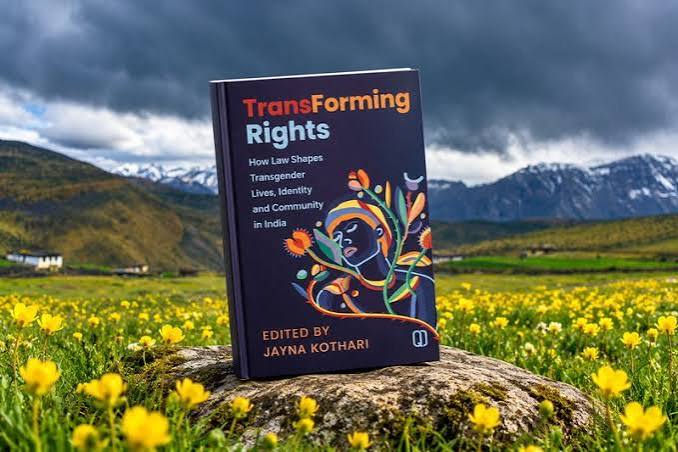
The books aims to assess where we stand on issues of self-identification by trans folx, demand for reservations, livelihood, familial spaces and identity
The laws around queer-trans jurisprudence are rooted in a colonial legacy beginning with the ominous Section 377, partly repealed by a judgment of the Supreme Court in 2018. The book ‘Transforming Rights : How the law shapes Transgender Lives, Identity and Community’, edited by Jayna Kothari, brings together activists, lawyers and professionals working in trans jurisprudence in India. Together they assess where we stand on issues of self-identification by trans folx, demand for reservations, livelihood, familial spaces, and identity under the larger project of nation-state while simultaneously also imagining possibilities of an inclusive future.
Surveys and current reports on socio-economic indicators present a bleak picture. As SVD Chandrashekhar and Avinaba Dutta write, 92 per cent of trans-population in India is denied the opportunity to engage in any economic activity, in fact skilled and qualified trans persons have also reported systemic workplace discrimination on account of their transness pointing to increased marginalisation. This is directly co-related to both covert and overt violence built into the Indian education system against queer, trans, intersex and other gender conforming minorities.
Violence is not limited to the public sphere for trans folx. Aqsha Sheikh and Raghavi Shukla talk about exclusion of queer-trans folx from both adoption and surrogacy frameworks in India. The state uses its legislative powers to restrict trans folx from living a fulfilling life by continuing to deny them the freedom to form families of their choosing. In such a scenario, love becomes subversive, an instrumentality mired in deliberate violence and denial. Even within the popular queer landscape, love’s portrayal has largely been limited to cis male desire. Indian State continues to deny queer couples the bouquet of rights available to cis heterosexual couples as a way of ordinary right. Sheikh and Shukla write that the denial of love, marriage and partnership to transgender persons violates their right to equality, privacy, choice and life with dignity. While some progress has been made in this regard through recent court judgments, the Supreme Court has refused to declare marriage equality a fundamental right refusing to extend the guarantees of Articles 14, 15, 19, and 21 to queer couples in any meaningful manner.
Santa Khurai explores the meaning of citizenship as a transperson belonging to the state of Manipur. She talks about systemic exclusion not just based on her gender but also inhabiting a space often excluded from the ‘Indian mainland’ in popular imagination, an existence woven with intergenerational trauma and of being removed from national consciousness. Even as the Trans Act, 2019, provided for an umbrella of rights, it didn’t concern itself with the needs of people who face multiple conflicts such as militarisation and ethnic strife. Larger questions around identity remain both contentious and unanswered for many.
Vajayanti Vasanta Mogli and Grace Banu further problematise the discourse on identity through caste. NALSA judgment of 2014 regards all transgender persons as members of socially and economically backward community (SEBC). They argue that this erases historic equations of power marked by caste divisions in India. Grace talks about the discrimination Dalit transfolx face within the larger trans category. While more overt forms are easy to recognise, silent discrimination is extremely common within the community. The reservation promised under the Trans Act, 2019, hasn’t materialised in any meaningful way. The National Education Policy 2020 also doesn’t mention anything about reservation for trans folx in educational institutes. Sayantan Datta rightly points out that policyscapes become ‘sites of confrontation’ for marginalised groups as they often exacerbate their marginalisation. The book also looks at various arguments presented in favour of horizontal reservations for transgender persons.
Jayna Kothari writes about the larger promise of emancipation built into the struggle for trans-rights. She particularly looks at articles 14, 15, and 16, which are a part of our fundamental rights, effect of trans rights cases and the meaningful ways in which it has transformed the rights of women and gay persons. Beginning with judgments in NALSA, Joseph Shine, and then Jane Kaushik, she argues that while Article 15(1) of the Indian Constitution guarantees non-discrimination only on five grounds (race, sex, caste, religion and place of birth), in NALSA, the Supreme Court expanded the ground of ‘sex’ to include gender identity. In Navtej, the route of analogous grounds was adopted. It is through these ways, Jayna writes that there exists an emancipatory potential for all women through the expansion of rights for transpersons. This book is a wonderful primer for anyone who is interested to learn about jurisprudence in India, in general, and trans-jurisprudence in particular.
Transforming Rights: How the Law Shapes Transgender Lives, Identity and Community in India, edited by Jayna Kothari. QD. Pages 324. Rs 599
Book Title: Transforming Rights: How the Law Shapes Transgender Lives, Identity and Community in India
Author: Edited by Jayna Kothari
[This book was published before the enactment of Transgender Persons (Protection of Rights) Amendment Act, 2026, which has since then been challenged in the Supreme Court]
Article_Author Anant
Courtesy : The Tribune
Note: This news is originally published on https:/thetribune.com/bha and is used purely for non-profit/non-commercial purposes, especially human rights