
Three arrested in linked cases involving Dalit woman in Kollur
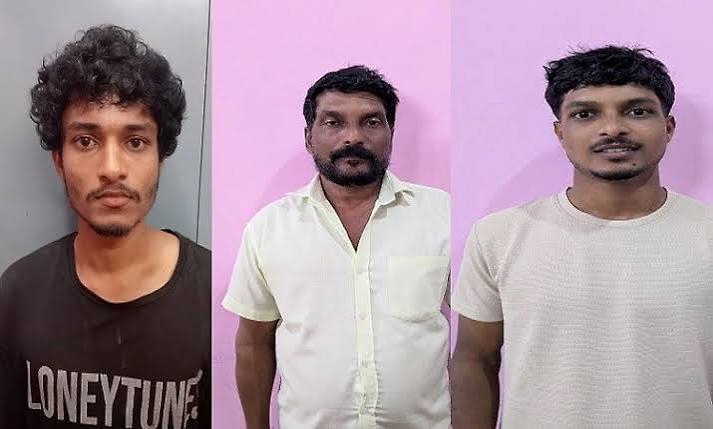
Byndoor: Kollur police have arrested three people in connection with two separate but related cases involving alleged caste-based abuse of a Dalit woman and a subsequent assault on a youth in Bellala village. The incidents reportedly occurred on Thursday, August 6, within the limits of Kollur police station. Police have registered separate cases based on complaints from both sides and are investigating the allegations. Youth arrested under SC/ST Act In the first case, police arrested Sanath Kundapur following a complaint filed by a Dalit woman. According to the complaint, Sanath allegedly approached the woman near her residence and behaved in a manner that outraged her modesty. She also alleged that he verbally abused her using casteist slurs. Based on the complaint, Kollur police registered a case under provisions of the Scheduled Castes and the Scheduled Tribes (Prevention of Atrocities) Act and arrested Sanath in connection with the allegations. Police are examining the circumstances surrounding the alleged incident and recording statements as part of the investigation. Counter-case filed after alleged assault Meanwhile, a counter-case was registered following a complaint filed by Sanath Kundapur. In his complaint, Sanath alleged that after the earlier incident, members of the woman’s family tied him up, assaulted him and attempted to kill him. Acting on his complaint, police registered a separate case under various provisions of the Bharatiya Nyaya Sanhita (BNS), including the section relating to attempt to murder. Following the complaint, police arrested two people identified as Ram Kumar and Nandish Kumar in connection with the alleged assault. The arrests have resulted in three people being taken into custody in the two connected cases. Police investigate both complaints Police are now investigating the allegations made by both parties to establish the sequence of events and determine the circumstances that led to the two incidents. The cases involve serious allegations on both sides, including offences under the SC/ST (Prevention of Atrocities) Act and an alleged attempt to murder. Investigators are expected to examine witness statements and other available evidence before taking further action. Police have stated that the investigation into both cases is currently underway. Officials are also working to identify and apprehend any other people allegedly involved in the incidents. Police said remaining accused persons, if their involvement is established during the investigation, will be apprehended in accordance with the law. Investigation underway The linked cases have drawn attention because of the serious allegations made by both sides. While the first complaint concerns alleged caste-based abuse and behaviour against a Dalit woman, the counter-complaint alleges that the accused in the first case was subsequently assaulted and subjected to an alleged attempt on his life. Police are treating the two complaints separately while examining whether and how the incidents are connected. Further details are expected to emerge as the investigation progresses. Authorities have not yet disclosed additional information regarding the condition of those involved or the specific circumstances surrounding the alleged assault. The Kollur police are continuing their investigation and are expected to take further legal action based on the evidence gathered. Courtesy : News Karnataka Note: This news is originally published on https:/newskarnataka.com/bha and is used purely for non-profit/non-commercial purposes, especially human rights
Health officials wash hands off Dalit girl’s life with Rs 2L
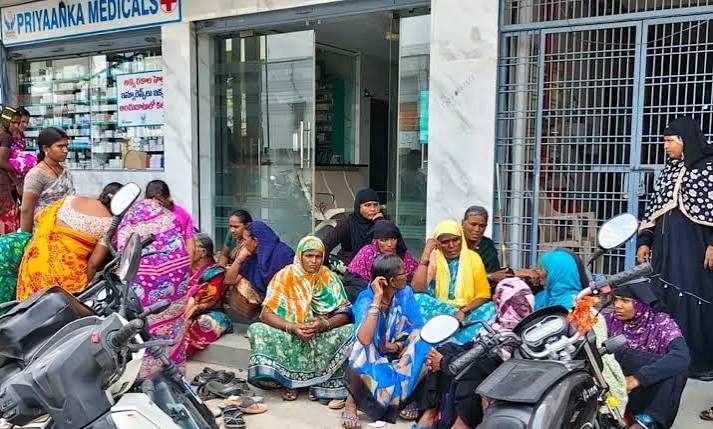
Private hospitals in Pebbair “settling” deaths due to alleged medical negligence Wanaparthy: Recent incidents of deaths resulting from alleged medical complications and negligence at private hospitals in Pebbair have caused public alarm. Allegations are surfacing that settlements regarding the deaths are being negotiated over the bodies in the presence of intermediaries to prevent the matter from becoming public and/or legal. Recounting a horrifying incident that occurred on September 28, 2025, locals informed that a young girl, who visited a private corporate hospital in the municipality with stomach pain, died following a medical complication. This incident occurred near the Subhash Chandra Bose Crossroads. Ramudu and Shirisha, a couple from the Dalit colony in Govardhanagiri village (Veepanagandla mandal), brought their five-year-old daughter, Ramya, to the hospital after she suddenly complained of stomach pain. Without conducting any tests, the doctor allegedly administered two injections; upon noticing foam coming from the child’s mouth, he took an X-ray and administered two more injections. As her condition deteriorated, the doctor advised the parents to take her to Mahbubnagar and sent her there in a private ambulance. However, doctors at the Mahbubnagar hospital examined the child and declared her dead. Alleging that the girl died due to the doctor’s negligence, family members and relatives staged a protest at the hospital. The price of a Dalit girl’s life settled by the hospital was Rs 2 lakhs. When questioned, DMHO Sainath Reddy said, “The medical officer conducted ground-level inspections and submitted a report to the Deputy DMHO who in turn also inspected the hospital. However, the submission of the report was delayed because he fell ill (fever). As there are holidays from tomorrow through Monday, the report is expected to reach me on Tuesday. I will take action once the report is received.” Meanwhile, many such incidents are being revealed by locals, such as the one on July 7 involving Sabera Begum (35) of Etigadda Sagapuram village, who came for delivery of twins after 16 years of marriage but was instead sent to the grave. Doctors had allegedly applied sutures without removing the placenta, which the family says attributed to the complication of her uterus. Residents of the municipality and district are criticising the situation, questioning whether anything can be done when medical officials appear to place a monetary value on human lives. They lament that officials, who ought to ensure such incidents don’t recur, are merely settling for paperwork instead of taking concrete action to prevent future occurrences Courtesy : THI Note: This news is originally published on https:/thehansindia.com/bha and is used purely for non-profit/non-commercial purposes, especially human rights
Case of Dalit boy beaten for drinking water from a bottle: Police issues notice to teacher, Human Rights Commission also seeks response
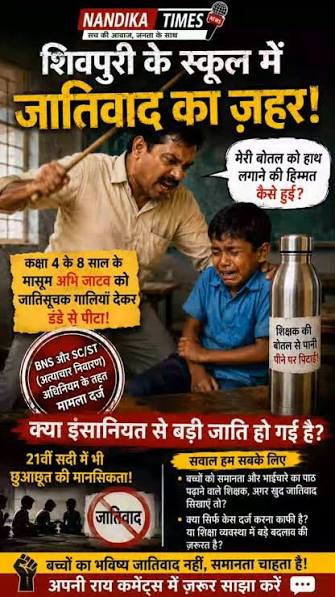
An FIR has been registered against a teacher under various sections of the SC/ST Act, including the SC/ST Act, for allegedly assaulting a Dalit student and making casteist remarks at a government school in Ukawal village, Shivpuri. The National Human Rights Commission has taken suo motu cognizance and sought a detailed report from the Madhya Pradesh government and police within two weeks. A case of alleged assault on a Dalit student at school has come to light in Kolaras, Shivpuri district. The teacher is accused of assaulting and using casteist slurs against the 8-year-old fourth-grade student at the government primary school in Ukawal village. Following the complaint, the police have registered an FIR against the accused teacher under sections of the BNS and the SC/ST Act and have initiated an investigation. The police have issued a notice to the accused teacher. The National Human Rights Commission has also taken cognizance of the matter and requested a report. The incident dates back to July 27th. An 8-year-old Dalit student, studying in the fourth grade at the Government Primary School in Ukawal village, Kolaras tehsil, has been allegedly assaulted. Family members allege that the child was thirsty and drank from the teacher’s water bottle. Angered by this, the teacher beat him with a stick. According to family members, the child returned home crying and informed the family about the entire incident at school. Following this, the family filed a police complaint. Based on the complaint, the Lukwasa police station has registered a case against the accused teacher, Lokesh Sharma. The FIR includes relevant sections of the BNS Act, as well as sections of the SC/ST Act. Following the registration of the case, the police have initiated an investigation. According to Kolaras Police Station Officer Puneet Vajpayee, a notice has been issued to the accused teacher. Police say the investigation is ongoing and further action will be taken based on the facts and evidence that emerge. Only after the police investigation will it be clear what actually happened at the school. Meanwhile, the alleged assault and casteist remarks against a minor student have raised questions about the safety of children in government schools and the conduct of teachers. NHRC seeks report from Madhya Pradesh government and police The National Human Rights Commission has taken suo motu cognizance of the matter. The Commission stated that if the claims made in media reports are true, this constitutes a serious human rights violation. The Commission has issued notices to the Chief Secretary of Madhya Pradesh and the Superintendent of Police of Shivpuri, seeking a detailed report within two weeks. The report should also include details of the legal relief provided to the victim and the action taken in the case. Published by: Dinesh Sharma Courtesy: Hindi News
When Dalits Own Temples: The Politics Behind Rajasthan’s Khakul Dev Dispute
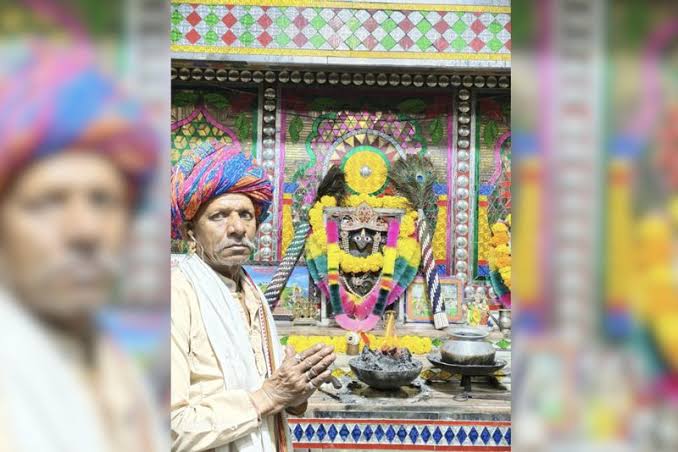
The Balai family is not demanding admission into someone else’s temple. It claims with historical authority that its ancestors established, maintained and served as hereditary priests of the shrine for centuries, and that these rights are now being challenged by people associated with the RSS. Khakul Dev Temple of Barana village in Rajasthan’s Bhilwara district. In frame, a member of the Balai family, who is the acting priest to the temple. Photo: By arrangement When Vishnu Kumar Balai, the hereditary priest of the Khakul Dev Temple of Barana village in Rajasthan’s Bhilwara district, wrote to Rashtriya Swayamsevak Sangh (RSS) chief Mohan Bhagwat in May this year asking, “Are we not Hindus?”, his appeal was widely understood as only an instance of caste discrimination and exploitation. But that reading misses what makes the Barana dispute historically and socially significant. This is not a story about Dalits seeking entry into Brahminical temples or demanding the right to perform rituals in Brahminical spaces. It is about a Dalit family which founded, owned and served as hereditary custodians of a temple for nearly four centuries, and whose assertions whose claims are supported by a body of historical material preserved by the family. Per the evidence furnished by the family, their position as priests and owners was recognised through a tamrapatra (copper-plate grant), issued by Maharana Karan Singh II of Mewar, grandson of Maharana Pratap, in 1624 CE. That historical continuity makes the present controversy all the more remarkable: a custodianship they say was acknowledged under a 17th-century Mewar ruler now finds itself challenged in 21st-century democratic India. The Khakul Dev dispute, therefore, raises a question that extends far beyond one village: why has a centuries-old Dalit temple ownership become the subject of contemporary political contestation? The tradition The Balai priestly family traces its association with Khakul Dev to Ghasiramji Balai, who, according to family tradition, discovered the deity in the early seventeenth century near present-day Hadkiya village. The shrine was subsequently established at Barana and gradually developed into an important regional place of worship. The family preserves a body of historical material – including genealogies, temple records, inscriptions and the 1624 tamrapatra – which it documents uninterrupted hereditary succession. The tamrapatra, as attested by the family, recognises their custodianship and ownership over both the temple and land attached to its maintenance, including their right for hereditary priesthood. Taken together, these records suggest that the family’s claim is rooted in a long tradition of hereditary custodianship rather than being a recent assertion. Rajasthan’s forgotten non-Brahmin religious landscape Many of Rajasthan’s most-revered folk shrines evolved outside the framework of orthodox Brahmanical institutions. Rajputs and Meghwals have historically performed hereditary ritual roles at the shrine of Baba Ramdevji, a 14th century Tomar chief whose cult transcends caste boundaries. In fact, the main temple of Baba Ramdev houses the samadhis of both Ramdevji and Dalibaiji, his Meghwal dharmbehan. Baba Ramdev Tomar, although a Rajput, is viewed as an important figure in the tradition founded by Meghrishi, a Dalit saint. Likewise, the traditions surrounding Pabuji Rathore, another Rajput folk hero, have long depended upon Nayak Bhils and Bhopa communities as hereditary ritual specialists and custodians of oral epics. Most temples dedicated to Gujjar deity Devnarayan are found in Mewar and built by Mewar’s rulers. The current Gogaji shrine at Gogamedi was built by the Bikaner’s rulers, but its tradition of Muslim priests has persisted till the modern era. Seen in this context, Khakul Dev is less an exception than a surviving example of a much older religious tradition. Recent scholarship has also questioned the assumption that Rajasthan’s religious institutions were historically organised according to a single Brahmanical model,showing that many Lok Devta traditions were sustained through the ritual practices of Bhopas, Bhils, Dalits and other non-Brahmin communities . In Merchants of Virtue, historian Divya Cherian shows how the increasing Brahminisation of Rajput courts during the 18th century reshaped social hierarchies and forms of social legitimacy. The persistence of non-Brahmin hereditary priesthoods at shrines such as Khakul Dev, Ramdevji, Gogamedi and Pabuji points to an older and more socially diverse religious landscape. Ownership, not entry Speaking to The Wire over email, social activist and Ambedkarite thinker Bhanwar Meghwanshi, said, “The Khakul Dev temple dispute also brings to light a striking historical irony. The feudal state, notwithstanding its own drawbacks and criticisms, not just recognised Dalits as hereditary priests but also granted them rights over the temples and the land attached to them. Yet, in contemporary democratic India, such hereditary rights are increasingly being challenged. In many places, dominant caste groups, including those classified as OBCs, have sought to wrest control of temples, offerings and attached lands from Dalit custodians, while simultaneously subjecting them to caste-based humiliation and violence.” Much of the discourse on caste and temples has understandably centred on temple entry – the struggle of Dalits to access spaces from which they were historically excluded. Khakul Dev presents an altogether different question. The Balai family is not demanding admission into someone else’s temple. It claims with historical authority that its ancestors established, maintained and served as hereditary priests of the shrine for centuries, and that these rights are now being challenged by people associated with the RSS. The issue, therefore, is not access but owner. It concerns hereditary priesthood, temple management, ritual legitimacy and institutional control. That distinction makes the dispute historically significant. Pamphlet published by the Dalit villagers for mobilisation against forceful takeover of the temple. Amid the ongoing dispute, the local Balai community have published and circulated pamphlets. For instance, this publication by the community was intended both, to mobilise support against what they view as an attempt by dominant castes to take over the temple and to document the historical and legal basis of the family’s claim. Photo: By arrangement The conflict According to Vishnu Kumar Balai, the conflict began in 2023, when influential villagers questioned the family’s exclusive custodianship of the temple. He has alleged that Sampat Jat, along with others, attempted to alter
‘Who Killed My Family?’: Rajasthan Court Acquits All 40 Accused in 2015 Dangawas Dalit Massacre, Cites Police and CBI Probe Failures
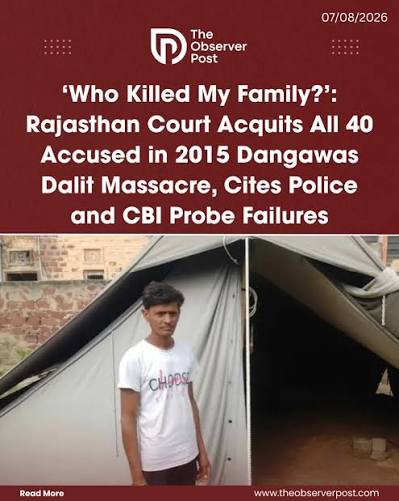
A special court in Rajasthan’s Merta has acquitted all 40 accused in the 2015 Dangawas massacre case, in which six people, including five Dalits, were killed, citing serious lapses in the police and CBI investigation. The court held that while the massacre was proven, the prosecution failed to establish the involvement of any particular accused beyond reasonable doubt. Court Says Investigation Failed to Link Accused to Crime Delivering its verdict after an 11-year trial, the Special Court for SC/ST (Prevention of Atrocities) Act cases observed that investigators failed to conduct a Test Identification Parade (TIP) after the arrests and did not collect DNA samples from the accused to match blood recovered from the crime scene. The court also noted delays in forensic examination and said investigators could not establish any forensic connection between the recovered weapons and the accused. Although forensic reports confirmed the presence of human blood on some seized weapons, the blood groups could not be conclusively matched with the deceased or injured victims. “It is not proved which party initiated the incident… The prosecution failed to prove beyond reasonable doubt the absence of the right of private defence,” the court said, adding that the evidence did not meet the required legal standard for conviction. 2015 Dangawas Massacre The violence took place on May 14, 2015, in Dangawas village of Rajasthan’s Nagaur district over a decades-old land dispute. According to the CBI charge sheet, nearly 200 people travelling on tractors and motorcycles allegedly attacked members of the Dalit Meghwal community who had set up a camp on disputed agricultural land. Five Dalits — Ratnaram, Pokharram, Pancharam, Khemaram and Ganpatram Meghwal — were killed, while 11 others, including five women, sustained injuries. Another man, Rampal Goswami, also died during the violence in a separate incident that remains subject to a different criminal case. The dispute centred around a 23-bigha plot of land allotted to Dalit farmer Bastaram Meghwal in 1961. The ownership was later transferred to his adopted son Ratnaram. The CBI alleged that tensions escalated after Ratnaram attempted to reclaim possession of the land, culminating in the deadly attack. Court Highlights Multiple Procedural Lapses The court pointed to several deficiencies in the investigation, including the failure to conduct identification parades, recover weapons from the accused, and seize or forensically examine tractors allegedly used during the attack. It also noted that no witness identified all 40 accused and that several witnesses admitted they knew only a few members of the alleged mob. The Central Forensic Science Laboratory visited the crime scene 21 days after the incident, by which time no weapons were recovered. In its judgment, the court remarked that the incident itself was beyond dispute but the prosecution failed to legally establish who was responsible. “What occurred on 14.05.2015… was beyond any doubt a heinous and heart-wrenching mass violence. What has not been proven is the connection, beyond reasonable doubt, of any particular accused to that violence,” the court observed. It further clarified that the acquittal did not mean the crime never occurred, but only that the perpetrators could not be identified through admissible evidence. Victims’ Families Question Verdict Speaking to The Wire after the verdict, Arjunram Meghwal, whose father Ratnaram was among those killed, said he was devastated by the acquittal and questioned how no one could be held responsible for the massacre. “I had hoped that those who murdered my father and other relatives would be punished. But today, after the court’s decision, I don’t know what to do. If nobody is guilty, then who killed my family? Did they die themselves?” he said. Arjunram, who was also injured in the attack, said he witnessed the killings and could not understand how the accused had been acquitted. His family has said it will challenge the verdict before the Rajasthan High Court. Victims’ counsel Abdul Salim Ansari alleged that the investigation had been weak from the beginning, claiming that the police omitted names mentioned by eyewitnesses in the FIR and later added others, creating inconsistencies that persisted throughout the trial. Activists, Congress Criticise Verdict Dalit rights activist Bhanwar Meghvanshi told The Wire that the acquittal exposed the difficulties Dalits face in securing justice. He argued that despite the CBI filing chargesheets, the prosecution failed to establish the case in court. “This shows how difficult it is for Dalits to get justice. This is eroding trust in the justice system and the constitutional guarantee of justice,” he said, urging the Rajasthan government to challenge the trial court’s judgment before the High Court. Congress leader and former Rajasthan Chief Minister Ashok Gehlot also criticised the verdict, questioning how all 40 accused could be acquitted when six people had lost their lives. He said the outcome highlighted serious shortcomings in the investigation and prosecution and demanded accountability from the BJP government. Meanwhile, counsel for the accused welcomed the verdict, maintaining that the investigation had not been fair and asserting that the accused had no role in the violence. The defence also claimed the disputed land belonged to their clients and rejected allegations that a large armed mob had gathered before the incident. Courtesy : TOP Note: This news is originally published on https:/theobserverpost.com/bha and is used purely for non-profit/non-commercial purposes, especially human rights
10 Years of the Una Dalit Incident: The victim’s family, desperate for justice, seeks community support in the High Court.
10 Years of the Una Incident: After disappointment in the lower court, the victim’s family seeks financial assistance from the community. Gujarat: A decade has passed since the highly publicized Dalit harassment case in Una, Gir Somnath district. Ten years ago, four Dalit youths were publicly beaten after being falsely accused of cow slaughter for skinning dead cows. Now, the victims of this horrific incident are pleading for financial support from the community to continue their fight for justice. In March of this year, a lower court in Veraval acquitted 35 accused in the case. The victims have appealed to the Gujarat High Court to challenge this decision. The next hearing on the appeal is scheduled for August 25th. According to the Indian Express report, Vashram Sarvaiya, one of the victims of the public beating, says that over the past ten years, he has incurred significant debt and expenses to fight his case. His sources of income are extremely limited. He did not seek help for a decade, but now he desperately needs financial support from society to continue his legal battle. Vashram explained that he will need funds to pursue justice in the High Court and, if necessary, the Supreme Court. The last hearing on Vashram’s appeal pending before the Gujarat High Court was held on July 20. That day, a division bench of the High Court directed the registry to summon the entire record of the lower court proceedings and listed the case for August 25. To seek justice, Vashram has been sending WhatsApp messages to his acquaintances since July 11, 2026, appealing for financial assistance directly to his bank account via UPI. He has also contacted people through phone calls and messages. His Gujarati message is deeply moving. It states that today his family is completely financially ruined. If society unites and supports this fight, even if only by a small amount of a flower petal, they will be able to win this battle for self-respect in the High Court and Supreme Court. The message further states that higher courts are highly expensive, so society should consider it its collective responsibility to help the victim’s family get justice. According to Vashram, since July 11, 2026, he has sent such messages to approximately 30 people in Gujarat, 10 of whom have contributed financially. He urgently needs at least two lakh rupees to fight the case. Depending on how long this legal battle drags on and whether the case reaches the Supreme Court, this expense could increase significantly. This entire incident has also severely affected the employment opportunities of the affected youth. Vashram explains that whenever he goes out to ask for work, people look at him as if he himself had slaughtered a cow. Due to this constant humiliation and discomfort, they have now stopped looking for work. Skinning dead animals has been a traditional occupation of the Dalit Sarvaiya community. On July 11, 2016, Vashram and two of his relatives were skinning dead cows outside Mota Samadhiyala village in the Una tehsil of Gir Somnath district. One of the cows had been killed by a lion. When some people claiming to be cow protectors arrived in two vehicles, they accused them of cow slaughter. The Dalit youths were then tied up and brutally beaten with sticks and iron rods. Vashram, along with Bechar, Ashok, and Ramesh, were taken to Una town, where they were publicly flogged and tortured again. After the video of this brutal attack went viral on social media, widespread outrage spread across the country. The then Chief Minister of Gujarat, Anandiben Patel, visited the Sarvaiya family. Following this incident, Dalit activist Jignesh Mevani organized a massive protest, which later catapulted him to the Gujarat Assembly. A total of 41 people, including four policemen from the Una police station, were prosecuted in this serious case. During the trial, then-Police Inspector Nirmal Singh Jhala died. On March 16th of this year, Veraval Additional Sessions Judge Jignesh Pandya delivered the verdict. He acquitted 35 accused, including three policemen who faced serious charges of abetment to crime, negligence, and falsification of government records. The court found only five people guilty of intentionally causing hurt with dangerous weapons, hostage taking, insulting with intent to provoke breach of peace, and insulting members of the Scheduled Castes. Those convicted include Ramesh Jadhav, Rakesh Joshi, Nagjibhai Vaniya, Pramodgiri Goswami, and Balwantgiri Goswami. Disappointed with the verdict, Vashram Sarvaiya told the media at the time that he would challenge this unsatisfactory decision in higher courts. Today, they are seeking help from everyone who believes in humanity. On July 11th, marking the 10th anniversary of the incident, a state-level “Justice and Solidarity Conference” was held at the Mangal Pandey Auditorium in Ahmedabad. There, Balu Sarvaiya, the father of Vashram and Ramesh, declared that he would continue his fight for justice as long as he lived. He said that after ten years of struggle, their case was suppressed in the lower court, but he would go to the Supreme Court and, if necessary, even protest against the government. Vashram also alleged that the accused have created a fund to continue their legal battle and are receiving covert support from political organizations. In response, the Sarvaiya family is also gathering support from members of the Dalit community and other humanitarian communities. He said that if needed, they can also seek support by posting videos on social media. Vashram’s family is landless. Their only reliable source of income is selling milk from their one cow and one buffalo. The family consists of Vashram, his wife, a daughter, younger siblings, and parents. They earn only ₹350 per day from milk sales. A few months ago, one of the two cows they reared was killed by a lion, further reducing their income. It is noteworthy that the lion population has increased significantly in the areas surrounding the Una tehsil of Gir Somnath district since the early 2000s, as lions are now moving out of the Gir protected forests
A Dalit fourth-grade student was brutally beaten for touching a water bottle. The NHRC issued a notice to the Madhya Pradesh government.
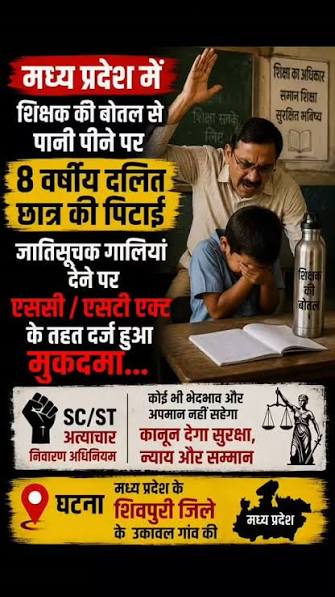
The NHRC has taken a strong stance on the assault and caste-based abuse of a Dalit student in Shivpuri, Madhya Pradesh, for drinking from a water bottle, and the death of a girl in Haryana due to contaminated water. It has issued notices to both state governments. New Delhi: The National Human Rights Commission (NHRC) has taken a strong stance on the incident of assault and caste-based abuse against a Dalit fourth-grade student in a government school in Madhya Pradesh. The Commission has issued notices to the Madhya Pradesh government and police officials seeking responses in this serious matter. This inhumane incident occurred on July 28th in Ukawal village, Shivpuri district. It is reported that a primary school teacher saw the child drinking from his bottle. Enraged, he not only brutally beat the innocent student but also hurled casteist abuse at him. The Commission took suo motu cognizance of this incident through a news report published on August 1st. The human rights panel has clarified that if this report is true, it represents a very serious case of gross human rights violations. The victim child recounted his ordeal to his parents upon reaching home, following which the family filed a police complaint. Given the seriousness of the matter, the NHRC has requested a detailed report from the state Chief Secretary and the Superintendent of Police (SP) of Shivpuri within two weeks. The Commission has also directed that this report should clearly state the statutory compensation and relief provided to the victim student. Meanwhile, the Human Rights Commission has also issued a notice to the Haryana government in another tragic incident. This case is from Shahzadpur in Ambala district, where a 12-year-old girl died tragically after allegedly drinking contaminated water due to jaundice. Local residents allege that the drinking water supplied from public taps in the area is completely contaminated. This toxic water has also caused several other children to contract jaundice and fall ill. In light of this alarming situation, the Commission has sought a response from the Chief Secretary of Haryana within two weeks. Based on the report, which was released on August 3rd, the Commission has asked the administration what concrete steps are being taken to address the contaminated water problem. The report also sought information on the current health status of other sick children undergoing treatment. The deceased girl was initially undergoing treatment for jaundice at a local hospital. When her condition worsened, doctors referred her to PGIMER, Chandigarh, where she succumbed to her injuries. Rajan Chaudhary Courtesy: Hindi News
Two days after getting doxed, Telugu Dalit content creator’s account suspended by Instagram
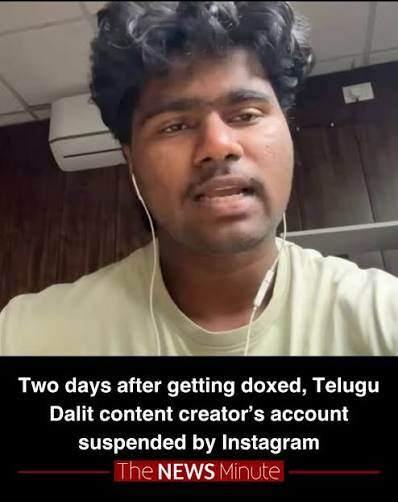
Following the doxing, Ajay approached the Panjagutta police station to register an FIR. While Ajay’s complaint petition has been noted, the FIR is yet to be lodged. A day after Telugu content creator Ajay Radha Kumar was doxed by a Hindutva digital creator, his account was suspended by Instagram on Wednesday, August 5 for not following Instagram’s “Terms of Use on intellectual property.” Ajay, a 23-year-old content creator who has amassed over 1 lakh followers, is well known in the Telugu media landscape for posting feminist, Ambedkarite content. Over the past few weeks, Ajay has been posting videos related to the Cockroach Janata Party (CJP) protests and public dissatisfaction with the Bharatiya Janata Party (BJP)-led Union government. He has also posted videos criticising the Telugu Desam Party (TDP) government’s push for data centres and the privatisation of medical colleges in Andhra Pradesh. Since Saturday, August 1, a Hindutva digital creator identified as TD Rakesh Sharma has made a series of videos criticising Ajay. “I can only assume this is in response to a video I did regarding posters at the CJP protest where PM Narendra Modi’s face was morphed and affixed on women’s bodies,” Ajay, a Dalit residing in Hyderabad, told TNM. In his video, Ajay is criticising the posters for the underlying sexism of correlating the Prime Minister’s inefficiency with womanhood. In response to that video, Rakesh Sharma posted another stating that Ajay could lodge a complaint against him to the police if he wanted to. “But then you also have to explain how you justified PM Modi being presented as a woman,” Rakesh said. It is unclear how Rakesh arrived at this conclusion, as Ajay’s video does not justify the posters in question. “He doesn’t seem to understand what I was saying. I spoke in Telugu, but still it was lost on him and other right-wing supporters,” Ajay said. In a second video published on Sunday, August 2, Rakesh can be seen abusing Ajay for criticising PM Modi and Andhra Deputy CM Pawan Kalyan. Things, however, took a turn on Monday, August 3, when Rakesh put out a reel on Instagram accusing him of duping women. “He (Ajay) targeted women students at law colleges and converted one such Hindu woman in Badhrachalam into an atheist,” Rakesh can be seen saying. Ajay told TNM that the woman in question was a friend of his who had her own political views. Rakesh also accused Ajay of making ‘anti-Hindu videos’ and made casteist remarks against him. But without stopping there, Rakesh put Ajay’s phone number on the video. “On Monday evening alone between 6 pm and 12:30 am, I got at least 100-120 calls,” Ajay told TNM. “I started to block them because I kept getting calls and messages incessantly,” he said. TNM also saw a few screenshots sent to Ajay which included messages from strangers abusing Ajay, his family and making outright casteist and communal remarks. Addressing the doxing, Ajay added that Rakesh had put out a lot of information about his identity. “A lot of information about me is factually incorrect. For instance, he said my mother is a Zilla Parishad Territorial Constituency (ZPTC) member, which is untrue, and made misleading statements about my family,” Ajay added. Following the doxing, Ajay approached the Panjagutta police station to register an FIR. While Ajay’s complaint petition has been noted, the FIR is yet to be lodged. Rakesh also posted further videos accusing Ajay of “using women” and making further videos on Ajay’s caste location. At the time of writing this article, Rakesh has posted 11 videos targeting Ajay. Written by:Anjana Meenakshi Edited by:Nandini Chandrashekar Courtesy : TNM Note: This news is originally published on https:/thenewsminute.com/bha and is used purely for non-profit/non-commercial purposes, especially human rights
DV Rao discussed the Dalit Panther movement of the 1970s and stressed the Agrarian Revolution
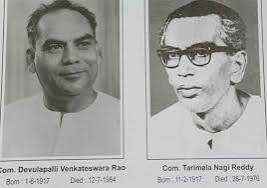
DV Rao, while dealing with politics of caste and casteism, commented on Dalit Panther movement (founded in 1972 May by Namdeo Dhasal, Raja Dhale, JV Pawar and others) and wrote on it way back in March 1974 issue of Proletarian Path, a journal published for sometime from Kolkata (then spelled as Calcutta) and edited jointly by DV Rao and Moni Guha. The article is of historic interest and importance at a time a new book (see cover page below) appeared 50 years after the dalit panthers appeared. In the context of assertions by some people that communists ignored the caste question, and in the background of some confessions made by some communists, including those of ML groups, this article draws attention to what com DV Rao wrote more than half a century ago, much before the subaltern and identity movements entered India. In fact, DV Rao discussed the related issues ever since his earliest available writings of 1946, during the Telangana struggle (1939-51 Oct) days. So did com T.Nagi Reddy (1917-1976 July 28), whose 50th death anniversary was observed in the two Telugu states recently. Several articles on these two comrades and their revolutionary contributions were published and archived by the countercurrents.org (See at the end of this article). The latest book is titled: Dalit Panther : The Truth Underlined by Arjun Dangle ( Translated from the original Marathi by Maya Pandit, Rs 990. Published by Orient Blackswan Private Limited, 2026… 3-6-752 Himayatnagar, Hyderabad, Telangana 500 029, India. .. info@orientblackswan.com). The blurb of the book says: The Author Arjun Dangle is a major writer of the Dalit literary, socio-cultural and political movements in Maharashtra. He was a founder member of the the Dalit Panthers, and later was also the president of the State Unit of the Bharatiya Republican Party of India. His published works include Dalit Sahitya: Ek Abhyas (1978), his poetry collection Chhavani Halte Ahe, which won the Maharashtra State Award in 1978, and the edited volumes of translations from modern Marathi Dalit literature, Homeless in My Land (1992) and Poisoned Bread (2009). About the movement it says: Led by powerful writer-activists such as Namdev Dhasal, J. V. Pawar, Raja Dhale, Bhai Sangare, Avinash Mahatekar and Arjun Dangle, the Panther mounted a fierce challenge to the casteist political and literary establishment of Maharashtra, while sharing solidarity with the struggles of workers, women and farmers. In documenting this history, Dangle also revisits the enduring debate on the relationship between the Dalit movement and the Left, and between Ambedkarism and Marxism. A Review of the book by scholar-activist Dr Anand Teltumbde is cited toward the end of this article. DV Rao (1917 June -1984 July 12) discussed the caste question and dealt with atrocities against dalits from his earliest available writings of 1946. DV called for militant resistance against the same as an inseparable part of the agrarian revolution, which includes the struggle for abolition of landlordism and for distribution of land to the tiller. The dalit question is inseparable from the land question, without which it remains merely formal and verbal. Words such as ‘Harijans’ and ‘Negroes’, it may be noted, were common in the political literature of those days, including this article of 1974, replaced later by the words ‘dalit’ and ‘Blacks’. The full text of the article, with its title, is given below (all emphases added). *** *** Dalit Panther movement and atrocities of landlords against the down-trodden That the Indian society is stinking with caste divisions from time immemorial is a fact beyond dispute. That the religions and social reformist movements, which claimed and still claim preaching equality between one and all, failed to dismantle these divisions is also a fact which cannot be disputed. Therefore, a new approach is needed to solve the problem. That there is a need to carry out an intense ideological struggle against the caste system cannot be denied by any one, who is for abolition of the system. Casteism intensifies caste division. A social reformist movement has some form of casteism as its content, or else it reduced itself into an idealist talk. Therefore, a revolutionary ideology is needed to fight it to the finish. Caste system, a survival of slavery and feudalism, is linked with the present-day political system in India. Though the Constitution provides equality for all citizens, economic inequality (capitalist and labour, landlord and landless) i.e., legal and social inequality is practised.There is a law prohibiting untouchabi’ity, but it is practised. In the name of providing facilities, existence of scheduled and backward classes is legalised. All the parliamentary parties have their own share in encouraging casteism for the sake of votes, representation in parliament and legislatures, jobs and other facilities etc. To expect abolition of casteism from such parties is nothing sort of hoping against hope. On the other hand, a revolutionary power, which enforces the abolition of caste system with all the force at its command, can alone do away with it. Behind the ideological-political frame work, there is the economic foundation of semi-slavery and semi-feudal relations in our country. The overwhelming majority of rural and urban poor, in which agricultural labour, poor peasants and industrial labour are included, come from certain castes in which the so-called Harijans ( ‘untouchables’ ) constitute considerable number. The landlords and the urban rich come from certain castes, in which poor and middle classes form a major part, as the rich is always smaller in number. There are some rich persons, though small in number, from the former category of caste, which are legally called as backward and scheduled castes. The backbone of the casteism consists of this upper strata of society which is exploiting it for its ends, political as well as economic. Therefore abolition of landlordism is the first essential task to root out the caste division and untouchability. Hence the need of an agrarian revolution. Not a day passes when we do not see the news of a landlord or a group of landlords harassing, torturing and
Dalit youth in Tamil Nadu killed over horse grazing on an upper-caste man’s land
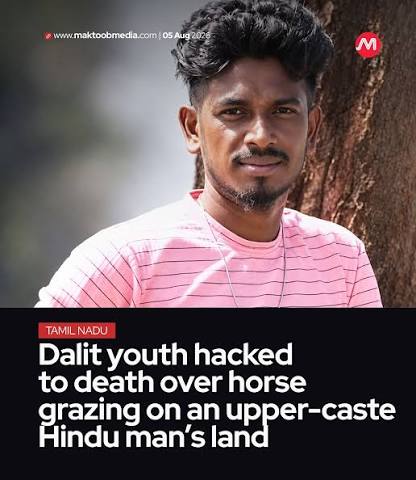
The organisation called for the immediate arrest of all the accused, statutory compensation for Ramar’s family, a government job for his wife, educational assistance for his two children, and advanced medical treatment for Prasanth. A 26-year-old Dalit man was allegedly hacked to death in Tamil Nadu’s Dindigul district after being lured out of his home over a dispute involving a horse, with the Tamil Nadu Untouchability Eradication Front (TNUEF) describing the incident as a brutal caste-based murder and demanding the immediate arrest of all those involved, along with police protection for the surviving victim and his family. According to TNUEF, the deceased, Ramar (26), and Prasanth (20), both residents of Poombarai village in Kodaikanal taluk, earned a living by transporting vegetables from the hills using horses before loading them into vehicles, Maktoob Media reported. The organisation alleged that on the night of July 30, a man identified as Raghu, who belongs to a dominant caste community, came to Ramar’s house claiming that their horse had grazed on his land and took him to the location. TNUEF claimed that Ramar was then attacked by a group of five men armed with sickles, sustaining multiple cut injuries that proved fatal. It added that Prasanth, who had accompanied him, suffered serious injuries in the attack and is undergoing treatment at Theni Government Medical College Hospital. Police have registered a case under the Scheduled Castes and Scheduled Tribes (Prevention of Atrocities) Act. However, TNUEF said that only one accused has been arrested so far, while the remaining suspects are yet to be apprehended. The organisation called for the immediate arrest of all the accused, statutory compensation for Ramar’s family, a government job for his wife, educational assistance for his two children, and advanced medical treatment for Prasanth. According to TNUEF, Prasanth’s mother informed a delegation that the family continued to receive threats after the attack and feared for her son’s safety. TNUEF state president K. Sellakkannu urged the Tamil Nadu government to provide permanent police protection to Prasanth and his family, arrest all those allegedly involved in the murder and attempted murder without delay, and invoke stringent provisions of the SC/ST (Prevention of Atrocities) Act against the accused. Meanwhile, TNUEF and the CPI(M) have been staging protests outside Dindigul Government Hospital, demanding the arrest of all the accused and justice for Ramar’s family. The organisations also alleged that district authorities attempted to pressure Ramar’s parents into accepting the body. Courtesy : Madhyamam Note: This news is originally published on https:/madhyamam.com/bha and is used purely for non-profit/non-commercial purposes, especially human rights