
₹13,177 crore from SC-ST funds diverted to women’s scheme, Tamil Nadu government under scrutiny | TM Special
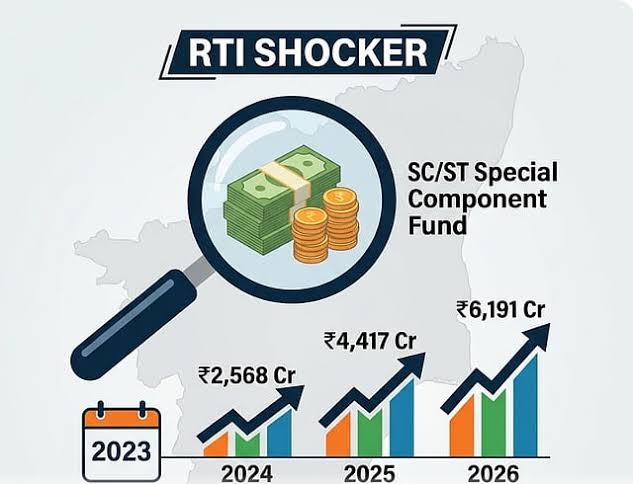
Social activists say that diverting special funds reserved for the development of SC-ST communities to any other general scheme violates the principles of social justice. Chennai – A major revelation has been made under the Right to Information Act. A total of ₹13,177.53 crore from the special component fund reserved for Scheduled Castes (SCs) and Scheduled Tribes (STs) has been used over the past three financial years for the Tamil Nadu government’s ambitious scheme, ‘Kalaignar Magalir Urimai Thogai’ (Women’s Monthly Assistance Scheme). This information was provided by the Commissionerate of Revenue Administration and Disaster Management in Chennai in response to an RTI application filed by S. Venkatesan, a resident of Chunampet in Chengalpattu district. Venkatesan is the state coordinator of the SC-ST Vimochana Morcha. The Assistant Commissioner-7 of the Commissionerate (who is also the Information Officer) provided a detailed breakdown of the allocation for the scheme and the amount utilized from the SC-ST Fund in his letter dated July 21, 2026. According to the RTI reply, a total of ₹18,509 crore (₹1,85,09,05,05,000) has been allocated for the Kalaignar Magalir Urimai Thogai scheme for the financial year 2025-2026. However, the most shocking fact is that ₹6,191.67 crore (₹6,19,16,73,20,000) has been allocated for the scheme from the SC-ST Special Component Fund in the same year. According to the year-wise details provided by the Commissionerate: ₹2,568.81 crore (₹2,56,88,17,22,264) from the SC-ST Fund in the financial year 2023-2024 ₹4,417.04 crore (₹4,41,70,46,37,000) in the financial year 2024-2025 ₹6,191.67 crore (₹6,19,16,73,20,000) in the financial year 2025-2026 Thus, a total of ₹13,177.53 crore (₹13,17,75,36,79,64) has been spent on this scheme from the SC-ST Fund in three years. The RTI reply also mentioned the total annual allocation for the scheme: 2023-2024: ₹5,812 crore 2024-2025: ₹5,138 crore 2025-2026: ₹18,509 crore However, the Commissionerate clearly stated that details of the number of SC/ST women benefiting from the scheme are not available in their office. They refused to answer the applicant’s query seeking this information. Venkatesan filed this RTI application on February 14, 2026. After reference to the government letter dated June 19, the letter was received at the Commissionerate on July 1, and a reply was finally sent on July 21. This revelation has sparked strong reactions from social activists and social justice advocates. They say that diverting special funds reserved for the development of SC/ST communities to another general scheme violates the principles of social justice. This violates the constitutional mandate that ensures dedicated funds for the welfare of Scheduled Castes and Scheduled Tribes. This revelation raises serious questions about the government’s commitment to protecting the interests of the underprivileged. The Maharashtra government also diverted funds in this manner. In July, the Vanchit Bahujan Aghadi (VBA) strongly protested the Maharashtra government’s approval of financial assistance of ₹2.80 crore from the Social Justice and Special Assistance Department’s budget for the Ashadhi Ekadashi festival through the Chief Minister’s Warkari Mahamandal. The party alleges that the budget allocated for the welfare of the Scheduled Caste community is being continuously diverted for other schemes, adversely affecting the rights and development of the Dalit community. Previously, on May 20, the Maharashtra government’s Social Justice and Special Assistance Department issued an executive order approving the use of funds allocated under the Scheduled Caste (SC) component scheme for the Chief Minister’s Majhi Ladki Behen Yojana. Under this decision, a provision of ₹3,000 crore was made for the 2026-27 fiscal year, of which a total of ₹730.51 crore (₹365.2550 crore each month) was distributed to the Women and Child Development Department for March 2026 and April 2026. In February, Maharashtra Social Justice Minister Sanjay Shirsat expressed dissatisfaction with his own government’s policy and reiterated that his department’s funds were being used for schemes like “Ladki Behen,” which was unacceptable. Geetha Sunil Pillai Courtesy: Hindi News
Justice after 19 years: Five convicts sentenced to life imprisonment for kidnapping a Dalit woman to prevent her from testifying; victim remains missing
A special court in Aligarh has sentenced five convicts to life imprisonment for kidnapping a Dalit woman in 2007 to prevent her from testifying in a rape case. However, even after 19 years, no trace of the abducted victim has been found. Uttar Pradesh: A special SC/ST court in Aligarh has sentenced five convicts to life imprisonment in a 2007 kidnapping case. These perpetrators abducted a 19-year-old Dalit woman solely to prevent her from testifying in a rape case. The court termed it a deliberate conspiracy to eliminate a key witness and derail the trial. However, the most tragic aspect is that despite nearly two decades of extensive search and investigation, the victim has still not been found. The perpetrators of this horrific crime are now between 40 and 50 years old. All of them were convicted and sentenced under Section 364 of the Indian Penal Code (IPC), which deals with kidnapping with intent to murder, and Section 3(2)(v) of the SC/ST (Prevention of Atrocities) Act. Delivering the verdict in this important case on Thursday, Special Judge II (SC/ST Act) Pratibha Saxena made a sharp remark. She noted that even after 19 years, the abducted girl has not been recovered. The court clarified that any undue sympathy in such serious cases would embolden the criminals and discourage victims and witnesses from coming forward. This tragic incident began on September 28, 2007. That day, the victim’s father filed a police complaint, stating that the accused had entered their village home in Aligarh district armed with weapons. These men, armed with country-made pistols, included Amar Singh, Lekhraj, Babulal, Suresh, and Usha Devi, all from Hathras. According to the father, these men forcibly abducted his daughter so that she could not testify against the accused in her own rape case. During the trial, the prosecution presented seven witnesses. Government lawyers strongly argued in court that the accused deliberately targeted this Dalit family to intimidate them and obstruct the course of justice. On Friday, Special Public Prosecutor Chaman Kumar Sharma shared a shocking fact while providing information about the case. He explained that the accused had been acquitted in the rape case related to this kidnapping earlier this year. The main reason for this was that the victim never appeared in court and the remaining witnesses recanted their statements. The father filed this kidnapping case just six months after the rape case was filed. Now, in this kidnapping case, the court has sentenced each of the accused to life imprisonment under Section 364 of the Indian Penal Code and the SC/ST Act, along with a fine of ₹10,000 for each offense. Meanwhile, a co-accused named Satish Pandey was acquitted due to lack of sufficient evidence. The accused pleaded for leniency in court, but the judge flatly rejected it. The court’s decision sent a strong message that the justice system must assure the vulnerable and vulnerable sections of society that crimes against them will result in the harshest punishment, no matter how influential the accused are. Rajan Chaudhary Courtesy: Hindi News
593 workers lost their lives in sewers, the government concealed 261 deaths: Safai Karmacharis took to the streets to protest false data and negligence.

The Safai Karmachari Andolan demanded that the government acknowledge the failure of the NAMASTE scheme and admit that despite the scheme, there has been an abnormal increase in deaths. New Delhi—On Tuesday, August 4, sanitation workers from more than 10 states, families of those killed in sewer and septic tank accidents, civil society members, writers, and students gathered in the capital to strongly condemn the illegal practice of forcibly pushing people to clean drains and septic tanks and the resulting deaths. The protest, organized by the Safai Karmachari Andolan (SKA) at Jantar Mantar, focused on the huge discrepancies in official data. On July 21, Social Justice and Empowerment Minister Ramdas Athawale told Parliament that 332 people died in sewer and septic tank accidents between January 2021 and June 2026. Meanwhile, according to the SKA’s own data, 593 people died during the same period. The organization alleges that the government concealed and underreported 261 deaths. According to the SKA, 113 people have died in sewers and septic tanks in the first 207 days of 2026, including 15 deaths in July alone. The organization stated, “The government’s brazen concealment of such a large number of deaths is criminal. Making 261 people and their families invisible is shameful.” The SKA has submitted these figures to MPs and urged them to raise the issue in Parliament. The organization calls the attempt to conceal the figures a national shame and an act of untouchability. It says that instead of preventing deaths, the government is focused on concealing the truth. The SKA has declared the practice illegal and linked the high mortality rate to caste-based work, despite the existence of laws prohibiting manual scavenging. The organization has made the following demands: The formation of a Parliamentary Standing Committee to investigate sewer and septic tank deaths, requiring the government to submit an annual report to Parliament on deaths, prosecutions, compensation, and rehabilitation. A time-bound national plan to immediately prevent sewer and septic tank deaths. Acknowledging the failure of the NAMASTE scheme and recognizing that despite this scheme, there has been an abnormal increase in deaths. National Convenor Bezwada Wilson said that the Prime Minister should acknowledge this failure and take immediate action. The protest ended with the slogan “#STOP KILLING US.” What is the NAMASTE scheme? The NAMASTE scheme is a central sector initiative to mechanize sewer and septic tank cleaning, eliminate hazardous cleaning tasks, and provide safety kits, skill training, and health insurance to Safai Mitras (sanitation workers). It is jointly implemented by the Ministry of Social Justice and Empowerment and the Ministry of Housing and Urban Affairs. It was launched as a central sector scheme in 2022. Its primary objective was to reduce deaths related to sanitation/cleaning work in India to zero, ensure that all sanitation work is carried out by skilled workers, and ensure that no sanitation worker comes into direct contact with human excreta. The Namaste scheme has not been completely shut down or declared a failure on paper, but it has faced significant criticism due to serious implementation gaps, sluggishness on the ground, and persistent sewer deaths. Despite stringent laws and the scheme’s claims, deaths of workers from toxic gases while cleaning septic tanks and sewers have not been completely stopped. According to reports from Parliament and parliamentary committees, far fewer than the designated sanitation workers have actually received PPE kits and modern safety equipment. The procurement and operation of modern machinery and robotic cleaning equipment in urban local bodies remains sluggish, leading to private contractors continuing to employ hazardous manual work. The rate of effective legal action or punishment for contractors and bodies that engage workers in illegal manual scavenging or hazardous work is very low. Geetha Sunil Pillai Courtesy: Hindi News
Rajasthan Dangavas massacre: 40 accused acquitted after 11 years, Dalit community shocked; ‘Who killed our five people?’

Speaking to The Mooknayak, Dalit thinker and writer Bhanwar Meghvanshi said, “The acquittal of all the accused in the Dangawas massacre case is not just the end of a case, but a serious question mark on the right to justice for Dalits.” Nagaur – The memory of the brutal incident that occurred on May 14, 2015, in Dangawas village of Nagaur district due to a land dispute, in which six people were brutally murdered by being crushed by a tractor and attacked with sharp weapons, still haunts the Dalit community. These included five members of the Dalit Meghwal family. On Wednesday, August 5, the SC-ST Special Court in Merta acquitted all 40 accused named by the CBI in this case. A large crowd gathered outside the court premises when the verdict was announced. While the faces of the accused were filled with joy, the families of the victims were clearly filled with despair. This decision has come as a shock to the Dalit community. There is a wave of deep despair and grief. The victim’s family is asking, “When all the accused were acquitted, who killed our five people? We will go to the High Court.” Judge Ashish Bijaranian of the Merta SC-ST Special Court delivered the verdict, acquitting all 40 accused. According to Advocate Mahipal Latiyal, the plaintiff presented eight witnesses, while the prosecution presented 82 witnesses. After a lengthy trial, the court acquitted the accused. What was the dispute? This case involved a nearly 40-year-old land dispute. A dispute was ongoing between Jat and Dalit (Meghwal) families over 3.77 hectares of land in Dangavas village. The Dalit family claimed that they had borrowed 1,500 rupees from a Jat family about 40 years ago, giving them the right to cultivate the land. When they returned the money, they were not given back the land. Under Section 42 of the Rajasthan Tenancy Act, 1955, Scheduled Caste land cannot be sold or transferred to a non-SC person. The dispute reached a head when Ratnaram Meghwal began building a house on the same land in May 2015. May 14 In 2015, more than 200 members of the Jat community allegedly attacked with sticks, sharp weapons, and tractors. Dalit women were molested, men were severely beaten, and several were crushed by tractors. Ratanaram Meghwal, Pokharram Meghwal, Pancharam Meghwal, Khemaram Meghwal, Ganpatram Meghwal, and Rampal Gosain were killed in the attack. A total of six people, including five Dalits, were killed. Given the gravity of the case, the Rajasthan government first handed over the investigation to the CID and then to the CBI. The CBI filed a charge sheet. In 2019, the Rajasthan High Court took a tough stand and ordered a three-month stay on the trial to apprehend the absconding accused. Subsequently, special police teams raided the premises, arrested all 40 accused, and sent them to jail. The trial had been ongoing in the Merta court since January 2018. When six people were brutally murdered, the entire country witnessed the brutality. For years, the victim families ran from court to court, hoping for justice. But ultimately, if no one is convicted, it signals a failure not just of the prosecution, but of the entire judicial process. – Bhanwar Meghwanshi, Dalit thinker The victim’s family has expressed deep sorrow over the verdict. They ask, “If all the accused were acquitted, who killed our five people?” They are preparing to challenge the verdict in the High Court. Dalit thinker and writer Bhanwar Meghwanshi, speaking to The Mooknayak, said, “The acquittal of all the accused in the Dangavas massacre is not just the end of a trial, but a serious question mark on the right to justice for Dalits. The question is simple: were those six innocent people not killed by anyone? Did they die on their own? When six people were brutally murdered, the entire country witnessed that brutality. For years, the victim’s families ran to the courts, hoping for justice. But ultimately, if no one is convicted, it signals a failure not just of the prosecution, but of the entire judicial process.” If the accused in such cases are acquitted in the absence of a fair investigation, bold evidence, and a fair trial, the biggest message it sends is that justice is becoming increasingly difficult for Dalits. This undermines the trust of marginalized communities in the judiciary. The Scheduled Castes and Scheduled Tribes (Prevention of Atrocities) Act was intended to provide effective justice to victims, but if convictions fail even in such heinous cases, it raises serious questions about the implementation of the law. The victims of Dangavas did not receive justice. This is not only a defeat for the victim families, but also a defeat of the promise of Indian democracy that the law is equal for all. This verdict forces us to introspect: where does justice lie for Dalits? This verdict reminds us of the many cases where victims of caste violence are denied justice even after a long wait. The wound of Dangavas has now been reopened. Geetha Sunil Pillai Courtesy: Hindi News
Uproar over high-tension line in Banda! Allegations of the line being laid over a Dalit settlement, complaint to DM

A dispute has escalated over an 11,000-volt high-tension line in Parsaunda village, Banda. Villagers allege that the line is being laid over the houses of the Dalit settlement. A memorandum has been submitted to the DM demanding a rerouting. 4PM News Network: A controversy has erupted over the proposed 11,000-volt high-tension line during road widening in the Gram Panchayat Parsaunda, located in the Tindwari block of Banda district. Villagers allege that the electricity department is preparing to lay the high-voltage line over the houses of the Scheduled Caste settlement. Regarding this, residents have submitted a memorandum to the District Magistrate demanding a rerouting of the line. Villagers ask, “Why is the line over a populated area despite vacant land?” Residents of Pradhan Ka Purwa (a Scheduled Caste settlement) say that there is ample vacant land available on the other side of the road, yet plans are being made to lay the power line over the populated area. Villagers say that if a high-tension line passes over their homes, there will be a risk of serious accidents in the future. They say that the line’s route should be changed, prioritizing public interest and safety. Memorandum submitted to DM, administrative action awaited Villagers submitted a memorandum to the District Magistrate demanding that the proposed 11 kV power line be rerouted to the other side of the road. The memorandum bears the signatures and thumbprints of several villagers. Currently, no official statement has been issued by the administration or the electricity department on this matter. Locals are now watching the administration’s decision following the complaint. Report – Iqbal Khan, Banda Courtesy: Hindi News
High Court Takes Major Action in Basti’s High-profile Dalit Girl Case, Commission Issues Notice to DM, SP
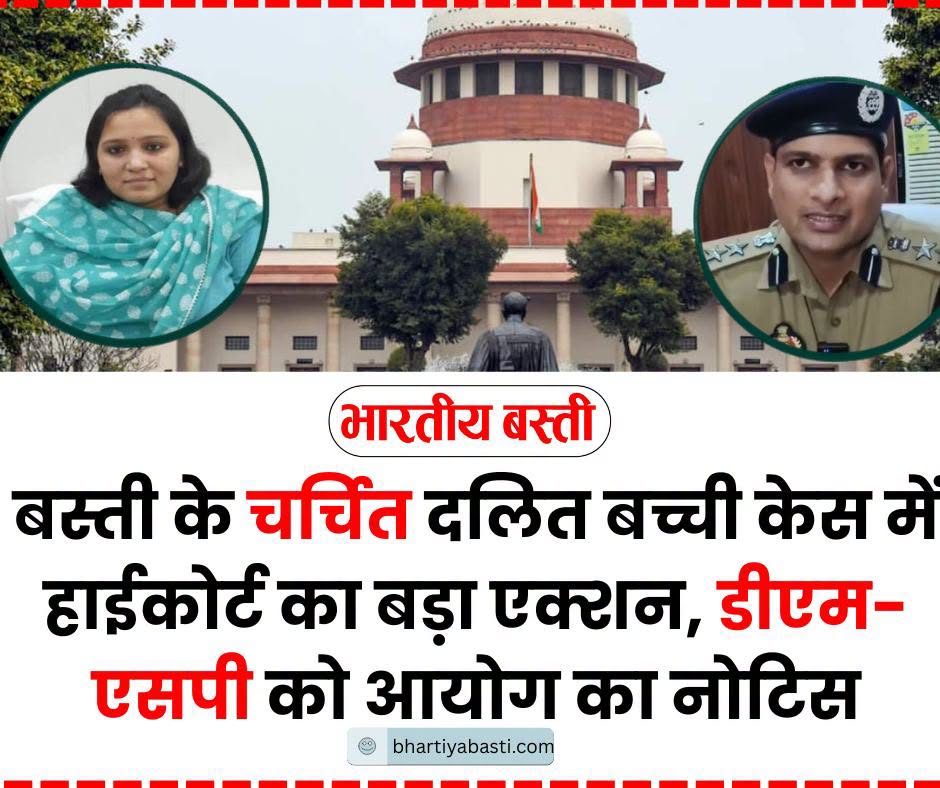
The Allahabad High Court has taken a tough stand in the highly publicized case of the alleged rape and murder of a five-year-old Dalit girl in Siddhnath village, under the Lalganj police station area. A press release issued by the Bhim Yuva Vahini organization claims that the High Court’s double bench has directed the Director General of Police (DGP) of Uttar Pradesh to personally monitor the case and ensure necessary action. According to the press release, the organization alleges that the local administration failed to take effective action against the accused in this incident, which occurred approximately 14 months ago. The organization states that after persistent advocacy and efforts in the court, the High Court took cognizance of the matter and issued directives to the DGP on July 30, 2026. The release states that the High Court has directed the DGP to take appropriate action against the concerned officials, if necessary, and to file an affidavit within three weeks. The organization also claims that the case is being monitored under the supervision of its national president, Sonu Rao, and senior advocate, Hanuman Deen Verma. According to a press release, the National Commission for Scheduled Castes (Government of India) has also issued a notice to the District Magistrate and Superintendent of Police, Basti, directing them to submit a report on the action taken in the case to the Commission within 15 days. Sonu Rao, National President of the Bhim Yuva Vahini, welcomed the action taken by the High Court and the National Commission for Scheduled Castes and expressed hope for justice. By Vikas Kumar Courtesy: Hindi News
5 juveniles held for gang-raping 9-year-old Dalit girl in UP
The accused are being questioned in the presence of their guardians, police said. Lucknow: Five minors have been booked for allegedly gang-raping a nine-year-old Dalit girl in a village in Uttar Pradesh’s Shahjahanpur, police said on Saturday, August 1. Circle Officer (Tilhar) Vidush Saxena told PTI that the incident took place on July 31 evening when the girl was playing with other children on a school ground, and the minors, aged between 10 and 14 years, allegedly took her to a nearby field. Citing the first information report (FIR) registered in the case, Saxena said the girl’s family alleged that the accused gang-raped her in the field and fled after the owner of the field spotted them there. The girl later reached home and informed her mother about the incident, following which a complaint was lodged and a case was registered late on Friday night, the CO said. “All five minors have been held and will be produced before the Juvenile Justice Board for further legal proceedings,” the station house officer said. Police have registered a case of gang rape under the Bharatiya Nyaya Sanhita (BNS), the Protection of Children from Sexual Offences (POCSO) Act and the Scheduled Castes and the Scheduled Tribes (Prevention of Atrocities) Act. MS Degree College Admissions Admissions 2026-27 The accused are being questioned in the presence of their guardians, police said, adding that the rape survivor has been sent for medical examination. Courtesy : TSD Note: This news is originally published on https:/thesiasatdaily.com/bha and is used purely for non-profit/non-commercial purposes, especially human rights
The rampage of a controversial Milak police inspector: Caste-related abuses against a Dalit youth, causing a stir as the audio goes viral
A Milak police inspector has been accused of violating the law by hurling caste-related abuses at a Dalit youth. Correspondent, Milak (Rampur). The law enforcers themselves are accused of breaking the law. The way an inspector, disregarding his oath of office, has once again put the police’s image in the dock. An inspector, who was transferred from Milak police station on July 7th, has been accused of using abusive language, caste-related abuses, and threatening to implicate him in a false case. After the audio of the conversation between the victim and the inspector went viral, questions have been raised about the police’s functioning. The victim has now filed a complaint with the National Human Rights Commission and the National Scheduled Caste Commission seeking justice against this harassment. According to Ajay Singh, a resident of Bhaisodi in the area, a minor dispute over a transaction of two thousand rupees was resolved amicably on August 2nd. However, the very next day, a sub-inspector posted at Milak police station called him on his mobile phone and created a ruckus. It is alleged that the uniformed man immediately began abusing him without any investigation. The victim alleges that the sub-inspector used casteist slurs and other abusive language, which violated his social dignity. When the victim attempted to express his views and stated that he was recording the conversation, the sub-inspector’s true nature was revealed. The sub-inspector threatened to file a false case. This incident raises a serious question about the police’s working style. While the police claim to serve and protect the public, caste discrimination and threats are being perpetrated under the guise of uniform. The sub-inspector has already been embroiled in controversy. One of the two sub-inspectors placed on the line on July 7th has previously been embroiled in controversy. He had previously been involved in disputes with another inspector posted on the same beat. They would pass the buck to each other in cases that offered no financial gain, and would fight to gain access to the areas where they expected to earn money. In this case, Superintendent of Police Somendra Meena had placed both of them under suspension. BY ANIL KUMAR AWASTHIEDITED BY: ANSHUL BHARTARIYA Courtesy: Hindi News
‘Anti-poor, anti-Dalit’: Chennai hunger strikers demand NEET abolition
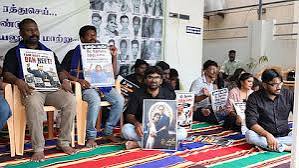
A group of hunger strikers in Chennai are on an indefinite fast, demanding a complete ban on the National Eligibility-cum-Entrance Test (NEET) and demanding that education be moved from the concurrent list to the state list. The protest, led by S Manirathinam — brother of the late S Anitha — is taking place at Thiruvaliur Illam in Koyambedu, even as nationwide student protests that forced the resignation of Education Minister Dharmendra Pradhan have been called off. The Ban NEET Movement – Tamil Nadu released an official statement hailing Pradhan’s resignation on July 25 as “the triumph of the people and the principles of democracy over an autocratic government.” The movement, which describes itself as fighting for a “deeply unequal and corrupt education system,” acknowledged the symbolic weight of the resignation but warned that it brings “no concrete change” for students. The context for this achievement was a remarkable wave of student protests led by the self-styled “Cockroach Janata Party” (CJP), sparked by the leak of the 2026 NEET medical entrance exam paper. The movement forced an unprecedented political concession in India: Dharmendra Pradhan became the first cabinet minister to resign due to social protests in recent history. In his resignation letter, Pradhan stated he stepped down “considering the situation” and to ensure that “anti-national forces should not take advantage,” urging students to focus on their studies. Despite the victory in Delhi, the Ban NEET Movement insists the struggle is far from over. Their statement expresses deep disappointment that protests were dispersed before concrete policy changes were enacted. They have now escalated their campaign with an indefinite hunger strike, which began on August 1. The movement states, “We have two demands. 1) The union government must ban NEET and allow states to evaluate medical college entrances on the basis of 12th standard/plus two marks. 2) The union government must move education from the concurrent list to the state list, allowing states to shape their own education policy. The strike will continue until these demands are met.” The movement also invokes the memory of S Anitha, a student who died by suicide in 2017 after failing to secure a medical seat under the NEET system, a tragedy that has become a rallying cry for opponents of the exam. The hunger strikers are drawing attention to the findings of the Justice AK Rajan Committee, a government-commissioned body in Tamil Nadu that studied the impact of NEET. According to the movement’s statement, the 2021 report provides “abundant proof” that NEET has had a devastating effect in the state. The movement alleges that NEET reduces access for students from poor, rural backgrounds and those educated in government schools, drastically reduces access for SC, ST, and OBC students, has led to the suicide of almost 100 young Indians (most of them Dalits) who dreamed of becoming doctors, and forces students to depend on a “new ecosystem of costly private coaching centres,” making wealth a barrier to education. The AK Rajan Committee, as reported by The Hindu, concluded that NEET is “anti-poor, anti-social justice and favoured students from affluent families” and those who could afford expensive coaching. The movement has framed its struggle as a constitutional and federalist issue. They argue that NEET “prevents states of the Indian union from deciding how their own educational institutions are run and therefore stands in violation of the principle of federalism.” This echoes the long-standing position of the Tamil Nadu government, which has consistently sought an exemption from NEET. The activists’ second demand — moving education from the concurrent list to the state list — is a fundamental restructuring of India’s federal system that would grant states the sole power to shape their education policies. In their statement, the Ban NEET Movement is urgently reaching out to “all movements, political parties, unions, student organizations and individuals interested in protecting our democracy” to join them. They are calling for supporters to come to the protest site at Thiruvaliur Illam in Koyambedu, spread the word through social media, and organize solidarity protests across the country. As the hunger strike continues, the movement’s stance poses a fundamental challenge to the Indian government. While the resignation of Dharmendra Pradhan is a major victory for the youth protest movement, the activists in Tamil Nadu insist that until NEET itself is abolished and states gain full control over education, the fight for a “democratic” and “equal” education system is not over. By A Representative Courtesy : Counterview Note: This news is originally published on https:/counterview.com/bha and is used purely for non-profit/non-commercial purposes, especially human rights
17 booked over threat to kill Dalits for refusing to dig burial pit in Yadgir district
A Dalit family was intercepted, physically assaulted, caste-abused, and threatened with death, on August 1 in Shakhapur (SH) village The Shorapur police in Yadgir district, in Karnataka, have booked 17 individuals after a Dalit family was intercepted, physically assaulted, caste-abused, and threatened with death, on August 1 in Shakhapur (SH) village. The alleged incident followed a dispute involving the digging of a burial pit. According to the FIR, on July 25, a woman from the Valmiki community passed away. The complainant, Devappa Shivappa Talwar—a Dalit originally from Kadyapur (Kalaburagi district) now residing in Shakhapur (SH) — was summoned along with his relative to dig a burial pit. But, they refused to dig a pit due to illness. Following the refusal, the accused individuals confronted Devappa at a local borewell on August 1 when he had gone to draw water, according to the FIR. Later that same day, Devappa, his wife Lalita, and relatives Bhimavva, Siddamma, and Gangamma were allegedly intercepted by the accused on their way to work in the fields. The group was allegedly assaulted with sticks, kicked, insulted using abusive words, and threatened with death if they continued to refuse digging burial pits, according to the FIR. All injured victims received medical treatment at the taluk hospital. Later, they lodged a police complaint. Following Devappa’s complaint, the Shorapur police registered a case under Sections 189(2), 191(2), 191(3), 115(2), 118(1), 74, 352, and 351(2) of the Bharatiya Nyay Samhita (BNS)-2023, and Sections 3(1)(5), 3(1)(2), and 3(2)(v-a) of the Scheduled Caste and Scheduled Caste (Prevention of Atrocities) Act. According to the FIR, the accused individual are Siddappa Shivaraya Devadurga Nagappa Mariyappa Masali Malappa Mudukappa Pujari Huligeppagouda Yallayyagouda Police Patil Mariyappa Basanagouda Maligouda Gangappa Narayanappa Policegouda Bheemanagouda Ninganagouda Malipatil Mallesh Ningappa Maligoudar Nagappa Huligeppa Policegoudar Bheemanna Ramangouda Police Patil Hanumanth Bheemanna Bhairamaddi Mounesh Bhimappa Bhimanna Bhimanna Paner Mallappa Ramanagouda Police Patil Devamma Hanumanth Malipatil Bhimavva Mareppa Malipatil Parashuram Eshappa Sugur Nagappa belongs to the Ediga community and Malappa to the Kuruba community. All others belong to the Valmiki community. Superintendent of Police Pruthvik Shankar informed that an investigation is underway. Police personnel have been deployed in Shakhapur (SH) village to maintain law and order, and ensure protection for local Dalits. The Deputy Superintendent of Police (Shorapur) and officials from the Social Welfare Department visited the village. The Hindu Bureau Courtesy : The Hindu Note: This news is originally published on https:/thehindu.com/bha and is used purely for non-profit/non-commercial purposes, especially human rights