
A Dalit man was tied upside down to a pole and beaten; he continued to plead for help in Balrampur, resulting in his death. A case has been filed under the SC/ST Act.
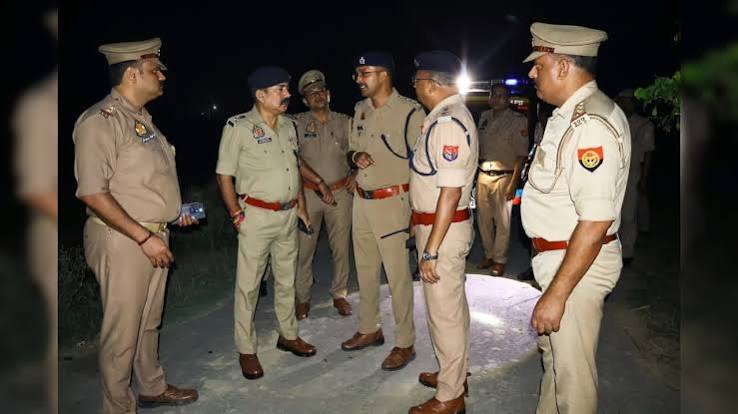
A case has been filed under murder and the SC/ST Act in the death of 38-year-old artisan Ram Sanehi in the Gasdi area of Balrampur. Efforts are now underway to uncover the truth based on video footage and other evidence. Balrampur: The case of the death of a Dalit youth in Balrampur district, Uttar Pradesh, is gaining momentum. A video of the alleged beating of 38-year-old artisan Ram Sanehi in Thakurpur village, located in the Gasdi police station area, has created a sensation in the area. In the viral video, a young man is seen tying him to a pole and beating him with a stick, while the victim is heard pleading for mercy. The family alleges that he was brutally beaten to death by goons. The accused party claims that Ram Sanehi had arrived with the intention of stealing. Police have registered a case of murder and under the SC/ST Act and have begun investigation. Viral Video Revealed The case is from Thakurapur village in the Gasdi police station area of Balrampur. The deceased has been identified as 38-year-old Ram Sanehi, a craftsman from Vishunpur Kalan. According to family members, Ram Sanehi earned his living as a laborer. His wife had left him, and he lived with his brothers. On Wednesday, a 33-second video went viral on social media. In the video, Ram Sanehi can be seen being tied to a pole and beaten. It is reported that the entire case took a new turn after this video surfaced. Brother Made the Video as Evidence The deceased’s brother, Phool Kumar, stated that someone had posted the video on Facebook. When the family learned of it, they downloaded the video and submitted it to the police as evidence. Phool Kumar alleges that Guddu, a resident of Thakurpur, his father Akbar Ali, Magghe Nau, and their associates beat Ram Sanehi, resulting in his death. The family has demanded strict action against the accused. What is the accused party’s claim? The accused party claims that Ram Sanehi arrived with the intention of stealing. He was then caught and beaten by the people. However, this claim is under investigation, and the police are investigating all the facts. Case filed based on video Based on the viral video and the family’s complaint, the police have filed a case against three named and one other accused. Sections of murder and the Scheduled Castes and Scheduled Tribes (Prevention of Atrocities) Act have been imposed in the case. According to sources, the police have detained some suspects and begun questioning them. Police said they will take further action based on the facts. Gasdi Kotwali in-charge Inspector Rajkumar Pandey said, “Some suspects are being questioned in connection with the young man’s murder. Initial investigations have revealed that the young man went there with the intention of stealing. People caught him and beat him. Further action will be taken based on the post-mortem report and the facts revealed in the investigation.” Reported by: Ranveer Singh Written by: Ajay Kumar Patel Courtesy: Hindi News
CM Shivakumar’s cabinet inducts 19 ministers as Congress high command clears portfolios

The allocation will become official only after the chief minister formally forwards the list and Lok Bhavan issues the notification, which is expected by Wednesday evening. BENGALURU: With hours to go before the joint legislature’s monsoon session, the Congress high command has reportedly cleared the allocation of portfolios to the 19 ministers inducted into Chief Minister D.K. Shivakumar’s cabinet, ending the prolonged uncertainty over department distribution. But the final list has not reached the Lok Bhavan for approval and notification. Shivakumar met his spiritual guru, Sri Karivrushabha Deshikendra Swamiji of Kadaaiddeshwara Mutt, who had arrived at a devotee’s residence in Bengaluru seeking his blessings. He is likely to make some changes in the portfolios, even as it’s being finalised by and large, before sending the final list to the Raj Bhavan. However, the issue of women’s representation in the cabinet remains unresolved, with the cabinet continuing without a woman minister. The decision to accommodate a woman legislator has reportedly been kept on hold, with sources indicating the issue could be taken up after the 10-day legislature session. The demand for the induction of Vijayanagar MLA M. Krishnappa, who is unhappy over his exclusion, has also been kept in abeyance. The allocation of portfolios is an urgent issue ahead of the monsoon session, which begins on August 13. Initial reports suggest that the proposed distribution of portfolios covers 11 ministers who were inducted during the cabinet expansion and sworn in on August 3. Those who have reportedly not been allotted the portfolios include former chief minister Siddaramiah’s son MLC Dr Yathindra Siddaramaiah, Arasikere MLA K. M. Shivalinge Gowda, Challakere MLA T. Raghumurthy, Ballari Rural MLA B. Nagendra, Malavalli MLA P. M. Narendraswamy, Chamarajanagar MLA Puttarangashetty, Haveri MLA Rudrappa Lamani and Bagalkote MLA Vijayanand Kashyapanavar. By evening, they may be allocated the portfolios, according to sources. The delay in allocating portfolios to some of the newly inducted ministers had triggered speculation that the chief minister was considering a minor reshuffle by dropping one or two existing ministers to accommodate and placate disgruntled legislators, particularly Vijayanagar MLA M. Krishnappa and Byadagi MLA Basavaraj Shivannanavar, who are believed to enjoy the backing of Siddaramaiah. The final list of portfolios is likely to be forwarded to Lok Bhavan for formal approval and notification. The decision follows several rounds of discussions between Shivakumar, senior Congress leaders in the state and the party high command. Shivakumar had discussed the issue with AICC president Mallikarjun Kharge, AICC general secretary (organisation) K. C. Venugopal and Karnataka Congress in-charge Randeep Singh Surjewala, pressing for an early resolution before the legislature session. The high command is also understood to have obtained the approval of Leader of Opposition Rahul Gandhi before giving a nod. According to the proposed allocation, N. Cheluvarayaswamy is likely to return to the Agriculture portfolio, which he held in the previous Siddaramaiah cabinet. H. Muniyappa, who earlier held the Food and Civil Supplies Department, is expected to be given Social Welfare, a portfolio he had reportedly sought. Mayakonda MLA K. Basavanthappa is likely to be entrusted with Fisheries and Ports, while Davanagere North MLA S. S. Mallikarjun is expected to get Mines and Geology, a department he had handled previously. Shivaraj Tangadagi is likely to be given Kannada and Culture, while Magadi MLC H. C. Balakrishna may get Minor Irrigation. Laxman Savadi is expected to be allotted Cooperation. Among the other proposed allocations, Assembly Speaker U. T. Khader is likely to be given the additional responsibility of Minority Welfare. Jewargi MLA Ajay Singh is expected to get Forests, while Madhu Bangarappa is likely to return to Primary Education and Santosh Lad to Labour Welfare—both portfolios they had held during the previous Siddaramaiah government. Rizwan Arshad is expected to be given Food and Civil Supplies. The portfolio exercise had triggered intense lobbying within the ruling Congress, with newly inducted ministers seeking departments of their choice while the leadership attempted to balance regional, caste and political considerations. The high command’s approval is expected to clear the way for the new ministers to assume charge of their respective departments ahead of the legislature session. The allocation will become official only after the chief minister formally forwards the list and Lok Bhavan issues the notification, which is expected by Wednesday evening. Devaraj B Hirehalli Courtesy : TNIE Note: This news is originally published on https:/thenewindianexpress.com/bha and is used purely for non-profit/non-commercial purposes, especially human rights
Benny, Kuzhalnadan & Shafi frontrunners for Kerala Congress chief post
All aspirants have been making trips to New Delhi, meeting Kharge and the Leader of the Opposition in the Lok Sabha, Rahul Gandhi, to bolster their claims for the post. THIRUVANANTHAPURAM: The Congress high command has narrowed the choice for the new KPCC president to three names — former UDF convenor Benny Behanan MP, state working president Shafi Parambil MP and state vice president Mathew Kuzhalnadan MLA. With two of his close associates — Shafi and Kuzhalnadan — among the frontrunners, influential AICC general secretary K C Venugopal is reportedly maintaining a neutral stand, leaving the choice to the Congress national leadership. However, Chief Minister V D Satheesan will have a crucial say in the selection of the new state party chief. Three other senior Congress MPs — Kodikkunnil Suresh, Adoor Prakash and Anto Antony — have apparently fallen out of the race despite backing from party stalwarts and a powerful religious organisation. Kodikkunnil, who is the Congress chief whip in the Lok Sabha, had the support of Congress President Mallikarjun Kharge and Satheesan, while Anto and UDF convenor Prakash had the backing of Priyanka Gandhi and Sivagiri Mutt, respectively. Anto had lost the post to Sunny Joseph last time. All aspirants have been making trips to New Delhi, meeting Kharge and Leader of the Opposition in the Lok Sabha Rahul Gandhi to bolster their claims for the post. With the Congress seeking closer coordination between the new government and the party ahead of an organisational reshuffle, the appointment is being viewed not merely as a change at the helm of the state unit but as part of a broader organisational overhaul. The final decision on the new KPCC president will be taken by Kharge and Rahul in consultation with Satheesan, sources said. Decision likely after Parl session, says senior leader “The announcement is likely after the ongoing Parliament session,” a senior party leader said. The need for a new party chief arose after incumbent Sunny conveyed his desire to step down after being inducted into the new cabinet. Among the shortlisted leaders, Benny brings considerable organisational experience, having served as UDF convenor and handled coordination among coalition partners. He is also seen as having the confidence of leaders across factions. Some senior leaders feel that an experienced organisational hand would be better placed to coordinate with a new government, in which most ministers, including the chief minister, are serving their first term. Shafi, who enjoys considerable popularity within the party and among the public, remains a strong contender. Kuzhalnadan’s proximity to Rahul is seen as an advantage. However, their relatively young age could work both in favour of and against the two contenders. Meanwhile, the powerful Catholic Church is closely watching the developments in the Congress. Sunny was made KPCC president after the Church took a strong position on the issue. K S Sreejith Courtesy : TNIE Note: This news is originally published on https:/thenewindianexpress.com/bha and is used purely for non-profit/non-commercial purposes, especially human rights
Dehradun: Dalit youth on ventilator, BJP leader charged with attempted murder; angry Valmiki community blocks Delhi-Haldwani highway
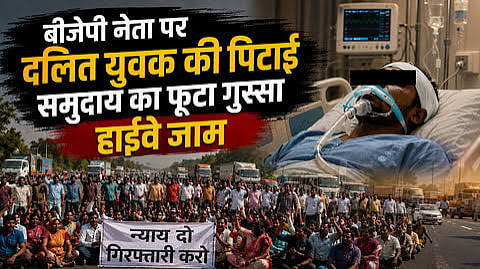
Following a fatal attack on a Dalit youth in Rudrapur, the Valmiki community staged a massive protest, blocking the highway and demanding the immediate arrest of the main accused, a BJP leader. New Delhi: The Valmiki community has erupted in anger following the fatal attack on a 20-year-old Dalit youth and his friends in Rudrapur. Hundreds of members of the community blocked the Delhi-Haldwani highway on Monday. The protesters were demanding the immediate arrest of BJP Mandal General Secretary Paras Chugh, accused in the case. The protest occurred hours after the arrest of Paras’ brother, Sunny Chugh, as the main accused, Paras, has not yet been taken into police custody. The incident occurred on the night of Friday, August 7th. A four-wheeler collided with a scooter near the Kashipur flyover, sparking a dispute that quickly escalated into a violent altercation. The victims allege that the Chugh brothers and their henchmen attacked them with sticks and iron rods, seriously injuring three people. The attackers are also accused of using casteist slurs during the assault. People and Society Abhishek Valmiki, the victim of this brutal attack, is in critical condition. He is battling for life on a ventilator in a private hospital in Bareilly, where doctors have given him little hope of survival. Police have registered a case against BJP leader Paras Chugh, his brother Sunny Chugh, and 10 unidentified individuals under Section 109 (attempt to murder) and other relevant sections of the Indian Penal Code (IPC). Before blocking the highway, protesters gathered at the Rudrapur Municipal Corporation premises, where they announced a complete boycott of sanitation work and raised slogans against the accused. Pooja Devi, the mother of the victim, Abhishek, who works as a sanitation worker in the Municipal Corporation, has raised serious questions about the administration’s functioning. As a widow, she said she expected justice from the mayor, but the police were avoiding arresting Paras Chugh because of his close ties to her. Despite an FIR being registered, the lack of arrest of the main accused has been growing, fueling anger among the Valmiki community. On Monday, police and administrative officials requested time until 2 p.m. to take action against the accused. Following this, CO Akhilesh Kumar Singh reached the Municipal Corporation and spoke with the protesters, but the discussions yielded no results. After much effort and heavy police deployment, the highway blockade was cleared in about 15 minutes. SP Uttam Singh Negi has officially confirmed the arrest of Sunny Chugh in the case. Earlier, Rudrapur in-charge CO Prashant Kumar had also announced the registration of a case. Meanwhile, Congress State Secretary Mohan Khera visited the Municipal Corporation and met with the victim’s family and assured them of full support, although the police detained him during the protest. Meanwhile, Rudrapur MLA Shiv Arora has clarified that the state government will not tolerate any kind of anarchy and that the law will take its course, regardless of who the accused are. Rajan Chaudhary Courtesy: Hindi News
Dalit youth beaten with belts in Jhansi, allegedly forced to drink urine from a pot; video goes viral
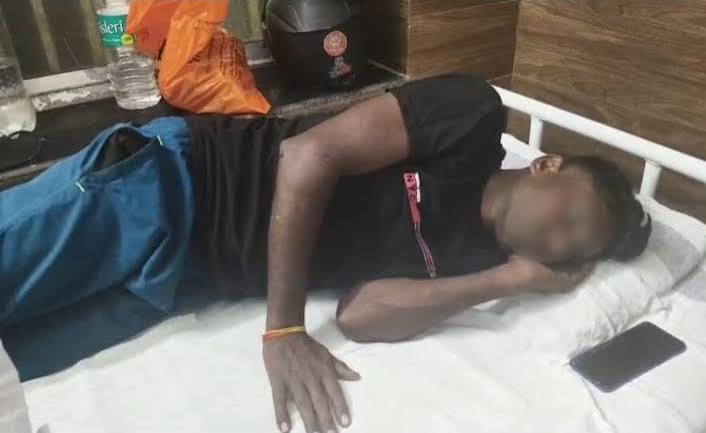
UP Crime: A shocking incident has come to light from Jhansi, Uttar Pradesh, where a Dalit youth was allegedly brutally beaten and forced to drink urine from a pot. The video of this incident is going viral on social media, sparking outrage. UP Crime: A video that shames humanity has surfaced from Jhansi district of Uttar Pradesh. A Dalit youth was allegedly brutally beaten and forced to drink urine from a pot. The video of the incident has also gone viral on social media. In the video, some people are seen assaulting and insulting the youth. The victim alleges that a group of bullies surrounded him and brutally beat him with belts. It is alleged that casteist and derogatory remarks were also hurled at him during the assault. After this, the accused subjected him to inhumane treatment, forced him to drink urine from a pot, and filmed the entire incident. Vikas and Aditya Thakur are fathers… In the viral video, some young men can allegedly be heard shouting slogans like, “Vikas and Aditya Thakur are fathers… Raising hands is a sin.” The video has sparked public outrage over the incident. However, independent verification of the viral video and official confirmation of the identities of all those seen in it will only be possible after an investigation. Victim blames the “Baba 302” gang The victim claims that more than a dozen powerful individuals operate a gang called “Baba 302.” According to him, the group’s objective is to instill terror and assault among people. The victim alleged that individuals associated with this alleged gang committed this crime against him. Questions about law and order raised after the video went viral After the video of the incident went viral on social media, questions have been raised about police action and law and order in the district. The biggest question is, if the allegations are true, why did the accused lack fear of the law? The alleged assault and inhumane treatment of the victim has raised serious questions about the safety of Dalits and the police’s control over the oppressors. People say that instilling fear of the law among criminals is the primary responsibility of the police and administration. Police investigation will reveal the full truth At present, the police investigation is crucial in this entire matter. The identity of the people seen in the video, the actual circumstances of the incident, and the veracity of the allegations made by the victim will only be clear after the investigation. If the allegations are found to be true, strict legal action must be taken against the culprits. Author: Tilak Kumar About the Author Tilak Kumar has been active in journalism for the past 14 years. He has extensive experience reporting in print and digital media. He has worked as a crime reporter for reputed news organizations such as Amar Ujala, Prabhat Khabar, Jan Sandesh Times, and Rashtriya Sahara. His areas of special interest and expertise are crime, politics, and hyperlocal journalism. During his field reporting, he has brought many important and impactful news stories to readers. His deep understanding of ground-level issues and fact-based reporting have been his hallmarks. He is currently associated with Prabhat Khabar’s digital team and continues to write and report on issues related to politics, crime, and public concerns in Uttar Pradesh. Courtesy: Hindi News
Before the Constitution: How ‘Scheduled Caste’ Was Born a Hindu Category — And Why the British Kept It That Way Part 1

Every argument about who is entitled to Scheduled Caste (SC) status in India today is, at bottom, an argument about history. Proponents of extending SC status to Dalit converts to Christianity and Islam often present the current religion-linked definition — Hindus, Sikhs, and Buddhists only — as a post-1950 anomaly, an accident of drafting that a more enlightened Republic ought to correct. The historical record says otherwise. The link between Scheduled Caste status and the Hindu social order was not invented by the Constituent Assembly in 1949. It was inherited, fully formed, from more than two decades of colonial administrative and political practice — practice that itself confronted, and rejected, the demand to extend caste-based protections to Christian and Muslim converts. This first article in the series traces that history. Untouchability as an Administrative Fact, Not a Legal Category Before “Scheduled Caste” existed as a term, the colonial state grappled with the reality of untouchability as a sociological fact peculiar to Hindu society. The 1881 census and subsequent decennial enumerations recorded a large population subjected to social disabilities on account of birth communities barred from temples, wells, schools, and public roads, and confined hereditarily to degrading occupations. British ethnographers and administrators, working through successive census operations, consistently identified this system of graded exclusion as an internal feature of Hindu social organisation, rooted in notions of ritual pollution that had no doctrinal counterpart in Islam or Christianity, notwithstanding that both faiths had, by then, acquired converts from the same untouchable communities. This is the crucial starting point often erased from public memory: the British did not invent the idea that untouchability was a Hindu phenomenon. They found it that way, documented it that way, and built their entire administrative response around that understanding. The Simon Commission and the Depressed Classes The Indian Statutory Commission of 1927 — the Simon Commission — was among the first bodies to give the phrase “Depressed Classes” (the pre-Independence term for what became Scheduled Castes) an administrative shape. Its enquiries, like the census operations before it, confirmed that the disabilities in question attached to caste communities within Hindu society. The Commission’s engagement with the question set the template that later instruments would follow: identify the castes suffering ritual and social disability, and confine protective measures to the community that generated and sustained that disability in the first place. The Communal Award of 1932: The First Legal Separation of Converts from Depressed Class The decisive administrative moment came in 1932. Prime Minister Ramsay MacDonald’s Communal Award, framed to allocate separate electorates among India’s communities, drew a sharp and deliberate line: it treated “Indian Christians” as a distinct political and electoral minority, wholly separate from the Depressed Classes. A Dalit who had converted to Christianity was, under the Award, an Indian Christian for electoral purposes, not a member of the Depressed Classes. Such a person could neither vote in, nor contest, the seats specifically reserved for the Depressed Classes. This was not an oversight. The British administration, dealing daily with the realities of caste, religion, and colonial governance, took the considered position that conversion to an Abrahamic faith changed a person’s political and social classification. It dissolved, for electoral law, the individual’s identity as a member of the Depressed Classes. The Poona Pact of the same year, the settlement between Gandhi and Ambedkar that replaced separate electorates with reserved seats within the general electorate, likewise operated within this same framework: the reserved seats were for the Depressed Classes as a Hindu social category, not for a religion-neutral class of the economically disadvantaged. The Government of India Act, 1935 and the 1936 Order Three years later, the Government of India Act, 1935 authorised the Governor-General to specify, by order, which castes, races, or tribes would be treated as Scheduled Castes for representation and administration. Acting under this power, the colonial government issued the Government of India (Scheduled Castes) Order, 1936, the instrument that coined the very term “Scheduled Castes.” The 1936 Order restricted the definition strictly to persons professing the Hindu religion. Indian Christians of Dalit origin were explicitly and knowingly excluded. It is worth pausing on the significance of this. The post-Independence Constitution (Scheduled Castes) Order, 1950, the instrument at the centre of today’s controversy, did not invent the religion criterion. It inherited it, almost verbatim, from an instrument that had already been in continuous administrative use for over a decade. When Dr Ambedkar and the framers of India’s Constitution came to address the question of Scheduled Castes in 1949, they were not writing on a blank slate. They were ratifying and, in the case of Sikhs and later Buddhists, cautiously extending a classification that colonial administrators, working from census data and ground-level observation rather than any ideological programme, had already settled a generation earlier. Early Representations for Inclusion — and Their Rejection The demand to bring Christian Dalits within the ambit of Depressed Classes protections is not a new one; it is, in fact, older than Independence itself. Christian organisations in South India — where a substantial proportion of Dalit conversions to Christianity had occurred through nineteenth and early twentieth-century missionary activity — periodically pressed the colonial government to recognise continuing caste-based disadvantage among converts and extend the same statutory protections available to Hindu Depressed Classes. These representations were considered and were not accepted. The colonial state’s position — later inherited without significant modification by the Constituent Assembly, as the second article in this series will show — was that the disability in question was untouchability, a phenomenon rooted in the Hindu social order, and that the act of conversion to a faith which formally repudiated caste distinctions was itself evidence that the convert had exited the social system generating the disability. The state did not deny that Christian converts of Dalit origin might continue to face economic hardship or informal social prejudice. It declined, however, to treat that hardship as equivalent to the specific, ritualised, birth-imposed disability of untouchability for which the Depressed Classes framework
Why are you not suspending him? Kerala HC pulls up State over inaction against cop in Dalit student suicide case
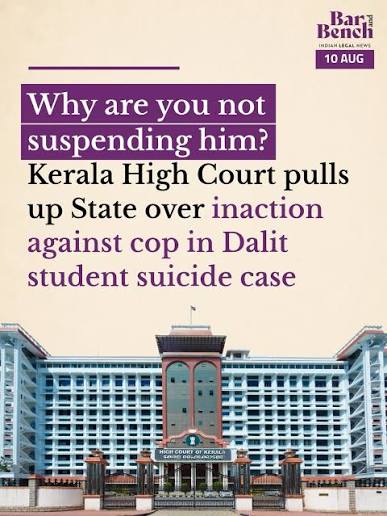
The Court asked whether higher-ranking police officials were attempting to protect their colleague from disciplinary action. The Kerala High Court on Monday questioned the State over its failure to suspend Deputy Superintendent of Police (DSP) Sudheer Kallan despite a finding of serious procedural lapses in the arrest of an accused in the case concerning the suicide of Dalit dental student Nithin Raj. Justice A Badharudeen said police’s negligent approach had initially led to the release of the prime accused Dr M Kodanda Ram, a Kannur Dental College professor. “Why are you not suspending him? The report states that there are serious procedural lapses coupled with a careless and negligent approach in the investigation by the police personnel who arrested him. The preparation of the arrest-related documents resulted in the release of the accused. Even after finding all this, he has not been suspended?” Justice Badharudeen orally asked. The Court was hearing the plea fled by victim’s parents, who have been seeking clarity on the investigation and circumstance surrounding the arrest of Dr. Ram. Nithin Raj, a dental college student in Kerala, died by suicide on April 10 after jumping from a building near the college. Before his demise, Raj is alleged to have faced caste-based harassment from the faculty at the dental college. The police registered a case for abetment of suicide and offences under the Scheduled Caste and Scheduled Tribes (Prevention of Atrocities) Act, 1989 (SC/ST Act) and arrested the prime accused, Dr. Ram. However, his initial arrest had been declared illegal by a trial court after the police failed to furnish mandatory grounds of arrest to the accused. He was subsequently re-arrested by the Crime Branch. Today, Special government pleader Rasheed C Nooranad told the Court that following a preliminary enquiry by Superintendent of Police of Wayanad, the State Police Chief has recommended disciplinary proceedings against DSP Kallan. However, he added that the disciplinary proceedings would be initiated only after the completion of a proposed enquiry by a panel of officers. Justice Badharudeen questioned the need for another enquiry when an oral enquiry has already found serious lapses in the arrest. The Court further asked whether higher-ranking police officials were attempting to protect the DSP. The judge made it clear that the government should take necessary action rather than wait for the Court to direct every step. “I don’t have an opinion that the government is not bonafide. The remedies available to the accused let him avail those, you (government) do your job. The job of police is to arrest. Court’s job is to take decision when such action is challenged,” Justice Badharudeen remarked. The Court in its order today, recorded that the officer had committed serious lapses but no immediate action was being taken by the State and instead a panel of competent enquiry officers is slated to be appointed. It directed the State Police Chief to consider the enquiry report and pass necessary orders while also directing that the proposed panel be constituted within one week. The matter will be heard next on August 17. Praisy Thomas Courtesy : Bar and Bench Note: This news is originally published on https:/barandbench.com/bha and is used purely for non-profit/non-commercial purposes, especially human rights
Punjab Election 2027: BJP prepares to break into the Dalit vote bank. Will the Punjab situation change in 2027?
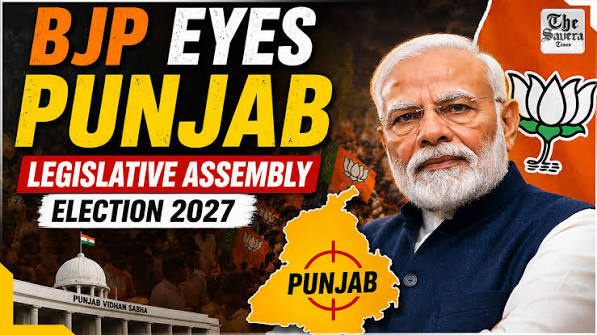
The BJP has now grasped the power of Dalit voters and the caste equations in Punjab. In the last Punjab elections, a simple Dalit candidate from the Aam Aadmi Party defeated the veteran former Congress Chief Minister Charanjit Singh Channi. The BJP now sees Dalit voters as game-changers. Punjab has the highest percentage of Scheduled Caste (SC/Dalit) population in any state in India. Dalits constitute approximately 32% to 33% of Punjab’s population. The Jat Sikh population is approximately 19% to 21%. Urban non-Dalit Hindus constitute approximately 18% to 20%. Other Backward Classes constitute approximately 20% to 31%. With the approach of the 2027 Punjab Assembly Elections, the political landscape in the state is beginning to unfold. The BJP, which has long relied on Punjab’s urban Hindu vote and as a stooge of the Akali Dal, is now fully prepared to take the lead. For decades, the BJP, confined to a minor coalition partner in Punjab, is preparing for a major political shift. The party has set its sights on the Dalit vote bank, the state’s largest social force. Following the success of the Haryana model of non-Jat and backward-Dalit alliances, the BJP is also constructing a maze of non-Jat Sikh and Dalit-Hindu alliances in Punjab. Its direct aim is to directly target the support base of the Congress and the Aam Aadmi Party. Dalits constitute approximately 32% to 33% of Punjab’s population. Jat Sikhs constitute approximately 19% to 21%. Urban non-Dalit Hindus constitute approximately 18% to 20%. Other Backward Classes constitute approximately 20% to 31%. However, Punjab’s Dalit community is not a unified whole; rather, it is primarily divided into two or three major religious and social factions: Sikhs and Hindus of the Ravidassia group, influenced by Dera Sachkhand Ballan. They constitute approximately 13% of the population and reside in the Doaba region of Jalandhar and Hoshiarpur. Second, the Mazhabi Sikhs, primarily affiliated with the Sikh religion, constitute approximately 10% of the population. They reside in the Malwa and Majha regions. Third, the Bhangi Hindu Sikhs constitute approximately 3.5% of the population and reside in urban and rural areas across Punjab. The BJP is now eyeing these voters. Will this BJP move be successful? Punjab’s 117 assembly seats are divided into three major regions. The BJP is seeking its counterweight in these regional and social dynamics. The Malwa region, which has 69 seats, will be the BJP’s target this time. Malwa, traditionally a stronghold of the Shiromani Akali Dal and the Congress, has completely shifted to the Aam Aadmi Party in 2022. There has been a long-standing tension between Jat Sikh farmers and Mazabi Sikh laborers over land and resources. What are the preparations for this time in Malwa, Doab, and Majha? Doab, which has 23 seats, is primarily a Congress-held area. It is considered the “Dalit capital” of Punjab, with a Dalit population of over 40%. This region has been a traditional stronghold of the Congress and Bahujan Samaj Party, where the Ravidassia and Ad-Dharma communities play a decisive role. Majha, meanwhile, has 25 seats. The last election saw a direct contest between the Congress and the Aam Aadmi Party, with the latter winning. This region encompassing Amritsar, Gurdaspur, and Tarn Taran is considered the center of sectarian Sikh politics, with the Congress, AAP, and the Akali Dal competing here. Will Dalit votes be divided along Haryana lines? In Haryana, the BJP consistently won elections by uniting Jats versus non-Jats and non-Jat Dalits. The BJP is pursuing a similar strategy in Punjab. For decades, the Chief Minister’s post in Punjab has been held by the Jat Sikh community, with the exception of Charanjit Singh Channi. The BJP is attempting to convey the message to non-Jat Sikh, Dalit, and Hindu voters that they have not received their due share in the state’s political leadership. The BJP is also working to bridge the social divide within Punjab’s Dalits between the religious Sikh and Ravidassia-Valmiki communities. The BJP’s primary goal is to attract sub-groups that received less representation in power during the Akali Dal and Congress regimes through organizational and welfare schemes. The BJP’s ‘Chakravyuh’ to encircle the Congress and AAP The BJP has prepared a three-pronged siege for Punjab 2027. First, deras like Dera Sachkhand Ballan and Dera Radha Soami Satsang Beas have a strong influence on Punjab’s Dalit vote bank. Through the central government, the BJP has prioritized direct contact with dera leaders and connectivity projects like the Kartarpur Corridor and the beautification of Guru Ravidas Maharaj sites. Second, the Congress made a major move by appointing Charanjit Singh Channi as the first Dalit Chief Minister in 2021. The BJP is now questioning why the Congress did not continue this experiment after Channi, which could have dented the Congress’s Dalit base. Third, the central government’s welfare schemes will be used to counter AAP’s freebies. The Aam Aadmi Party won in 2022 with significant support from Dalits and the poor. The BJP is now attempting to counter AAP’s freebies by capitalizing on the PM Awas Yojana, free rations, and schemes for Dalit entrepreneurs directly in villages, thus neutralizing the impact of AAP’s free electricity and water. Overall, the road ahead for the BJP in Punjab is not easy. The resentment against the BJP in rural areas, particularly among Jat Sikh farmers, stemming from the protests against the three agricultural laws remains a major challenge. Furthermore, the BJP lacks a strong local grassroots cadre like other parties in rural Punjab and the Malwa region. Furthermore, if the BJP focuses solely on the Hindu and Dalit equation, it risks facing a blanket opposition from the Sikh sectarian vote. Reported by: Ravi Shankar Singh Courtesy: Hindi News
A call to solidarity: Why queer movements need broader alliances

There is much to learn from the recent student-led protests, specifically the need for the queer community to build broader, cross-movement coalitions rooted in an organic politics of resistance. As young people took to the streets across India last month, asking for accountability and justice, it all felt familiar for the transgender community On March 13, when the Union Government tabled its amendments to the Transgender Persons (Protection of Rights) Act, 2019—the principal legislation governing the rights of transgender persons in India—in the Lok Sabha, the transgender community was rightfully outraged. Among other things, the Bill sought to narrow the legal definition of a transgender person, which would further bureaucratize the process of gender recognition, and, more worryingly, roll back key aspects of the rights to privacy, autonomy, and selfdetermination of gender as recognised by the Supreme Court in multiple prior judgments. What followed were weeks of public protests on the streets, consultations organised by queer rights groups, and press conferences led by leaders of the queer and transgender community. And yet, the Bill was passed barely two weeks later. Fast forward a few months, in May, groundwork was being laid for a movement that would go on to leave a stubborn mark on the country’s socio-political space. The Cockroach Janta Party (CJP) emerged as a social media page, a response to a derogatory remark directed at India’s unemployed youth. Initially centred on the 2026 NEET paper leak and demands for systemic education reforms, the movement moved beyond CJP to encompass broader concerns around youth unemployment. Lessons from recent protests Compared to the protests against the Transgender Persons (Protection of Rights) Amendment Bill, 2026, this movement has arguably been far more successful in achieving tangible political outcomes in a much shorter span of time. After weeks of sustained, multi-city protests, a prolonged sit-in at Jantar Mantar, and the moral support generated by activist Sonam Wangchuk’s indefinite fast, the protesters ultimately secured one of their principal demands: the resignation of the then-Union Education Minister, Dharmendra Pradhan, on July 25. They did so despite police crackdowns, internet shutdowns, online and offline harassment, and repeated attempts to suppress dissent. A significant reason for this success was the movement’s ability to build broad-based solidarities with people across regions, languages, age groups, professions, and, in some cases, even the political spectrum. The movement was no longer just about students; it instead became a broader struggle for transparency and accountability from the Union Government. To be clear, the queer community has frequently found itself on the receiving end of hostility and insults from leaders of various social movements, including this one. Former CJP spokesperson Vijeta Dahiya, while commenting on the 2026 amendments to the Transgender Persons (Protection of Rights) Act, remarked that “some rich folks bored with their purposeless existence want to identify themselves as a man on Monday, woman on Tuesday, gender-fluid and 86 other categories.” Such language not only trivialises the struggles of transgender people but also reinforces the very stereotypes they have long fought to dismantle. Despite this hostility, transgender and queer people continued to participate in the Jantar Mantar protests in Delhi and other cities. Need for better alliances This tension is not unique to the “cockroach” movement. Early iterations of the women’s movement in India similarly marginalised lesbian and bisexual women. Many feminists even today continue to espouse biological essentialist views that exclude transgender women from women’s spaces. Religious leaders in India, too, have remained largely hostile to queer issues, as have most mainstream political outfits. Given this history, the queer movement’s hesitation to build alliances with other social movements is somewhat understandable. And yet, this bridge needs to be crossed if the movement ever hopes to achieve meaningful political change in the near future. One way of doing so is by broadening the movement’s political imagination beyond issues largely seen as queer, and bringing them into conversation with ancillary debates around governance, rights, and democratic accountability for everyone. Take for example the passage of the Transgender Persons (Protection of Rights) Act 2026. While it directly affect transgender persons, the questions raised are far broader. If the State can, almost overnight, shrink the legal definition of transgender and roll back rights that had been recognised by the Supreme Court, what is to stop it from redefining other contested legal categories such as citizenship? The same is true of the struggle for same-sex marriage. Far from being only about gay rights, the issue was fundamentally about the freedom to choose one’s partner and to have that choice respected by the State. Those concerns should have resonated with live-in, interfaith, inter-caste, transnational, intergenerational, and countless other heterosexual couples in India who have faced similar familial and state interference in their relationships—across regions, generations, and political affiliations. And yet, for the most part, the same-sex marriage litigation was mostly seen as not just a “queer issue” but also an “urban elitist” one. So, where do we go from here? As many people in the country continue to celebrate Pradhan’s resignation, the queer community must pause for a moment and remember that building broader, cross-movement coalitions rooted in an organic politics of resistance will be necessary if meaningful change is to happen in the near future. Otherwise, the State will continue to dilute queer people’s rights as they keep fighting (mostly) alone. Kanav Narayan Sahgal (The author is a communications manager at Nyaaya, the Vidhi Centre for Legal Policy and can be reached at sahgalkanav@gmail.com) Courtesy : DH Note: This news is originally published on https:/deccanherald.com/bha and is used purely for non-profit/non-commercial purposes, especially human rights
Adivasi-Dalit convention seeks justice for Jogi, Muthanga violence victims

Adivasi-Dalit convention and Declaration of Rights held at Sulthan Bathery in Wayanad on Sunday. Bommi Amma of Cheeral, the oldest surviving participant in the Muthanga struggle, inaugurated the gathering Bommi Amma, the oldest surviving participant in the Muthanga agitation, inaugurating the Adivasi-Dalit gathering at Sulthan Bathery in Wayanad on August 9. Bommi Amma, the oldest surviving participant in the Muthanga agitation, inaugurating the Adivasi-Dalit gathering at Sulthan Bathery in Wayanad on August 9. | Photo Credit: Special Arrangement As part of intensifying protests demanding a comprehensive inquiry into the death of Yogi (Jogi), who was reportedly killed in police firing during the 2003 Muthanga land agitation and the alleged human rights violations in connection with the stir, an Adivasi-Dalit convention and Declaration of Rights were held at Sulthan Bathery in Wayanad on Sunday (August 9) on the occasion of the International Day of the World’s Indigenous Peoples. The gathering was inaugurated by Bommi Amma of Cheeral, the oldest surviving participant in the Muthanga struggle. Several people who participated in the land stir shared their experiences at the meeting, organised by the Adivasi Gothra Mahasabha (AGMS) and the Ambedkarite Democratic Front (ADF). In the evening, a cultural procession was taken out through the town under the leadership of the Adi Shakti Summer School, followed by a public meeting at the Municipal Town Hall. It was inaugurated by ADF State working chairperson K. Ambujakshan. AGMS general secretary P.G. Janardhanan made the Declaration of Rights. The resolution demanded a fair investigation into Jogi’s death, implementation of the direction issued by the National Human Rights Commission calling for a comprehensive inquiry into the human rights violations during the Muthanga agitation and adequate compensation for all those affected by the violence. Sivan Yogi, son of Jogi, and others attended. The Muthanga land agitation has returned to the limelight after the Kalpetta Principal Sessions Court, on July 31, acquitted all the accused who stood trial, including social activist M. Geethanandan, in the case relating to the murder of police constable K.V. Vinod. However, the court convicted Geethanandan and three others on other charges related to the case and sentenced each to five years of rigorous imprisonment. The Hindu Bureau Courtesy : The Hindu Note: This news is originally published on https:/thehindu.com/bha and is used purely for non-profit/non-commercial purposes, especially human rights