
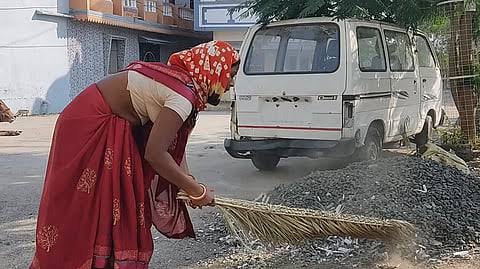
The truth about the lives of sanitation workers, as statistics are now revealing
New Delhi – A report was released on World Toilet Day (November 19). According to “Bridging the Life-Expectancy Gap of Sanitation Workers in India” by Reckitt and the International Institute for Population Sciences (IIPS), the average life expectancy of sanitation workers in India is 63.8 years. This is 11.4 years less than that of professional and managerial workers. Even when compared to agricultural and manual workers with similar education and income, the gap is still 9.6 years.
According to the report, 30.2 percent of recorded deaths among sanitation workers are related to toxic gas exposure and poisoning. Only 1 percent of workers are able to contribute to health insurance. Urban male sanitation workers have the lowest life expectancy at 62.3 years, nearly nine years less than urban men in the country. Studies estimate that this inequality results in a loss of approximately 1.03 percent of GDP each year.
These figures may surprise policymakers. But when The Mooknayak spoke to sanitation workers and members of self-help groups working for them in several cities across the country, a harsh truth emerged. No one was surprised. Some sighed deeply, others said, “This is how we live every day.”
Bhilai: “How can we run a household on just eight thousand rupees?”
Bharti Pakhale, in Bhilai, Chhattisgarh, has been working as a sanitation worker for the past eight years. Forty-year-old Bharti is the supervisor of dry and wet waste sorting in her ward. She earns eight thousand rupees per month and works eight hours a day.
When asked about weekly leave, she says, “There is no provision for weekly leave. Yes, if there is an emergency, we have to take leave. Everyone takes it as per their need, so we get four days of rest a month.”
There’s no provision for ESI or PF in the contract. If someone falls ill, they have to bear the entire cost of treatment out of their own pocket. “How can anyone survive on just eight thousand rupees? This is the reality, but we have no other option.”
Bharti, who grew up in a Dalit family, didn’t receive much education. According to her, women, especially in such circumstances, have no other option. Her hope now rests with her 14-year-old daughter. “My husband and I always tell her, ‘Don’t ever have to endure what we’re going through. Get a good education and get a good, respectable job.'”
Despite coming from a Scheduled Caste background, Bharti says that at least she hasn’t faced discrimination at her workplace.
Her demand is clear: “If our demand for at least 15,000 rupees a month, along with ESI and PF, is accepted and implemented, we will get some relief.”
Women workers face a different problem. They report for duty at 6 a.m. and work until 2 p.m., but they don’t get any relief even during their menstrual periods. Bharti says that for this there should be a provision like period leave.
Her experience with mechanization differs from claims. “There are robotic machines for cleaning sewer lines, but the actual work is still done by human hands. There are safety measures, but people are still exposed to toxic gases and polluted air.”
When told that the report suggests the life expectancy of sanitation workers is so low, Bharti sighed. “It’s no surprise that our life expectancy is so low.”
According to an IIPS study, the estimated life expectancy of sanitation workers in India is 63.8 years, while those in professional, technical, and managerial positions have a life expectancy of 75.2 years. That’s a difference of 11.4 years. The report also estimates that premature deaths result in a total of 77,458 life years lost per 100,000 sanitation workers.
Kharagpur (Bihar): “This work since I was 15.”
30-year-old Uttam Kumar from Kharagpur, Bihar, belongs to the Dalit community. He went to help his parents at the age of 15, and this has been his livelihood ever since.
Today, Uttam and his wife, Anjani, together earn 20,000 rupees per month, in exchange for eight hours of work. They are a family of four, with two children aged 10 and 7.
Uttam explains, “We get uniforms and shoes once a year. We don’t have a health card.” Then he asks, “We have a family of four. We run the house, educate our children, and get them medical treatment if we get sick. Tell me, how can our lives be truly good?”
When he started working, he earned 4,600 rupees a month. 13 years later, he has reached 10,000 rupees. His opinion on studies is straightforward. “If such a survey is conducted, I am confident that the quality of life will not change unless a uniform policy is established for sanitation workers across India.”
Jodhpur, Rajasthan: “Sanitation workers are the most neglected, cows and dogs have a better life than us.”
Prakash Vidrohi, leader of the Sanitation Workers Union in Jodhpur, Rajasthan, has the most harsh words to say.
He says, “At least one to two sanitation workers die every year in Jodhpur, and the reason is dangerous working conditions. Robotic and mechanical systems are boasted about, but the reality is that manual scavenging and manual labor are prevalent throughout Rajasthan. The safety equipment provided is ineffective, and our people continue to be exposed to toxic chemicals emanating from sewer chambers.” Regarding housing, he raises questions, “There are railway quarters for railway employees, and other departments have quarters, but have you heard of a sanitation worker colony anywhere in Rajasthan? The municipalities or the UIT have never allocated any projects for our housing and welfare.”
The Jodhpur Municipal Corporation (JMC) provides health cards, but if employees are unable to renew them on time due to some unforeseen event, they become useless. Once a gap occurs, renewal becomes a “difficult task” due to the bureaucrats. According to Vidrohi, this card is limited to common illnesses. For serious illnesses, most sanitation workers only have the Ayushman card.
He also points out the salary difference. “Permanent JMC employees receive 55,000 rupees a month, but contract workers are worse off. They receive only 7,000 rupees, and no ESI or PF deductions. Corruption is everything.”
He cites a recent example of exploitation. According to him, female workers were taken outside the Jodhpur Municipal Corporation area to a remote village panchayat in Luni to clean the streets of a private Raja Ram temple. This temple is run by a large and wealthy trust. Vidrohi complained to the officials there about why the workers were sent outside their jurisdiction. He received no response. Instead, they said, “This is religious work, what’s your objection?”
Workers who report for duty at six in the morning work until two in the afternoon, yet they don’t get any free time. “It’s four by the time we get home. And we don’t get any overtime for the hard work we put in.” His anger at the plight of female workers during menstruation is palpable. “They don’t have toilets, and there’s no place to rest. If they need to change, people don’t let them in. We know the condition of the public toilets we see in the markets. They’re either locked or in a bad condition because they’re used by ordinary people or beggars who don’t understand hygiene.”
At the end of the conversation, he says, “I can confidently say that in India, the lives of cows and dogs are better than those of sanitation workers. The lives of manual scavengers are worse. There are laws for cows and dogs, but no one cares about sanitation workers.”
In the Kushalgarh Municipality of Banswara district, sanitation workers, who tirelessly clean roads and drains for six hours a day, face not only a lack of pay but also deeply ingrained caste discrimination. Kalpana and Shilpa, two female sanitation workers working here, say, “Our salaries are very low, and the government should consider how we can survive on 6,000-7,000 rupees in today’s times. Those with permanent jobs earn 40,000 or more, but because our salaries are low, they don’t come on time. We have to borrow money, which charges 100 rupees of interest on every thousand rupees. When our salaries come, we repay the loan and then take another loan to meet household expenses—and so on.”
Chandigarh: The same story even in the most planned city
The situation is not much better even in Chandigarh, considered one of India’s most planned and clean cities. Shama, from a self-help group that conducts surveys on issues related to sanitation workers in the city, told The Mooknayak that she has frequent conversations with sanitation workers regarding work.
“Chandigarh has a large area, but the number of sanitation workers is limited. Consequently, they have to work harder. The entire day is spent cleaning a single area,” says Shama. Her group suggested 7-8 months ago that more people should be employed, given the shortage of manpower compared to the area. “But I don’t think any action has been taken on this recommendation.”
Regarding holidays, she explains that sanitation workers get one day off a week, but if someone falls ill during the month, their leave money is deducted. “The government may or may not deduct, but the contractor will.” This means they have to pay for their sick leave from their salaries.
Damoh (Madhya Pradesh): No salary for three months, Diwali empty-handed
The situation in Damoh, Madhya Pradesh, is even more dire. Rajat Kachhwa, associated with the Valmiki Self-Help Group, explains that the number of sanitation workers here is very low compared to the population. “There are about 50 permanent employees and about 100 on contract. Altogether, there are 150 to 200 sanitation workers.”
The biggest burden is the wait for pay. “We don’t get our salaries for three months. I myself belong to this community. People have to sell their household jewelry to support their families. They can’t even educate their children, and they’re expelled from schools. What are you talking about with a survey?” Rajat says.
He reminds us that Diwali is the country’s biggest festival, but even on this occasion, Damoh’s sanitation workers haven’t received any pay, let alone a bonus. “How can anyone celebrate a festival when it’s so difficult to survive?”
Contract workers receive a salary of 10,000 rupees, from which only PF is deducted. Due to the lack of ESI, even medicines for minor ailments have to be purchased out of pocket. Those with Ayushman cards are able to get treatment for major illnesses, but even that only involves select private hospitals, and they have to pay a small fee for admission.
Rajat runs awareness programs for the Dalit community. His group has brought the plight of sanitation workers to the attention of local authorities, but receives no concrete action, only assurances.
He demands, “The contract system should be abolished. All municipalities across the country should hire sanitation workers directly instead of through contractors and pay them a respectable minimum wage. Payments should be made on time, medical and PF should be mandatory. Facilities for children’s education, etc., should also be expanded so that the next generation can at least live a respectable life.”
The report also highlights the financial challenges faced by sanitation workers’ families. Their average monthly per capita expenditure is ₹3,357, the lowest among all the occupational groups studied. Healthcare costs further exacerbate their burden; 17.4% of their monthly family expenditure goes towards out-of-pocket health expenses.
Data and Ground: The Same Story
The report states that only 1 percent of workers contribute to health insurance, and in Bhilai, Jodhpur, and Damoh, contract workers do not receive ESI, nor are they paid PF. The report cites toxic gas as a major cause of deaths, with one or two sanitation workers losing their lives every year in Jodhpur. The report considers mechanization as the key to the solution, while workers from Bhilai to Jodhpur say the actual work is still done manually.
Dr. Srinivas Goli, Associate Professor at IIPS, says that poverty is not the only reason for this disparity. Nearly one in three deaths among sanitation workers is linked to poisoning, while in other occupations, the ratio is around one in twenty. He believes this points to a specific workplace hazard that can be eliminated through mechanization and gas detection.
The report’s six strategic priority areas include reducing hazardous manual entry, improving workforce records, supporting sanitation workers’ families, and strengthening livelihood security. Reckitt’s Harpic World Toilet College has trained 250,000 sanitation workers so far.
But the demands of the land are simple: timely and adequate pay, an end to the contract system, social security like ESI-PF, effective safety equipment, sufficient personnel, toilets for women, rest areas, and period leave, residential colonies, educational facilities for children, and a uniform policy across the country.
How can a person whose duty starts at 6 a.m., who doesn’t receive a salary for months, who faces pay cuts if they fall ill, whose child is expelled from school due to non-payment of fees, and who has to breathe poisonous gas, not live long? This figure of 63.8 years is perhaps the answer to this question.
Bharti’s daughter goes to school every day. Bharti says, “We want our children not to endure all this.”
Geetha Sunil Pillai
Courtesy: Hindi News