
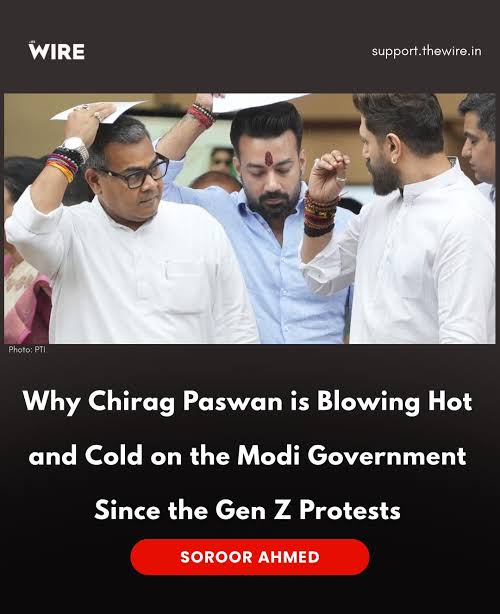
Understanding the politics of Chirag Paswan, Abhijeet Dipke and Chandrashekhar Azad in the context of the deep sense of disenchantment with the ruling regime among Dalit communities.
Union minister of food processing industries Chirag Paswan’s vocal opposition to how the Narendra Modi government handled the October 10 protests against the revision of voter lists and election chief Gyanesh Kumar reflects the unease within his own social base regarding the current government.
The Lok Janshakti Party (LJP) leader, with five Members of Parliament and 19 legislators in Bihar and one in Jharkhand, knows that the leading light of the Cockroach Janata Party (CJP), Abhijeet Dipke, belongs to a Scheduled Caste and is from Maharashtra – the home turf of Babasaheb Bhim Rao Ambedkar.
This can explain why Paswan has been blowing hot and cold ever since the CJP-led agitation began, and why his comments on the Modi government, though occasional, merit a closer look. After all the Bharatiya Janata Party (BJP) allies in the National Democratic Alliance (NDA) hardly ever speak up.
There is a growing restlessness among the Dalits in large parts of India, especially Maharashtra, Uttar Pradesh, Bihar and Punjab, where the socially and economically weakest sections have waged long and arduous struggles for their uplift. There is growing concern over rising unemployment among these sections, who are also struggling to keep pace with the rapid changes to workplaces brought by new technologies.
The Generation-Z amongst the Dalits are finding it difficult to adjust to the frequent occupational shifts they are being forced to make.
On the political front, Mayawati’s Bahujan Samaj Party (BSP), with its primary base in Uttar Pradesh, appears to have lost all hope of returning to power, at least in the near future. In Punjab, the Dalits, though constituting about one-third of population, find themselves leaderless ever since the demise of Kanshi Ram, who revived the Scheduled Castes movement in the 1980s after the death of Dr Ambedkar.
In Maharashtra, too, Dalit groups have splintered, disintegrated or have migrated away to support the BJP. After 2014, in Bihar too, Chirag Paswan’s father, the late Ram Vilas Paswan, and his uncle, Pashupati Kumar Paras, deemed it fit to toe the line of the saffron party for their own political survival.
In Uttar Pradesh, Chandrashekar Azad is trying to fill the vacuum created by the weakening of the BSP. He floated the Azad Samaj Party and won the 2024 Lok Sabha election from Nagina.
CJP’s arrival, Dipke’s rise
But the sudden emergence of Abhijeet Dipke on the forefront of the nationwide youth agitation, which started on the issue of exam paper leaks, has taken Dalit leaders by complete surprise. Though Dipke never projected himself as the leader of the Dalit community, the way he has shot into the limelight had alarmed those who claim to champion the cause of the Scheduled Castes.
Congress president Mallikarjun Kharge, also a Dalit, does not fall in this category as the Grand Old Party is essentially an umbrella group, not one that espouses the cause of any one social group.
Chirag leads a faction of the LJP, founded on November 28, 2000, by his father after breaking away from the Janata Dal (United). The father-son duo never trusted Nitish Kumar, the JD(U) leader, who later became the longest-serving chief minister of Bihar.
Nitish Kumar’s antipathy for the Paswans can be recalled, in particular, from how the Mahadalit Commission, formed by his government, excluded just the Dusadhs – one of the 22 Scheduled Castes in Bihar – from those who could access special schemes and packages announced for the entire state’s Dalits.
Dusadh is the caste community to which the Paswans belong, and it is numerically the strongest amongst Bihar’s Schedule Castes, with the population share of 5.31%. They follow only the Yadavs, who account for 14.26% of the population, in terms of numerical strength.
According to the 2023 Caste Survey conducted by the Bihar government, the Scheduled Castes in Bihar account for around 19.65% of its population.
Chaotic times for Dalit politics
There is a growing sense of unease and fear, among Chirag Paswan and other Scheduled Caste leaders that Dipke can marginalise them. Paswan, in particular, knows that the NDA in Bihar is in a state of chaos – almost all its major constituents, even the BJP itself, and the JD(U) and Rashtriya Lok Morcha headed by Upendra Kushwaha, are embroiled in infighting.
The defeat of the BJP candidate from all important Bankipur seat in Patna in the recently held by-poll is a pointer to the true state of affairs in Bihar, beyond just the Dalit voters.
The ruling combination in Bihar has become leaderless and rudderless. Knowing that age is on his side, the Paswan often flexes his muscles. Indeed it is a fact that the BJP’s dependency on him would increase as the JD(U) progressively weakens.
Remember that Paswan was hurriedly inducted into the NDA in March 2024, just ahead of the Lok Sabha elections that year. Pashupati Kumar Paras was virtually kicked out from the Modi Cabinet on March 19, 2024.
What is more, the BJP, in July 2021, not only triggered the splintering of the LJP but also made uncle Paras Union fertiliser minister. While four other party MPs were asked to side with Paras, Chirag Paswan was left alone.
Ram Vilas Paswan’s son was being punished for stabbing the NDA during the 2020 Assembly elections, in which he had put up 137 candidates. The bungalow to allotted to his father was evicted and his bust installed on the premises was also removed.
But ahead of the 2024 election, the BJP was hurriedly reminded of young Chirag’s hold over 5.31% voters – the Dusadh community. He was prevented from crossing over to Indian National Developmental Inclusive Alliance (INDIA).
Aware of his importance within the NDA, especially with the saffron party increasingly cornered by youth and Opposition protests over the SIR, Chirag is often takes what may be construed as an independent line. He strongly criticised the Samrat Chaudhary government after the recent spate of crimes in Bihar, putting the 20 years of BJP-JD(U) rule in Bihar in a spot, particularly over crimes against girls.
He is, of course, taking this line to improve his own bargaining position within the NDA and at the same time sending a signal to the INDIA bloc as the political situation grows increasingly uncertain. Chirag and his late father have a long history of switching political loyalties.
The Dipke phenomenon is likely to have an impact on next year’s Assembly polls in Punjab, which has the highest percentage share of Dalits in the country and in Uttar Pradesh, which has 21.3% Dalit voters.
During the 2024 Lok Sabha polls, Dalit disenchantment cost the NDA dearly, with the BJP candidate losing from the all-important Ayodhya seat to Awadhesh Prasad, a Scheduled Caste nominee of the Samajwadi Party. His victory over this unreserved seat was a major upset for the BJP, which it has still not been able to live down.
Soroor Ahmed
Soroor Ahmed is an independent journalist based in Bihar.
Courtesy : The Wire
Note: This news is originally published on https:/thewire.com/bha and is used purely for non-profit/non-commercial purposes, especially human rights