
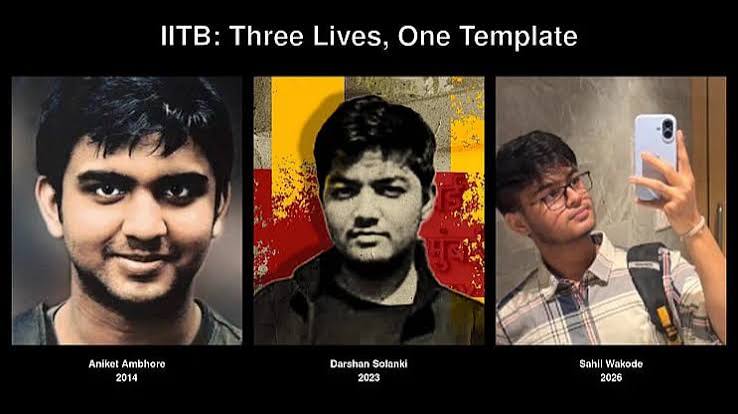
Student Group Alleges Inquiry Committees Follow a “Template,” Always Clean Chit to the Institute of Caste Discrimination
Mumbai – The Ambedkar Periyar Phule Study Circle (APPSC), a student group at IIT Bombay, believes that the institute’s internal investigation into Sahil Wakode’s death has already concluded. According to the group, like the cases of Aniket Ambhore and Darshan Solanki, this case will also be considered to have no caste discrimination. The group alleged that the institute investigates the deaths of Scheduled Caste (SC) and Scheduled Tribe (ST) students according to a set “template.” It called Wakode’s death an “institutional death” and reiterated its demand for an independent, external investigation.
In a statement on Sunday, the group cited the reports of two previous internal committees. The student group stated that a committee headed by Professor A.K. Suresh was formed after Aniket Ambhore’s suicide. According to the group, its report (page 24) concluded that the institute and its official bodies did not discriminate, either explicitly or implicitly.
The committee headed by Professor Nand Kishore, formed to investigate Darshan Solanki’s death, stated in its report (page 6) that none of the people interviewed—friends, wingmates, teachers, TAs, mentors, and Hostel 16 staff—mentioned caste-based or any other discrimination. Neither Solanki himself nor any of his friends mentioned this.
The APPSC stated that these findings reflect a pattern rather than an independent investigation, “a template is set and the conclusions are predetermined.”
Questioning the functioning of the inquiry committees, the group stated, “These committees are formed by the Board of Governors and work in coordination to quickly rule out caste-based discrimination.” The group alleges that they operate in isolation, within a well-designed institutional framework, and consistently draw the same limited sample and ultimately exonerate the institution of all charges. The statement describes these ad hoc committees as “placeholders for institutional inertia.”
The group also commented on the committees’ social composition. According to it, their members are not separate from the country’s social fabric, and caste does not exist for them because it is not an intimate experience of their lives. The group argues that this blanket denial of discrimination reveals how caste privilege masks inequality within the institution.
The Students’ Collective argues that investigations demand evidence of “clear acts of caste aggression.” This reduces a multi-layered and nuanced phenomenon to a narrow set of criteria. According to the group, this places the burden of proof on the person least capable of doing so, as dominant groups define “intent” and “overt act.”
The group also raised three questions about campus preparations:
- Have those with authority over students fresh out of school received caste sensitivity training?
- Is there a system in place to identify and bridge the gap in social and material status among peers?
- Why should SC/ST students be burdened with creating a safe and inclusive environment, when they already bear the double burden of proving merit, grappling with the “stigma of quotas,” and constantly being wary of their caste identity?
What are the Supreme Court’s directives?
The statement said that the Supreme Court’s guidelines in the case of Sukadeb Saha v. State of Andhra Pradesh and others are binding on every educational institution in the country from July 25, 2025. These require:
- Written protocols for immediate referral to mental health services.
- Twice-yearly training of staff to recognize warning signs.
- Dedicated mentors, especially during examination periods.
The group states that the IIT Bombay administration is guilty on many of these counts, but is vulnerable to acquittal at every turn due to institutional apathy and the “dominance of caste-blind forces.”
The statement questions the image of IITs as destinations for the country’s brightest minds. According to the group, rankings and research output create an image of a “smooth-flowing machinery of academic production,” while the merit that is celebrated is “upper caste dominance couched in the language of modernity and castelessness.”
The group alleges that the system implicitly requires students to be upper caste, while the space for disadvantaged students is “limited and restricted.” According to it, acknowledging caste discrimination would be detrimental to the notions of post-colonial modernity and merit that privileged castes celebrate.
Citing RTI data, it stated that as of September this year, out of 412 professors at IIT Bombay, only 5 are from the SC and 6 from the OBC categories, while there is no professor from the ST community. According to the group, this demonstrates that knowledge production is limited to a specific segment of society. Citing the institute’s motto, “Gyanam Param Dhyeyam,” the student collective also stated that the institute’s knowledge production process is an “echo chamber of upper-caste-disseminated knowledge,” making it devoid of diversity.
The Students Collective states that IITs are designated as “Institutes of National Importance” under the Institutes of Technology Act, 1961. Citing scholar Jayaram (2011), it states that these institutions operate autonomously and have largely been free from government or political interference.
According to the group, it is time to subject IITs to close scrutiny and open dialogue among stakeholders and civil society. It described the institute’s “caste amnesia” as “ridiculous and violent.” The statement also said that IITs have long been free from student politics, which should be condemned in a democratic framework. The group claims that the aim of these institutes is to produce an “obedient, caste-blind, and efficient workforce.”
Referring to the Wakode case, the APPSC said that the same institutional indifference persists here, and the “falsity” of IIT excellence and reputation remains unchallenged. The group reiterated its demands, demanding an external and independent investigation without institutional interference or “unconditional support” for the accused. They demanded that the committee be chaired by a person from the SC/ST community and include at least one external expert member to ensure a fair investigation. The committee should have at least 50% SC/ST representation and at least 50% women members from various disciplines.
Geetha Sunil Pillai
Courtesy: Hindi News