
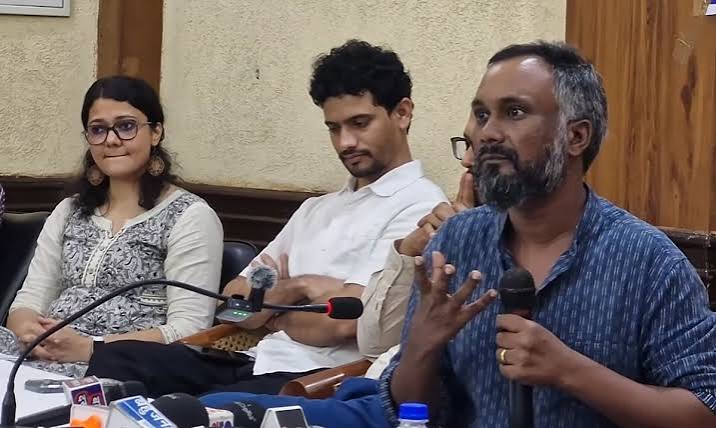
Dalit Organization Launches Nationwide Protest at Press Club, Major Event at Ambedkar Bhawan on October 2
New Delhi. The All India Independent Scheduled Caste Association (AIISCA) held a press conference at the Press Club in Delhi, reiterating its demand for reservation and affirmative action in private employment and private educational institutions. The organization stated that government jobs and government educational institutions are continuously shrinking, while employment, education, and economic power are becoming concentrated in private hands. Therefore, it is essential to extend the system of social justice to the private sector.
On this occasion, the organization released a document titled “Reservation in the Private Sector: From Government Jobs to Private Employment, Education, and Economic Power.” The conference was addressed by the organization’s president, Dr. Rahul Sonpimple, Prof. Sumit Mhaskar, Prof. N. Sukumar, and Prof. Sonajharia Minj and student leaders Aishwarya, Ashwini Kumar, Bhomaram, and Ashutosh Vidrohi addressed the gathering.
AIISCA Founder President Dr. Rahul Sonpimple stated that reservation in the private sector is “a political issue in every sense” and that it is not a question of today, but dates back to the British era. He cited Dr. Ambedkar’s demand for separate electorates at the Round Table Conference. According to him, the Poona Pact was a contract between India’s emerging modern state and the Scheduled Castes. In this agreement between equal parties, the Scheduled Castes gave up separate electorates and received the promise of reservation in jobs and politics. He also cited the promises made to the tribals (Fifth and Sixth Schedules, autonomy) and the Constituent Assembly debates. He said that just as Jinnah expressed lack of confidence in the demand for a separate country, Ambedkar believed in democracy.
He cited Ambedkar’s speech that discussed the contradiction between political equality and socio-economic inequality. Sonpimple asked the gathering whether inequality had decreased, stating that no one could say yes to this. He concluded that when inequality persists, the state’s contract is incomplete.
He stated that reservation is not a favor or a charity. According to him, it is the only thread connecting disadvantaged communities and the Indian state, and at the same time, a very fragile one. He alleged that the current government is weakening this thread. He urged social justice advocates to abandon their defense of reservation, as it is their constitutional right.
Sonpimple stated that government jobs have declined and sectors like mining are being transferred to private hands. According to him, mining takes place on tribal land, but local tribals are not getting even small jobs. He criticized the slogan “Minimum Government, Maximum Governance” and named the Adani Group as one of the allegations. These allegations are the speaker’s own, without any independent verification.
He claimed that the Scheduled Caste population would exceed 200 million in a correct count, and that OBCs constitute approximately 52% of the population according to the Mandal Commission’s estimates. Regarding the caste census, he said it was a victory of the Bahujans’ long struggle that the government had to acknowledge it.
He criticized the social media trolling and TV debates surrounding the suicide of an IIT student. He said that dismissing a complaint of caste discrimination if it is filed late is wrong. Referring to the Prime Minister’s claim of being an OBC and the Kalekar Commission, he questioned why the ruling party has not issued any statement on incidents against Dalit and Adivasi students on campuses.
He urged Dalit and Adivasi youth not to silently tolerate insults and abuse in the name of “morality” and not to hesitate to respond. He said, “We must not die,” and cited the struggles of his parents. He explained that his father used to drive a cycle rickshaw and his mother was a construction worker.
He said that the community is not “just for voting.” He demanded that both the ruling party and the opposition embrace this demand. The bill for reservation in the private sector be discussed and passed in the upcoming winter session of Parliament. In his words, the community will stand with whoever supports this demand.
He declared that a new struggle on this issue would begin on Gandhi Jayanti. He linked it to the Poona Pact, saying that the new fight would begin on the day Gandhi “snatched separate electorates from us.”
What other speakers said
Aishwarya, a research scholar from the Law Department of Delhi University, presented the constitutional and legal aspects. Citing the All India Survey on Higher Education 2023-24, she said that between 2013 and 2023, the number of private universities increased by 149%, while government universities increased by 45%.
Referring to disinvestment, outsourcing, and contractualization, he claimed that since 2018, 63 Group A-level positions (Joint Secretaries, Directors, Deputy Directors, etc.) were filled through lateral entry, where reservation was not applicable. In 2024, 45 such positions were withdrawn after protests. According to him, only about 4% of the total workforce is in government employment at most, and accurate figures are not available due to the lack of a census.
Citing ILO 2024 estimates, she stated that 88.4% of the workforce is informal. 7.3% of Scheduled Castes and 5.1% of Scheduled Tribes are in formal employment, compared to 16.2% in the unreserved category. Based on her fieldwork, she pointed to undeclared “reservations” in sanitation-related jobs. She cited Article 15(5) of the 93rd Constitutional Amendment (2006), which provides for legislation for backward classes in private (aided and unaided) educational institutions. She noted that Haryana, Maharashtra, Karnataka, Uttar Pradesh, Bihar, Arunachal Pradesh, Kerala, and Assam have enacted their own laws. She demanded a central law, fixed category-wise quotas, transparent admissions, and a caste census.
Aishwarya said that in August 2025, a Parliamentary Standing Committee recommended a central law to implement Article 15(5) in private higher education institutions, but the Ministry of Education stated that it was within the discretion of the states. He cited a Chennai study that found lower-caste applicants had to submit approximately 20% more applications despite equal qualifications. He also cited the Cisco case in California, ILO Convention 111, Canada’s Employment Equity Act, and South Africa’s Broad-Based Black Economic Empowerment Model.
According to Ashwini Kumar of the Ambedkar Student Association, LPG reforms were introduced in 1991 after the Mandal Commission, and in recent years, everything has been sold. He said that blaming reservations for the decline in government jobs is used to create conflict between communities. His message was that instead of debating “abolishing reservations,” the focus should be on increasing reservations and implementing them in the private sector. He announced a major event at Ambedkar Bhawan on October 2nd and stated that events would also be held in other states, including Uttar Pradesh and Haryana. A coordination team has been formed, and he appealed for participation.
Bhomaram of the School of International Studies, JNU, explained that he is the first generation in his family to pass the 10th grade. He mentioned the “Frontiers to the Peak” initiative of JNU colleagues, in which approximately 1,900 students applied for CUET, and about 1,100 passed the exam, but only a few hundred were able to enter central universities. He said that Ambedkar considered private property a cause of discrimination and advocated for moving towards public ownership. Regarding the efficiency argument, he cited a 2016 study (by Ashwini Deshpande and Thomas Weiskopf), which found no decline in the efficiency of SC/ST officers in Group A and B of the Railways. He criticized the reduction in scholarships and the lack of support mechanisms on campus.
Ashutosh Vidrohi, a law student and president of the Ambedkar Student Association of Delhi University, said that this issue is linked to the promise of the Poona Pact. He said that privatization increased after Mandal, and now a large share of the country’s resources are in private hands. He gave the figures of “about 98%” private and “1.7%” public sector, but also admitted that this is not accurate data. He stated that a press release is being issued, and a major event will be held in Delhi on October 2nd. He appealed for this demand to become a nationwide movement.
Sociologist Professor Sumit Mhaskar stated that around 2004-05, during Professor Thorat’s event, leaders from all parties had reached a consensus on this issue, but today, no government seems to have the political will. Regarding school education, he stated that the state of the school system is extremely poor, with poor, Dalit, and tribal children being the hardest hit.
He demanded an immediate increase in scholarship amounts in line with inflation. He stated that even with reservations in private higher education, if the fee issue is not resolved, it will become “negligible.” He noted that even in 1950, formal employment was 8-9%, while today government jobs remain at 2-3%, and even among these, more than 50-60% of Class 3 and 4 employees are contractual. He cited a BBC Marathi report in which teachers in Maharashtra, who teach on a “clock-hour” basis, were seen selling vegetables in the evenings. According to him, the demand for EWS quotas stems from a lack of jobs, so the issue isn’t limited to one community. He demanded that incentives such as government contracts, subsidies, free electricity, water, and affordable land should also be available to Dalit and tribal entrepreneurs.
Prof. N. Sukumar (Political Science, Delhi University) stated that the private sector must also respect constitutional social justice, as land, water, electricity, and subsidies are provided by the government. He cited the SC/ST MPs’ meeting during the Vajpayee government in 2003-04, the “voluntary” initiatives of industry organizations (CII, FICCI, etc.) during the Manmohan Singh era, and Chandrashekhar Azad’s private member’s bill in 2024.
He stated that the number of sanctioned posts and employees in the central government has declined compared to 2001, and there are approximately 9.5 lakh vacancies. Citing a response from the Ministry of Social Justice, he stated that between 2019 and 2023-24, the number of regular employees in central public sector undertakings declined from 9.2 lakh to 8.12 lakh. He also noted the decline in the number of employees in Coal India from approximately 7 lakh to approximately 2.4 lakh. He also expressed concern about contractualization in BSNL, DRDO, Air India, and BALCO.
Geetha Sunil Pillai
Courtesy: Hindi News