
After coming to Baba Saheb Bhimrao Ambedkar University, Amay also understood BBAU’s unique role in social justice. He learned that it is a central university established under a special act and has 50 percent reservation for SC and ST students.
Lucknow – The university that a student saw from his school window and path in his childhood, after a few years, was no longer just a place of study for him. He became a student there, studied law, participated in academic and co-curricular activities, raised student issues through student politics, engaged in legal awareness work, and finally received a gold medal at the same university’s convocation.
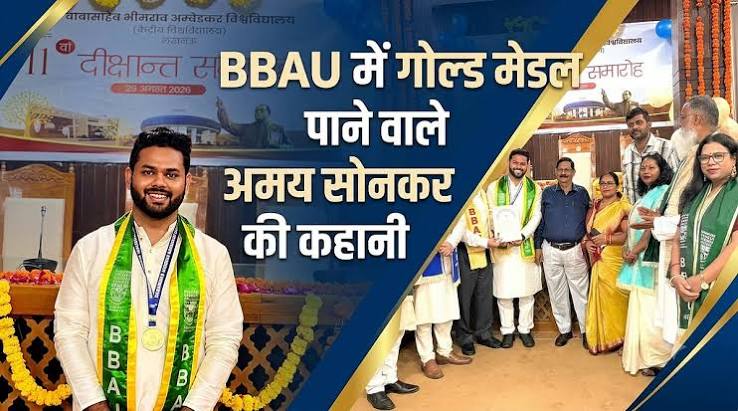
This is the story of Amay Sonkar, who was awarded the gold medal in the Scheduled Caste category at the 11th convocation of Baba Saheb Bhimrao Ambedkar University (BBAU), Lucknow, on August 29th. He completed his BBA LLB (Hons) from BBAU in the 2021-2026 session, securing 82.5 percent marks.
But for Amay, this medal isn’t just an academic achievement. According to him, it’s a long journey of family financial challenges, Ambedkarite ideals inherited from his father, personal experiences with caste discrimination, a desire to understand the law, student politics, legal awareness, and a view of education as a social responsibility.
Amay was born in 2001 in Rasra, Ballia district, Uttar Pradesh, into an economically struggling Scheduled Caste family. His mother managed the household while his father worked to support the family. Amay explains that despite limited resources, education and social equality were given special importance in his home.
His father is a postgraduate in human rights and has been involved in the Ambedkarite movement. He also served as the convener of BAMCEF. According to Amay, his father organized several meetings of Manvendra Kanshi Ram Saheb in Ballia district between 1986 and 2001 and worked to raise awareness among Bahujans about their social and political rights.
Amay says that his father was his first teacher. From childhood, he heard his father speak about the struggles, thoughts, and philosophy of Babasaheb Dr. B.R. Ambedkar. His understanding of respect, equality, and social justice developed in this family environment.
BBAU was opposite his school, and he dreamed of studying there.
Amay completed his primary education at St. Mary’s School in Rasra. After his father’s transfer to Azamgarh, he continued his studies at St. Xavier’s School. Later, the family moved to Lucknow, and he enrolled at The Millennium School, Lucknow. He scored over 75 percent in both grades 10 and 12.
Downtown was located right next to his school, Babasaheb Bhimrao Ambedkar University. Amay says that he would gaze at the university every day while going to school.
For Amay, who grew up hearing about Babasaheb from his father, seeing a university named after him was not an ordinary experience. Gradually, he began to dream that one day he too would be a student at BBAU. At that time, he couldn’t fully express this connection in words, but the desire to study at this university was clear within him.
Law is not just a career choice.
According to Amay, during his school days, he experienced some experiences of caste discrimination that changed his way of thinking. He was around 16-17 years old at the time.
He says that before this, caste discrimination was primarily a problem he had heard about or learned about. But when he experienced it firsthand, he realized its reality and pain. The question of why a teacher might treat a student differently based on their caste also became important to him.
These experiences sparked a desire in him to understand the law. According to Amay, he wanted to understand why this happened to him, how he could question such injustice, and how to effectively stand up for the rights of the Bahujan community.
For him, law wasn’t just a career choice. In his words, studying law was the result of a desire, born of his personal experiences, to understand injustice and gain the tools to challenge it.
In 2021, Amay took the BBAU entrance exam and secured admission to the BBA LLB program. This was an emotional moment for him, as the university he saw every day from outside his school was now going to be his academic campus for the next five years.
After joining the university, he also understood BBAU’s unique role in social justice. According to Amay, he learned that it is a central university established under a special act and has 50 percent reservation for SC and ST students. He also notes that the university’s student community also has a significant number of students from SC and ST backgrounds.
This is why Amay saw the university not only as a place to earn a degree. It also became an opportunity for him to work for students and communities who have historically been deprived of equal opportunities.
Student Politics, Full Focus on Studies
While studying at BBAU, Amay remained active in student politics and other activities, but he believes this did not impact his studies. During his BBA LLB, he participated and achieved success in numerous academic and co-curricular competitions.
He served on various legal committees within the university and served as co-convenor and later convenor of the BBA University Moot Court Committee. During this period, he organized the first and second Babasaheb Bhimrao Ambedkar National Moot Court Competitions. He also participated in various national and state-level seminars and academic programs in various capacities.
For him, legal education was not limited to classrooms, exams, and competitions. He saw it as deeply rooted in Babasaheb’s legacy and questions of social justice.
Amay developed an interest in legal research while still an undergraduate. He wrote and published research papers on topics such as food security and caste discrimination in prisons. Some of his other research papers are currently under review.
He also completed internships at several government and legal institutions. These included opportunities to work with High Court judges, internships with state and government authorities, and work with private lawyers practicing in the High Court and district courts. According to him, these experiences gave him a practical understanding of the courts, legal institutions, and the justice system.
Legal awareness work in slum areas
Amay believed that the ultimate goal of legal education should be to serve society. With this thought in mind, he participated in and helped organize legal aid initiatives in slum areas.
During these initiatives, people living on the economically and socially marginalized were interacted with. They were provided basic legal information, informed about their rights, and efforts were made to explain the available legal remedies.
These experiences further strengthened Amay’s belief that, in addition to the complexity of the law, a lack of information, guidance, and resources also hinders access to justice for ordinary people.
His father also played a crucial role in Amay’s decision to enter student politics. He explains that when he decided to enter student politics, his father, instead of restraining him, encouraged him to stand up for the rights of the Bahujan community and help people.
According to Amay, his father often told him: “If we don’t speak up, who will? We have to carry forward what Babasaheb has done.”
This support was crucial for Amay. This encouragement gave him the courage to become active in student politics and work on student and social issues.
Student Organizations and Student Issues at BBAU
Amay worked on student politics and student welfare through the National Students’ Union of India (NSUI). After becoming the Student Union President at BBAU in 2022-23, he established the university’s first formal student body, consisting of a 15-member structured committee and office bearers.
Through this platform, he worked on issues such as student welfare, discrimination, violence against SC/ST students, and other student-related issues. During a membership drive, he engaged with over 500 students in 15 days.
Subsequently, he was appointed State Secretary of NSUI Uttar Pradesh, where he was responsible for Shravasti and Kanpur University. He worked on building organizational structures and units at various levels.
Following this, he served as the election in-charge in Rae Bareli and then became the National Coordinator of NSUI. In this role, he was responsible for Gujarat, Dadra and Nagar Haveli, and Daman and Diu.
Protests over Babasaheb’s Honor and the Difficulties That Followed
There was an incident during Amay’s student life that he considers a significant part of his journey. He organized a protest at BBAU following Amit Shah’s comments about Babasaheb Dr. B.R. Ambedkar.
Amay explains that by that time, Babasaheb was no longer just a name to him. His ideas had become central to his understanding of education, dignity, and equality. This is why he felt it necessary to protest. He burned an effigy of Amit Shah at BBAU.
According to Amay, he faced consequences at the university after this protest. He says this incident taught him that standing up for one’s beliefs can have personal consequences.
During his active student life, he faced numerous actions and formal notices from the university administration. On one occasion, he says, the proctor confined him to the university campus for more than eight hours without any explanation.
During these difficult times, Amay received significant support from his law department. He expresses his gratitude to his law professors for their guidance and support during these difficult times. He particularly cites the support, guidance, and blessings of his department head as crucial to his journey.
SC All India Rank 84, UP Rank 18 in CLAT PG
During the ninth semester of his BBA LLB, Amay began seriously preparing for further studies. His goal was to study at a national law university. He prepared for CLAT PG 2026 and secured an All India SC Rank of 84 and an Uttar Pradesh SC Rank of 18. Subsequently, he secured admission to the LLM program at Dr. Ram Manohar Lohia National Law University (RMLNLU), Lucknow.
He also took the All India Bar Examination (AIBE) and passed it on his first attempt. Subsequently, in June 2026, he took the UGC-NET exam. According to Amay, he initially took it as a chance because he was still pursuing his postgraduate studies at the time, but he was successful in qualifying for the UGC-NET for PhD admission.
Then came the day that Amay considers the most emotional moment of his entire academic journey.
On August 29, 2026, he was awarded the Gold Medal in the Scheduled Caste category at the 11th Convocation of BBA University. He had scored 82.5 percent marks in his BBA LLB.
For Amay, the significance of this achievement is not just the gold medal. Years later, he studied as a student at the same university he had seen from his childhood home and dreamed of studying there, and then received the Gold Medal on the same campus.
For him, this journey was a journey that came full circle. From a child observing the university from outside, he became a law student within the same university and was later honored by the same institution for his academic achievements.
Amay considers Babasaheb Dr. B.R. Ambedkar his role model. The influence of his father’s teachings in childhood deepened during his years at BBA University.
For him, Babasaheb’s most inspiring legacy is his vision of education, equality, dignity, constitutionalism, and social change. Therefore, he does not consider the Gold Medal merely a recognition of academic performance. According to him, education also brings responsibility.
This idea is reflected in his future plans. Amay’s journey isn’t going to stop after the gold medal. He is currently pursuing an LLM at RMLNLU, Lucknow. His future goal is to pursue a PhD and enter academia.
He aspires to work in the field of legal research and teaching. He also wants to remain connected to the Ambedkarite movement and contribute to the empowerment of Bahujan communities.
His long-term ambition is to contribute to building a strong Ambedkarite movement through education, legal awareness, research, and social engagement. He wants to work for those who face discrimination and inequality or lack adequate access to information and knowledge about their rights.
What message does this journey offer to other Dalit youth?
An important aspect of Amay’s story is that his achievement cannot be seen solely in the picture of a gold medal. His journey shows an intertwining of education, personal experience, legal understanding, social concerns, and student leadership.
Coming from a financially struggling Scheduled Caste family, entering BBAU, achieving academic success while pursuing law at the same university, gaining research and legal experience, working on student issues, holding various responsibilities in student politics, achieving an All India Rank of 84 in the SC category in CLAT PG, passing the AIBE in his first attempt, qualifying the UGC-NET, and finally receiving the Gold Medal in the SC category at the BBAU convocation—these are the highlights of Amay’s journey so far. And at the core of this entire journey, Amay holds one idea: education is not just an opportunity, it’s also a responsibility.
Geetha Sunil Pillai
Courtesy: Hindi News