
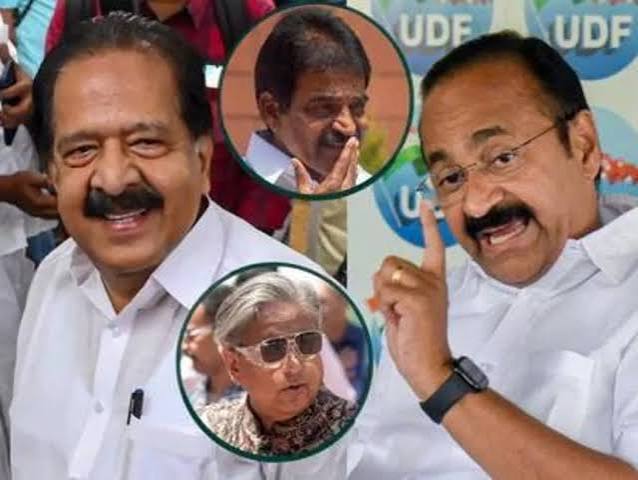
The political conflict between the BJP and Congress over the demand for reservation for Dalit Christians in Kerala has intensified. A statement by Chief Minister V.D. Satheesan has reignited the issue, raising questions about the BJP’s carefully crafted Christian vote bank strategy.
Thiruvananthapuram – At an event commemorating the 163rd birth anniversary of social reformer Ayyankali, Chief Minister V.D. Satheesan stated that the Dalit Christian community is not receiving the facilities available to Christians or the benefits afforded to Scheduled Castes (SCs). He assured that his government would study the issue and find ways to address the community’s backwardness.
The Chief Minister’s statement drew a sharp reaction from the BJP’s Scheduled Caste (SC) Morcha. State president Shajumon Vattekkad demanded Satheesan retract his statement, alleging that the Chief Minister was engaging in appeasement politics. He warned that extending the reservation for the Scheduled Caste community to Dalit Christians would be like playing with fire. Vattekkad stressed that the quota granted to the Scheduled Caste community by the Constitution is not a charity but their right, and that the BJP’s SC Morcha will mobilize the community and launch a movement against the government.
BJP State Vice President K.S. Radhakrishnan also questioned the validity of the demand. In a Facebook post on Tuesday, he argued that if conversion eliminates caste identity and caste-based oppression, then the demand for SC status has no basis. He said that if caste discrimination still persists within the Christian community, they should first acknowledge it and address it.
What is the demand of Dalit Christians and how long has it been ongoing?
The demand for SC status for Dalit Christians is not new. This demand has long been raised, especially by a section of the Christian community in Kerala and the Catholic Church. Dalit Christians are primarily descendants of Hindu communities who were historically marginalized and later converted to Christianity.
Under the Constitution (Scheduled Castes) Order, 1950, SC status is limited to members of the Hindu, Sikh, and Buddhist communities. Various governments have considered proposals to extend this status to Dalits who converted to Christianity or Islam from time to time.
Kerala has a large Dalit Christian population, whose ancestors converted generations ago. The community argues that despite conversion, they continue to face social and economic discrimination based on caste and should be granted the same constitutional protections as Dalits of other religions. Dalit Christians affiliated with the Syro-Malabar Catholic Church are primarily concentrated in Kottayam, while non-Catholic communities such as Pentecostals reside in large numbers in Pathanamthitta and Idukki districts.
Why is this issue a political dilemma for the BJP?
This issue poses a major political dilemma for the BJP. The party has been striving to expand its reach beyond its traditional Hindu base to Kerala’s Christian community over the past few years. The issue of conversion has been a major obstacle to this outreach, although a section of the BJP’s state leadership has tried to downplay it, arguing that the Christian population in Kerala is declining, so conversion should not become a barrier between the party and the Christian community.
The party has also tried to portray Hindus and Christians as communities with shared interests, especially on what BJP leaders call “Muslim appeasement.” Despite this, the issue of conversion remains a thorn within the BJP and the broader Sangh Parivar.
Last year, the arrest of two Kerala Catholic nuns in Chhattisgarh on charges of forced conversion and human trafficking brought this tension to the fore. Several leaders, including Kerala BJP President Rajeev, rejected allegations of forced conversion and expressed solidarity with the nuns. This stance was criticized by some sections of the Sangh Parivar in Kerala, who cited it as an example of the conversion of members of marginalized Hindu communities.
This debate again came to the fore this year regarding the Foreign Contribution (Regulation) Amendment Bill, 2026. The bill, introduced by the central government, was later referred to a joint parliamentary committee. While BJP leaders attempted to allay Christian organizations’ concerns about the proposed changes, some sections of Hindutva organizations in Kerala alleged that this funding could encourage religious conversions and demanded strict scrutiny of foreign donations to churches. R.V. Babu, state president of the Hindu Aikya Vedi, also opposed any move to extend Scheduled Caste reservations to converted Christians, alleging that the government was “promoting religious conversions.” The Vedi is an umbrella organization of several Sangh Parivar-affiliated organizations in Kerala.
The BJP inducted Christian leaders into the party to woo the Christian vote and fielded Christian candidates in areas with large Christian populations. However, the party failed to achieve significant success among Christian voters in the 2026 assembly elections. The BJP won three assembly seats—Nemom, Kazhakootam, and Chathannoor—but its victories in these seats were attributed to its traditional Hindu base rather than any major shift in Christian voter sentiment.
These limited electoral results have further fueled debate within the BJP about the direction and political benefits of its Christian-centric strategy. In such a situation, Satheesan’s statement is being seen as part of the Congress’s strategy to dent the BJP’s Christian outreach, while some sections within the BJP have become more vocal than ever on the issue of conversion.
The issue is also under consideration at the central level.
The question of granting SC status to Dalits who convert to Christianity or Islam is also under consideration at the national level. In 2022, the central government constituted a commission headed by former Chief Justice of India K.G. Balakrishnan to investigate this issue. The commission’s work included investigating the demand for SC status for Dalit converts and the discrimination they face. The case for granting SC status to Dalit Muslims and Christians has been pending in the Supreme Court for 20 years. The commission’s tenure was extended several times. After several extensions, the commission finalized its report by the scheduled deadline of June 10.
A community grappling with caste discrimination
The situation of Dalit Christians in Kerala is socially and economically challenging, where they continue to face caste discrimination despite their conversion. Dalits embraced Christianity generations ago, but their representation in higher echelons of the church and society remains negligible. Members of the community still experience discrimination in inter-caste marriages, social interactions, and institutions.
Geetha Sunil Pillai
Courtesy: Hindi News