
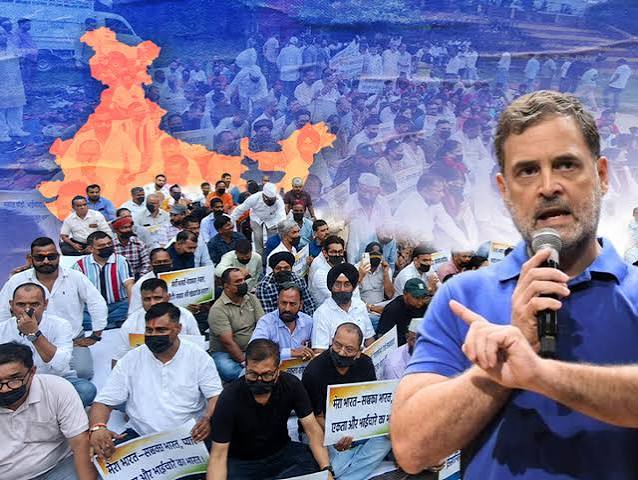
An FIR has been registered against Rahul Gandhi. It was filed on the complaint of Amit Kumar, a Scheduled Caste youth.
Congress is opposing the FIR and has accused the BJP of targeting Gandhi.
The fight has now moved beyond Haldwani. In Haryana too, Congress has accused the BJP of using Dalit politics to strengthen its support among Dalit communities.
Why does caste still shape Indian politics nearly 80 years after Independence? And is the BJP trying to win the Dalit vote once seen as a Congress stronghold? Let’s explore …
What is the Rahul Gandhi controversy about?
The controversy began after Congress president Mallikarjun Kharge addressed a rally in Haldwani, Uttarakhand.
The rally was held at Ramlila Maidan on 8 August.
Two days later, a group performed a shuddhikaran havan, or purification ritual, at the same ground.
Congress said the ritual targeted Kharge’s Dalit identity.
The organisers denied this. They said the ritual was only to clean the venue.
Kharge raised the issue in the Rajya Sabha on 13 August.
He said he had spoken about public problems at the rally. He also said he had never asked for help by identifying himself as SC or Dalit.
But he said being subjected to untouchability was humiliating.
BJP president JP Nadda distanced the party from the incident.
He said the BJP did not support such activities.
The issue became bigger on 29 August
Rahul Gandhi called the purification ritual an example of untouchability. He demanded an FIR under the SC/ST Act.
Then came another twist.
On 30 August, Uttarakhand Police registered an FIR against Rahul Gandhi.
A Valmiki community office bearer Amit Kumar filed the complaint.
He alleged that Gandhi had wrongly portrayed members of the Scheduled Caste community who took part in the ritual as caste discriminators.
The FIR invokes the SC/ST Act and Sections 196 and 299 of the Bharatiya Nyaya Sanhita.
Congress says the incident is a double insult: Kharge was disrespected first, and then Rahul Gandhi was booked for raising the issue.
Kamal Nath said the BJP first insulted Dalits by carrying out the ritual and then filed an FIR against Gandhi when he spoke about it.
A dispute over a ritual has now become a bigger political fight over caste, dignity and who gets to speak for Dalits.
BJP has also been accused of strengthening its Dalit vote bank in Haryana, what is the reality?
Haryana is witnessing a new phase of Dalit politics.
Since 2014, the BJP has worked to expand its support among non-Jat voters and smaller Dalit communities, especially Balmikis. This strategy has continued under Chief Minister Nayab Singh Saini.
This politics brings together three identities: Ambedkarite pride represented by “Jai Bhim”, Balmiki community pride, and a broader Hindu identity symbolised by Lord Ram.
Political scientist Sanjay Kumar say the BJP is trying to bring smaller Dalit groups into a wider Hindu political coalition.
A recent example was the protests following the killing of 25-year-old Biru Balmiki in Karnal. Demonstrators raised slogans such as “Jai Bhim, Jai Balmiki, Jai Shri Ram”.
Reservation has become another battleground. After the Supreme Court’s August 2024 ruling on SC sub-classification, Haryana divided its 20% SC quota into two categories.
The move could benefit smaller communities but may weaken larger groups such as Jatavs.
The debate is also important in Uttar Pradesh, where parties are trying to win over different Dalit communities.
The contest is no longer just over a single “Dalit vote bank”, but over representation and reservation.is no longer just over a single “Dalit vote bank”, but over representation and reservation.
Are political parties focusing more on Dalit vote-bank politics again?
No. Dalit politics has never gone away.
It has been part of Indian politics since before Independence. Every generation has produced new leaders, new movements and new demands.
B R Ambedkar himself warned in 1932 that social reform had done little to change the lives of Dalits. As he put it: “Mahatmas have come and gone, but untouchables have remained as untouchables.”
After Ambedkar came leaders such as Jagjivan Ram. Later came Kanshi Ram, who founded the Bahujan Samaj Party (BSP) in 1984.
His protégé Mayawati turned the BSP into one of India’s most successful Dalit-led political movements.
The party reached its peak in 2007, when it won 206 of Uttar Pradesh’s 403 Assembly seats and formed the government on its own.
Today, however, the BSP is much weaker. In the 2022 Uttar Pradesh Assembly election, it won only one seat and secured 12.88% of the vote. In the 2024 Lok Sabha election, it failed to win a single seat.
Its decline has created space for other parties and new Dalit leaders, including figures such as Chandrashekhar Azad, who won the Nagina Lok Sabha seat in 2024.
Political scientist Badri Narayan has studied this shift closely. In his book The Making of the Dalit Public in North India, he argues that Dalit political consciousness grew through grassroots movements, local struggles and everyday experiences, not just through elections.
In another book, Republic of Hindutva, he explains how the Sangh Parivar expanded its reach among some Dalit communities through welfare outreach and by incorporating Dalit and OBC icons into a broader Hindu narrative.
So political parties are not suddenly discovering Dalit politics. What has changed is the political space around Dalit voters.
The party that once dominated much of that space has weakened, and more players are now competing to represent different sections of the Dalit community.
The Making of a Dalit Public in North India looks at Dalit political consciousness, participation and mobilisation in northern India, based on extensive village-level fieldwork in eastern Uttar Pradesh.
The Making of a Dalit Public in North India looks at Dalit political consciousness, participation and mobilisation in northern India, based on extensive village-level fieldwork in eastern Uttar Pradesh.
How have Dalit voting patterns changed across elections?
Sanjay Kumar and Vibha Attri analysed Hindu Dalit voting patterns in Lok Sabha elections from 1996 to 2024, using Lokniti-CSDS election studies.
In 1996, Congress received 34% of the Hindu Dalit vote, compared with 14% for the BJP. Congress and its allies remained ahead through the 1990s and much of the 2000s.
The big change came in 2014. The BJP’s share among Hindu Dalit voters doubled from 12% in 2009 to 24%. With its allies, the NDA reached 30%, overtaking the UPA at 20%.
By 2019, NDA support among Hindu Dalit voters had risen further to 41%. But the 2024 election showed that this support was not permanent. The NDA’s share fell to 36%, while the Congress-led INDIA bloc rose to 32%
Sanjay Kumar found that the national picture hides major differences between states.
In Karnataka, Congress’s Dalit vote share rose from 51% in 2018 to 63% in 2023. In Telangana, Congress also gained among Dalit voters, although the BRS retained a significant share.
So, the story is not simply Congress to BJP. Congress dominated the Dalit vote for much of the earlier period. The BJP made major gains after 2014, but by 2024 the gap had narrowed again.
The larger lesson is that Dalit voting is not a fixed bloc. Party preferences can shift with state politics, alliances and local issues.
Why is the Dalit vote not one vote?
The state is heading for the 2027 Assembly election, while Mayawati’s political position is weaker than it was earlier. Congress is also trying to rebuild its support among Dalits.
UP has several Dalit communities. Jatavs have traditionally been the core of Mayawati’s BSP. Pasis, Valmikis, Khatiks and Gonds are among the other major communities.
They do not always vote in the same way.
The Samajwadi Party has been trying to reach non-Jatav Dalits. It set up the Ambedkar Vahini for this outreach.
In 2022, it also brought in former BSP leader Swami Prasad Maurya.
In 1996, BSP and Congress joined hands in UP, seeking to bring Dalit votes together. The election produced a hung Assembly, setting the stage for shifting alliances.
In 1996, BSP and Congress joined hands in UP, seeking to bring Dalit votes together. The election produced a hung Assembly, setting the stage for shifting alliances.
The BJP has been working among these communities too. It has aimed to expand beyond the Jatav vote that has traditionally backed the BSP.
The Lokniti-CSDS data from the 2024 election shows how sharply these choices can differ. BJP support among Jatavs rose from 17% in 2019 to 24% in 2024. Among non-Jatav Dalits, however, it fell from 48% to 29%.
So, in the same election, the BJP gained among one Dalit community and lost support among another.
That is why the old idea of a single “Dalit vote bank” is becoming harder to explain. With the BSP weakening, parties are now trying to win different Dalit communities separately.
Graphics- Anas Shakir
Courtesy : Bhaskar English
Note: This news is originally published on https:/bhaskarenglish.com/bha and is used purely for non-profit/non-commercial purposes, especially human rights