
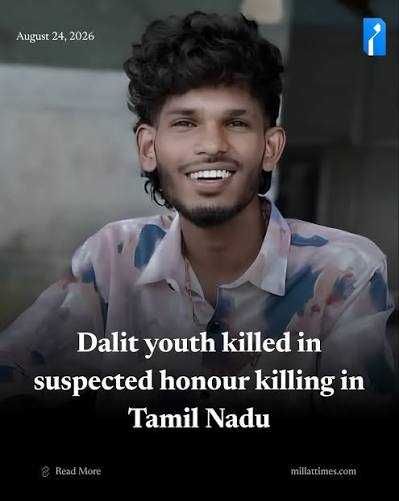
An ‘honor killing’ case in Chengalpattu, Tamil Nadu: A ruling party leader is accused of brutally murdering a 23-year-old Dalit youth due to economic inequality.
Tamil Nadu: A heartbreaking incident has occurred in Chengalpattu district. A 23-year-old Dalit youth was brutally murdered on suspicion of honor killing. This horrific incident has shocked the entire area.
The deceased youth was Praveen, a resident of Kelambakkam, Chengalpattu. On the night of August 16th, Praveen was attacked with sharp-edged weapons by assailants. He was seriously injured in the violent incident. He was subsequently admitted to the Rajiv Gandhi Government General Hospital in Chennai, where he succumbed to his injuries on August 20th.
The police acted swiftly and arrested four of the accused in the murder. They were identified as Manikandan, Ezhumalai, Nandish, and Gautam. All were remanded to judicial custody on August 17th. The administration and police are currently searching for the fifth absconding accused.
According to several media reports, the main accused, Ezhumalai, is a member of the ruling Tamil Nadu Vetri Kazhagam (TVK). It is reported that Ezhumalai’s daughter, Aswathy, and Praveen were in a love affair. Satish Kumar, a neighbor of the deceased, stated that Praveen and Ezhumalai both belonged to the Scheduled Caste (Adi Dravidar) community. However, Praveen’s family was financially weak, and this perceived poverty-wealth gap was the primary reason for the murder.
Caste and Identity Groups
This attack was not a random incident. Aswathy’s family had previously threatened Praveen with death several times. According to neighbor Satish, a relative of Aswathi once came to Praveen’s house armed with a weapon. He tried to attack Praveen with a knife and left, screaming and shouting threats.
Not only this, Praveen was also brutally assaulted about six months ago. At that time, Ezhumalai and other accused tied Praveen with ropes and beat him severely. However, fearing the dispute, Praveen’s family decided not to file a police complaint at that time.
It is alleged that this brutal murder was carried out as part of a well-planned conspiracy. One of the accused, Manikandan, had befriended Praveen about three months earlier. On the day of the murder, August 16, Praveen had gone to meet Manikandan. He was abducted in a car, taken to another location, and fatally attacked.
This incident has once again intensified the demand for stricter laws against honor killings in the state. Anti-caste activists report shocking statistics. In Tamil Nadu alone, 59 cases of honor killings were reported between January and March 2026. Activists believe that the Scheduled Castes and Scheduled Tribes (Prevention of Atrocities) Act is insufficient to address such cases.
Social activists say that not only caste superiority, but also class, religion, and gender identity play a significant role in honor killings. As in Praveen’s case, when both the killer and the victim belong to the same Dalit community, enforcing the SC/ST Act becomes legally difficult. Furthermore, activists point out that Christian or Muslim Dalits are also not protected under this law because they are not recognized as Scheduled Castes.
People and Society
Anti-caste activist and author Shalin Maria Lawrence has expressed deep concern over this incident. She argues that honor killings within Dalit communities are mostly based on economic status or class. She emphasizes the need to understand these attacks from the perspective of Dr. B.R. Ambedkar’s concept of “graded inequality.”
Discrimination and Identity Relations
He wrote on the social media platform ‘X’ that Praveen’s murder demonstrates how caste, class, and patriarchy intersect even within oppressed communities. Two people may belong to the same caste, but their social or economic status may differ. In such a situation, the claim to family ‘honor’ becomes a weapon against those who try to cross these boundaries.
He explained that Praveen was killed because someone felt that his family’s honor outweighed the young man’s right to live and love. This represents the most horrific manifestation of the deeply ingrained inequality and cruelty in society.
Rajan Chaudhary
Courtesy: Hindi News