
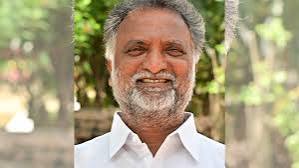
The Mayakonda MLA hails from a humble background and grew up amidst hardship as the son of civic workers Sangappa Pailwan and Hanumakka.
Bengaluru: In 2020, senior Congressman G Parameshwara offered the Legislative Assembly a chilling account of caste-based discrimination.
“I became an MLA for the first time in 1989. While going on a victory round, they took us to a village which naturally will have temples and Ramesh Kumar (in an apparent reference to fellow Congress leader Ramesh Kumar, a Brahmin) must be there. They took me into the Hanuman temple, I saluted the deity, took the Mangalarathi and came out. After I left, there was a fight as to how could I have been taken inside the temple”.
Narrating this, Parameshwara, who hails from Dalit (right) community, said thereafter, he avoids entering temples with discriminatory practices and instead, does the rituals outside the premises on some pretext.
Six years later, the Congress government, with Parameshwara as deputy CM, has taken a progressive step by appointing first-time MLA K S Basavanthappa from Dalit (left) community as minister for Muzrai department, which manages Hindu temples.
The Mayakonda MLA hails from a humble background and grew up amidst hardship as the son of civic workers Sangappa Pailwan and Hanumakka.
His appointment is being interpreted as a powerful counter to the despicable practice of caste-based discrimination in some temples.
Though Rudrappa Lamani also held Muzrai portfolio in previous Congress government during 2016-18 (he hails from Lambani sub-sect among scheduled castes), Basavanthappa is the first from among SC (left)/SC (right) communities, which are comparatively more marginalised, to do so.
On Aug 10, right-wing outfit Shri Ram Sena Dharmarth Seva Nyas performed Shuddhikaran (‘purification’), after AICC president Mallikarjun Kharge’s speech at Ramlila maidan at Haldwani, Uttarakhand on Aug 8.
A senior minister told DH that the government believed in 12th-century social reformer and anti-caste crusader Basavanna’s principle of ‘Kayakave Kailasa’ (work is worship). “There is a quote inscribed at the entrance of Vidhana Soudha that says ‘Government work is God’s work’.
Ultimately, it’s about carrying out the responsibility bestowed on an individual by the party. If an atheist is handed over the responsibility of the muzrai or minorities welfare department, he or she should still undertake the duty,” he said.
Leader of the Opposition in the Council Chalavadi Narayanaswamy said one way of looking at it would be to appreciate the decision. But, he also wondered if “upper castes” were ready for such a development.
The BJP leader, who hails from SC (right) community, felt the decision could be a “test case” to gauge society’s reaction.
Sujay B M DHNS
Courtesy : DH
Note: This news is originally published on https:/deccanherald.com/bha and is used purely for non-profit/non-commercial purposes, especially human rights