
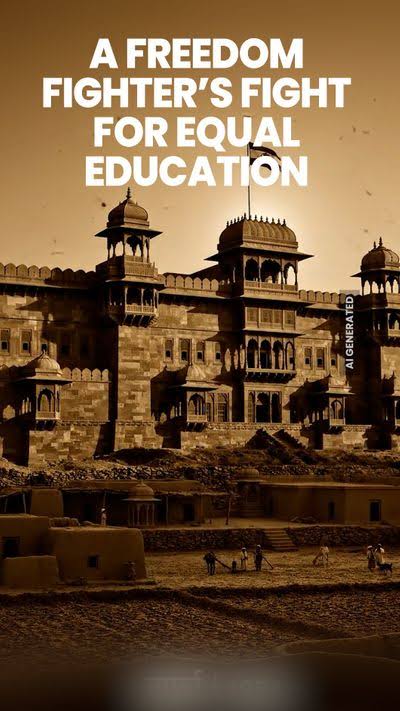
At an age when most children are busy playing, 12-year-old Rampratap Sharma lost both his parents. Jagirdars (landlords) seized his ancestral land, while incidents of oppression against weaker sections deeply disturbed him.
After listening to Netaji Subhas Chandra Bose’s speech in Jodhpur, he resigned from his police job and joined the freedom struggle. He faced lathi charges during various movements and was also jailed. At a time when untouchability was widespread and schools refused admission to Dalit children, he opened Rajasthan’s first Dalit school in a rented house.
He persuaded his younger brother to leave his job and take responsibility for teaching at the school. It later developed into a full-fledged school. Today, a Government Senior Secondary School operates in the same bungalow that once housed British officers.
The Bhaskar team visited his village to trace the story of freedom fighter Rampratap Sharma, who fought not only against British rule but also campaigned against untouchability. Read this special report.
Lost his parents at the age of 12
Gundoj village is around 20 kilometres from Pali. In the Brahmpuri area of the village stand the ancestral homes of freedom fighter Rampratap Sharma and his younger brother, Magraj. When we visited the house, his grandson and Magraj’s son recounted stories from that era.
Grandson Mahesh Joshi recalls that Rampratap Sharma was 12 when he lost his parents. Under the feudal system, jagirdars had seized the family’s ancestral land. In these circumstances, he had to take refuge in his maternal grandparents’ village, Bagri. The land belonging to his maternal grandparents was also under the control of feudal lords.
Assault on weaker sections deeply disturbed him
In 1934, an open court was held in Bagri, his maternal grandparents’ village. There, prominent moneylenders and traders, along with people from weaker sections of society, were openly and brutally beaten. The incident deeply shook Rampratap.
It was then that he decided to free both his family’s land and his maternal grandfather’s land from the control of the feudal lords.
Sharma wanted to join the Indian Army and rise to a position of authority. However, according to the book Vande Mataram, Brahmins were not recruited into the British-Indian Army at the time. As a result, Rampratap Sharma joined the police and was appointed as a head constable.
Quit police job after hearing Netaji’s speech in Jodhpur
In 1938, Netaji Subhas Chandra Bose, who had returned from abroad, addressed a public meeting in Jodhpur. Head Constable Rampratap Sharma was responsible for maintaining law and order at the gathering.
After hearing Bose’s speech, Sharma was deeply inspired by his nationalist spirit.
The following year, in 1939, Rampratap Sharma resigned from the police service. He returned to his ancestral village, Gundoj, and began raising his voice against the jagirdari and feudal systems. That same year, he became a member of the Marwar Lok Parishad.
Jailed during the Satyagraha movement
Under the guidance of Jamnalal Bajaj and Hiralal Shastri, the Satyagraha movement was in full swing. For actively participating in the movement, the British government arrested Rampratap Sharma in 1943 and sent him to jail. Cases were registered against him under several sections, including robbery.
After spending two years in jail, Sharma was acquitted in 1945 by Hakim Roopsingh Rathore and Gordhan Singh Bhandari. After being released from Jodhpur jail, he returned to his village and once again joined the farmers’ movement.
He was also assaulted several times for opposing British rule and the feudal system.
Opened Rajasthan’s first Dalit school in a rented house
According to his biography published in Vande Mataram, Rampratap Sharma was a strong supporter of Vinoba Bhave’s movement against untouchability. He was therefore firmly opposed to the practice.
At the time, Dalit or Scheduled Caste children were not admitted to Gundoj’s school. To educate these children, Sharma rented the house of Seth Pukhraj Jain, who had supported him during the Satyagraha movement.
In 1945, an education committee was formed and the state’s first Dalit school was established. The responsibility for teaching was given to his younger brother, Magraj. He brought to the school children for whom getting an education had been little more than a dream.
At the time, small bungalows for British officers stood near the village bus stand. After India gained independence, Sharma shifted the school to these bungalows in 1955.
Today, the same school is known as Government Senior Secondary School, Gundoj.
Adopted a Dalit girl as his daughter and arranged her marriage
Badri Lal Joshi, 73, nephew of freedom fighter Rampratap Sharma, says Jaianarayan Vyas, under the guidance of Mathuradas Mathur, led a campaign against untouchability. He travelled on foot to several villages in Pali district to spread awareness.
Badri Lal Joshi says, “Before independence, the first Dalit school in the state was opened by my uncle Rampratap Sharma. My father was a government teacher at the time. He left his job and taught at that school.”
Became the village’s first sarpanch
Freedom fighter Rampratap Sharma’s grandson, Mahesh Joshi, says his grandfather was the voice of the poor and deprived.
After India gained independence, Sharma hoisted the Tricolour at the Dalit school and later became the village’s first sarpanch.
Mahesh Joshi says his grandfather, Rampratap Sharma, became the first District Congress President in 1954. He also took a Dalit girl from the village into his family and raised her as his own daughter. He educated her and arranged her marriage.
Even today, the family maintains regular contact with her family and continues to share a relationship based on mutual respect.
Virendra Udesh/ Gundoj,
Courtesy : Bhaskar English
Note: This news is originally published on https:/bhaskarenglish.com/bha and is used purely for non-profit/non-commercial purposes, especially human rights