
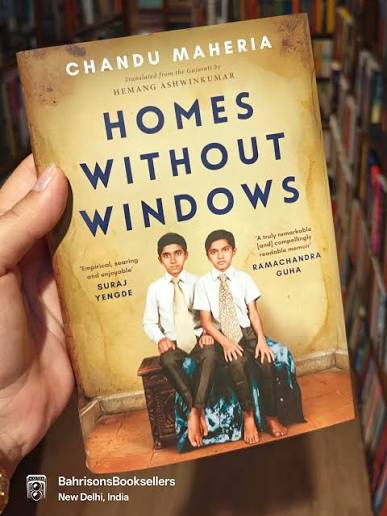
Translated by Hemang Ashwinkumar, Maheria’s book offers an intimate account of caste, poverty, and survival in urban Gujarat but is undermined by an embellished translation
Monsoon arrived in Gujarat just as I finished reading Homes without Windows, a collection of 11 autobiographical essays by Dalit activist Chandu Maheria, translated by Hemang Ashwinkumar. Originally written in the Gujarati and published in non-literary magazines, these essays are now available in English.
“Today, when I utter stuff like I don’t like monsoon or the prospect of getting wet in rain, my audience gasps, their eyebrows raised in mock surprise. How could someone, who has spent most of his life’s monsoons in just two pairs of mostly wet clothes, still like to get soaked is a question beyond them…,” writes Maheria in one of the essays. For him, the monsoon evokes memories of hellish public toilets, the scramble to cover the house with a sheet of cheap tarpaulin, rainwater flooding homes and streets, and his mother praying to Varun, the god of rain. In the chawls of Rajpur, where Maheria spent most of his life, there was little time to marvel at the beauty of a rainbow.
A life of deprivation
When you enter Ahmedabad, the commercial capital of Gujarat, from the eastern side, a dense web of chawls lines both sides of the main road, inhabited mostly by Muslims, Dalits, Christians, and poor communities. Maheria takes us into the heart of this labyrinth. He introduces us to its seasons and festivals, its sorrows and moments of happiness despite scarcity and untouchability, its schools, toilets, and hospitals, and the enduring presence of B.R. Ambedkar and M.K. Gandhi in the lives of its people.
Maheria’s childhood was marked by extreme food deprivation. His father, a textile mill worker, was the sole breadwinner of a family of nine. During Maheria’s early school years, the children received a glass of milk every day before classes, but little else. Maheria writes about those dark days with disarming honesty. There were times when a relative who delivered tiffin boxes would stop by their home at the end of his rounds and let the family eat the leftovers from the boxes. At the end of the chapter, Maheria expresses his gratitude for the reservation policy, which enabled him and his siblings to pursue education and secure jobs and escape those years of hardship.
In another chapter, he writes, “As if the question of filling the bottomless pits of hunger was not vexed enough, the daily dilemma of emptying our bowels had made our lives, both personal and social, embarrassing and miserable.” Their dingy dwelling, Abu Kasai’s chawl, did not have a single public toilet of its own, forcing its residents to use the filthy toilets in the neighbouring Hiralal’s chawl. Decades later, a large, modern, and well-maintained public toilet stands there, yet it remains beyond the reach of the daily-wage poor and the unemployed because it costs one rupee per visit. As a result, it is seldom used by the local residents, who have wryly come to call it ‘The Mayor’s Bungalow’.
Maheria, a noted scholar of Dalit life in Gujarat, has important points to make in the ever-contentious debate on Gandhi and Ambedkar. Unlike many of his Dalit friends, he admires Gandhi. He writes, “Gandhi might have been anything — call him whatever names — but one thing he was certainly not was anti-Dalit.” Maheria loved wearing Khadi despite his mother’s opposition; his father too was anti-Gandhi. Yet Maheria affectionately refers to Gandhi as “That Fellow, Gandhido.”
When Maheria was just two years away from retirement, he received a promotion along with a transfer to a town called Dhoraji in the Saurashtra region. There the author says he repeatedly encountered the question, “Tame keva? (What caste are you?)”, which he had never been asked in urban Gujarat. While much of his writing focuses on Dalit life in urban Gujarat, his two-year stay in this dusty town offers a glimpse into caste discrimination and the ways in which Dalits and Muslims are excluded from the broader development agenda. It also shows how these communities are pushed into segregated ghettos on the outskirts of so-called developing towns.
Losing the writer’s voice
Having read the original Gujarati essays alongside their English translations, I have a few observations about Ashwinkumar’s translation. A translator’s foremost responsibility is to preserve the original author’s voice and tonal quality. Maheria’s language is simple and he rarely uses ornamental expressions; his economy of words is almost Gandhian.
In many places, however, the English translation departs from this restraint by adding flourishes. In the chapter on Diwali, for instance, the translation reads: “Ramanbhai worked tirelessly…treating the wall as a wide canvas, painting it in broad strokes. Thanks to his speed and finesse, the whole drawing room, the biggest room in the house, would be taken care of by the afternoon.” In the original Gujarati, this is a single sentence. The added phrases do not align with Maheria’s sparse style. Moreover, the sentence is factually inaccurate: in the original, there is no drawing room; it refers instead to a small, single thatched room in a chawl. The use of the words “drawing room” creates a misleading impression. A translator should remain faithful to the original text and avoid such liberties.
Despite these concerns, Homes Without Windows remains an important and deeply affecting work. Maheria’s essays offer an intimate, lived account of caste, poverty, and survival in urban Gujarat. What stays with the reader is the dignity and wit with which he recounts them. Maheria’s voice continues to insist on being heard.
Mehul Devkala
The reviewer is a Gujarati poet, writer, and award-winning filmmaker.
Courtesy : The Hindu
Note: This news is originally published on https:/thehindu.com/bha and is used purely for non-profit/non-commercial purposes, especially human rights